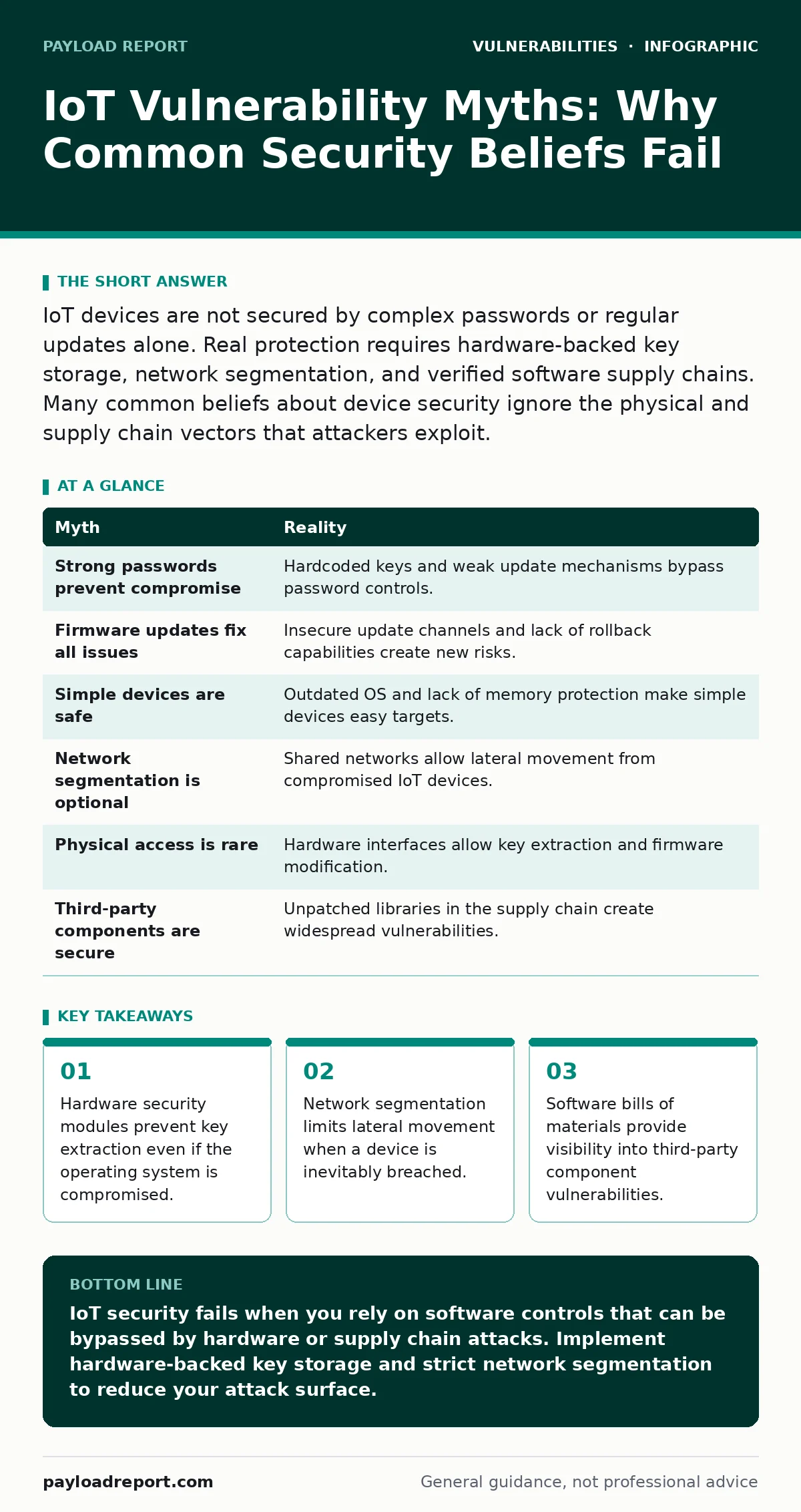
IoT devices are not secured by complex passwords or regular updates alone. Real protection requires hardware-backed key storage, network segmentation, and verified software supply chains. Many common beliefs about device security ignore the physical and supply chain vectors that attackers exploit.
Myth: Strong Passwords Prevent Compromise
Reality: Password complexity does not protect devices that store cryptographic keys in plaintext or use hardcoded credentials in their firmware. Attackers do not need to guess a password to extract sensitive data if the device’s internal storage is unencrypted. Many IoT manufacturers embed default credentials directly into the binary code to simplify production and reduce support costs. These credentials cannot be changed by the user and remain active even after the device is deployed.
A strong password only protects the login interface. It does nothing to stop an attacker who has physical access to the device or who can intercept unencrypted traffic. If the device uses a shared secret for all units of the same model, one compromise breaks security for every unit. This is a design flaw, not a user error. You must ensure the device uses unique keys per unit, stored in a secure element.
Myth: Firmware Updates Fix All Vulnerabilities
Reality: Patching is ineffective if the update mechanism itself lacks cryptographic verification or if the device cannot reach the update server. Many devices use insecure protocols to fetch updates, allowing attackers to inject malicious code during the download process. Even if the update is valid, applying it may brick the device if the power fails or the process is interrupted. This creates a trade-off between security and reliability that manufacturers often ignore.
Furthermore, many IoT devices lack the storage space to hold both the current and new firmware simultaneously. This forces an in-place overwrite, which is risky. If the update fails, the device becomes unusable. You need a dual-bank firmware design where the system can revert to a known good state if the new version fails to boot. Without this, updates become a liability rather than a shield.
Myth: IoT Devices Are Too Simple to Hack
Reality: Complexity is not a prerequisite for vulnerability. Simple devices often run outdated operating systems with known exploits that have been public for years. Attackers exploit these known weaknesses because they are easy to automate. The simplicity of the device often means it lacks basic security features like memory protection or address space layout randomisation. This makes buffer overflow attacks trivial to execute.
A device that does one thing well, like monitoring temperature, still has a network stack, a bootloader, and a management interface. Each of these components has a surface area for attack. The assumption that simplicity equals security ignores the reality of inherited code. Many cheap sensors use the same vulnerable libraries as more complex devices. You must treat every network-connected device as a potential entry point, regardless of its function.
Myth: Network Segmentation Is Optional for IoT
Reality: Treating IoT devices as part of the general network invites lateral movement. When a compromised device shares the same broadcast domain as critical servers, attackers can pivot from the device to more valuable targets. Segmentation isolates the device, limiting the damage it can cause if breached. This is not just a best practice; it is a fundamental control for risk reduction.
Without segmentation, a single vulnerable sensor can expose the entire corporate network. Attackers use compromised devices as jumping points to scan for other weaknesses. By placing IoT devices on a separate virtual local area network with strict firewall rules, you limit their ability to communicate with internal systems. They should only talk to the specific services they need. This contains the blast radius of any successful attack.
Myth: Physical Access Is Rarely a Threat
Reality: Physical access allows attackers to bypass software controls entirely. They can use hardware interfaces like USB, JTAG, or UART to dump memory and extract encryption keys. Many consumer devices have these debug ports exposed on the circuit board. Even if the software is secure, the hardware may not be. Attackers can modify the bootloader or replace the firmware with a malicious version.
This risk is often underestimated because it requires physical proximity. However, for devices in public spaces or homes, this proximity is easy to achieve. Thieves can clone devices or extract data by opening the casing. You must design devices with tamper-evident seals and disable debug interfaces in production builds. Physical security is not just about locking the door; it is about securing the hardware itself.
Myth: Third-Party Components Are Secure by Default
Reality: Most IoT devices rely on open-source libraries and third-party chips that may contain unpatched vulnerabilities. Manufacturers often assume that if the component is popular, it is secure. This is false. Popular components are targeted by attackers because compromising them affects many devices. A single vulnerability in a widely used library can break security for thousands of products.
You need visibility into every component in your device. A software bill of materials (SBOM) lists all third-party components and their versions. This allows you to track vulnerabilities as they are discovered. Without an SBOM, you are flying blind. When a new vulnerability is announced, you cannot determine if your device is affected. This lack of visibility delays patching and increases exposure.
| Myth | Reality |
|---|---|
| Strong passwords prevent compromise | Hardcoded keys and weak update mechanisms bypass password controls. |
| Firmware updates fix all issues | Insecure update channels and lack of rollback capabilities create new risks. |
| Simple devices are safe | Outdated OS and lack of memory protection make simple devices easy targets. |
| Network segmentation is optional | Shared networks allow lateral movement from compromised IoT devices. |
| Physical access is rare | Hardware interfaces allow key extraction and firmware modification. |
| Third-party components are secure | Unpatched libraries in the supply chain create widespread vulnerabilities. |
Key takeaways
- Hardware security modules prevent key extraction even if the operating system is compromised.
- Network segmentation limits lateral movement when a device is inevitably breached.
- Software bills of materials provide visibility into third-party component vulnerabilities.
- Default credentials are a secondary risk compared to hardcoded cryptographic keys.
IoT security fails when you rely on software controls that can be bypassed by hardware or supply chain attacks. Implement hardware-backed key storage and strict network segmentation to reduce your attack surface.
Frequently asked questions
How do I verify if an IoT device uses secure boot?
Check the manufacturer’s documentation for mentions of secure boot and cryptographic signature verification. Look for details on how the bootloader validates the operating system.
What is the risk of using IoT devices on guest Wi-Fi?
Guest networks typically isolate devices from your main network, reducing the risk of lateral movement. However, they do not protect the device itself from external attacks.
Can I secure an IoT device that has no update capability?
You must isolate it on a separate network segment and restrict its outbound traffic. Treat it as untrusted and monitor its behaviour for anomalies.
How often should I review my IoT security posture?
Review your network segmentation and device configurations whenever you add new devices or when new vulnerabilities are disclosed for your hardware models.
How this guide was produced: written by the Payload Report editorial team with AI assistance, checked against the public references listed below, and reviewed when the facts change. See our editorial policy or report an error.