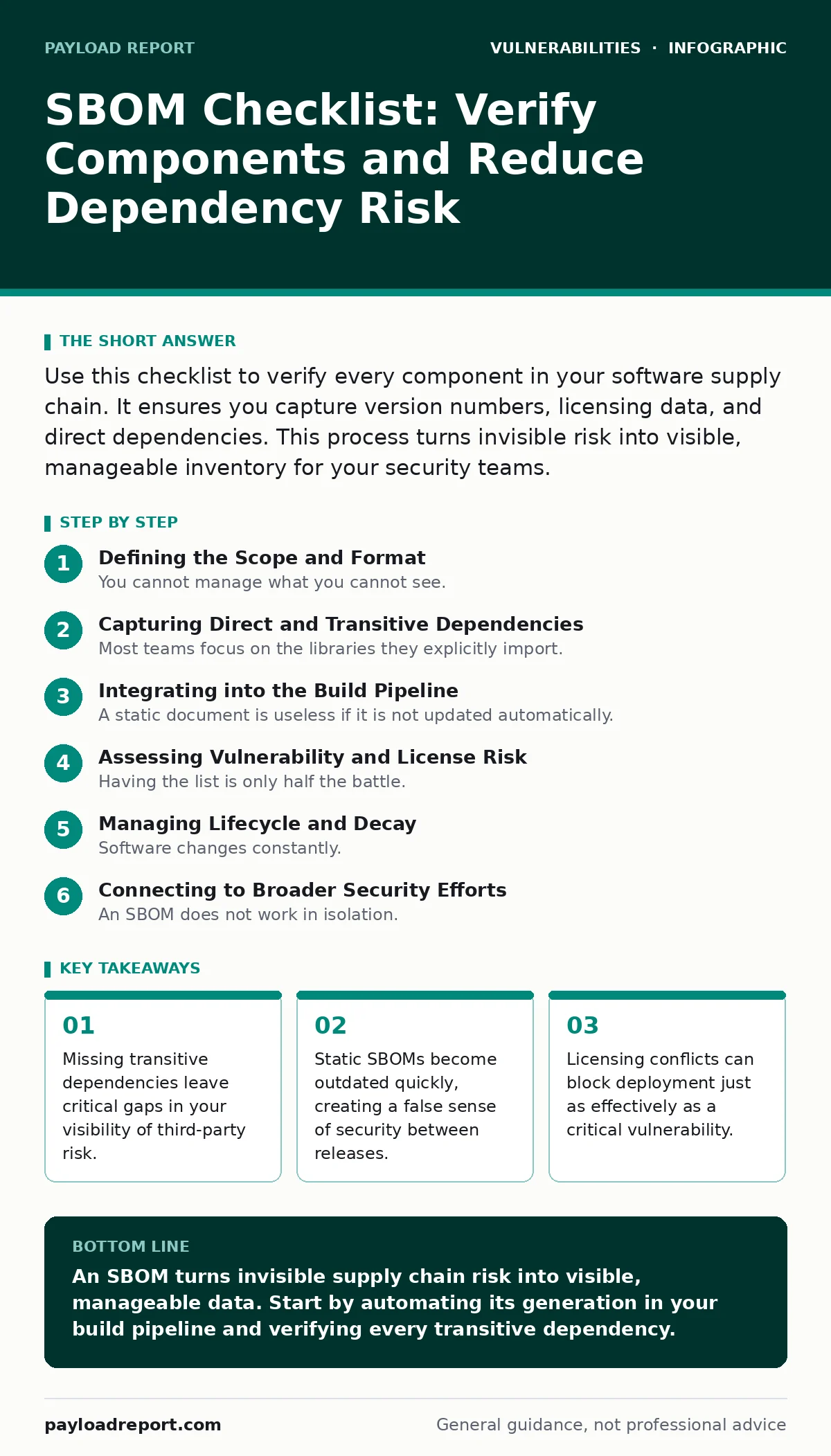
Use this checklist to verify every component in your software supply chain. It ensures you capture version numbers, licensing data, and direct dependencies. This process turns invisible risk into visible, manageable inventory for your security teams.
Defining the Scope and Format
You cannot manage what you cannot see. A software bill of materials is a structured list of components within a software product. It acts as an inventory of every library, module, and framework your code relies upon. Without this list, you are guessing which parts of your application might fail.
- Select a standard format: Choose CycloneDX or SPDX to ensure machine readability.
- Define the boundary: Clarify whether the SBOM covers only your code or the entire runtime environment.
- Establish ownership: Assign a single team responsible for maintaining the SBOM accuracy.
A standard format matters because custom XML or JSON structures break automated scanning tools. If your data is not in a recognised schema, it becomes useless during an incident. You must decide early whether the SBOM represents the build artefact or the deployed instance. These two states often differ significantly.
Capturing Direct and Transitive Dependencies
Most teams focus on the libraries they explicitly import. This is a mistake. Modern applications rely on deep trees of dependencies. A library you use might depend on another library, which depends on a third. These are transitive dependencies.
- Include all transitive dependencies: List every nested component, not just the top-level imports.
- Record exact version numbers: Use semantic versioning to pin specific releases, not ranges.
- Verify hashes: Include cryptographic hashes for each component to prevent substitution attacks.
Transitive dependencies matter because vulnerabilities often hide deep in the chain. You might trust a popular framework, but that framework might pull in a lesser-known utility with a known flaw. Exact version numbers matter because "latest" is a moving target. A patch released today might break your application tomorrow. Cryptographic hashes matter because they prove the component has not been tampered with since you downloaded it.
Integrating into the Build Pipeline
A static document is useless if it is not updated automatically. You must generate the SBOM as part of your continuous integration process. This ensures the inventory matches the code you are about to ship.
- Automate generation: Trigger SBOM creation on every successful build, not just releases.
- Validate completeness: Fail the build if the SBOM generator cannot resolve all dependencies.
- Store immutably: Archive the SBOM alongside the build artefact for future auditing.
Automating generation matters because manual updates are prone to human error. If you generate the SBOM only at release time, you miss weeks of potential exposure. Validating completeness matters because an incomplete SBOM gives you blind spots. Storing it immutably matters because you need proof of what was shipped when an incident occurs years later.
Assessing Vulnerability and License Risk
Having the list is only half the battle. You must cross-reference it against known vulnerability databases and license databases. This step transforms raw data into actionable risk intelligence.
- Scan for known vulnerabilities: Match component versions against public vulnerability databases.
- Check license compatibility: Ensure all components allow your intended use case and distribution model.
- Priorise by severity: Focus remediation efforts on components exposed to untrusted inputs.
Scanning for known vulnerabilities matters because not all components are equal. Some are exposed to the internet, while others run in isolated environments. Checking license compatibility matters because legal risk can halt operations as effectively as a security breach. Priorising by severity matters because you cannot fix everything at once. You must focus on the code that an attacker can actually reach.
Managing Lifecycle and Decay
Software changes constantly. Your SBOM decays the moment you ship it. Dependencies are updated, components are deprecated, and new vulnerabilities are discovered. You need a strategy for ongoing maintenance.
- Set update frequency: Define how often you re-scan and update the SBOM for running systems.
- Track end-of-life dates: Flag components that no longer receive security patches.
- Plan for remediation: Have a process for updating components without breaking functionality.
Setting update frequency matters because a six-month-old SBOM is largely irrelevant for active threats. Tracking end-of-life dates matters because abandoned code is a permanent risk. Planning for remediation matters because finding a fix is easier than implementing it without causing outages.
Connecting to Broader Security Efforts
An SBOM does not work in isolation. It connects to your broader security posture. It informs your understanding of the attack surface and helps you prioritise testing efforts.
- Map to authentication bypass vulnerabilities: Identify which components handle identity and access control.
- Support secure code review: Provide reviewers with context on third-party code they cannot change.
- Enhance penetration testing: Give testers a map of the underlying technology stack.
Mapping to authentication bypass vulnerabilities matters because identity management is often handled by third-party libraries. If those libraries fail, your entire access control model collapses. Supporting secure code review matters because reviewers need to know where your code ends and third-party code begins. Enhancing penetration testing matters because testers can target specific versions of components known to be weak.
Handling Edge Cases and Ambiguity
Not every component is easy to classify. Some are custom-built, some are dynamically loaded, and some are embedded in binary form. You must have a policy for these edge cases.
- Define custom component rules: Decide how to name and version internal libraries.
- Address dynamic loading: Account for plugins or modules loaded at runtime.
- Handle binary blobs: Document components where source code is unavailable.
Defining custom component rules matters because internal libraries can have the same flaws as external ones. Addressing dynamic loading matters because attackers often exploit plugins that are not part of the main build. Handling binary blobs matters because you cannot audit what you cannot see. You must at least record their presence and origin.
Key takeaways
- Missing transitive dependencies leave critical gaps in your visibility of third-party risk.
- Static SBOMs become outdated quickly, creating a false sense of security between releases.
- Licensing conflicts can block deployment just as effectively as a critical vulnerability.
An SBOM turns invisible supply chain risk into visible, manageable data. Start by automating its generation in your build pipeline and verifying every transitive dependency.
Frequently asked questions
How often should I update my SBOM?
Update it every time you build or deploy new code. For running systems, re-scan at least monthly to catch newly discovered vulnerabilities.
Can I use an SBOM for compliance?
Yes. Many regulations now require visibility into software components. An SBOM provides the evidence needed to prove due diligence.
How this guide was produced: written by the Payload Report editorial team with AI assistance, checked against the public references listed below, and reviewed when the facts change. See our editorial policy or report an error.