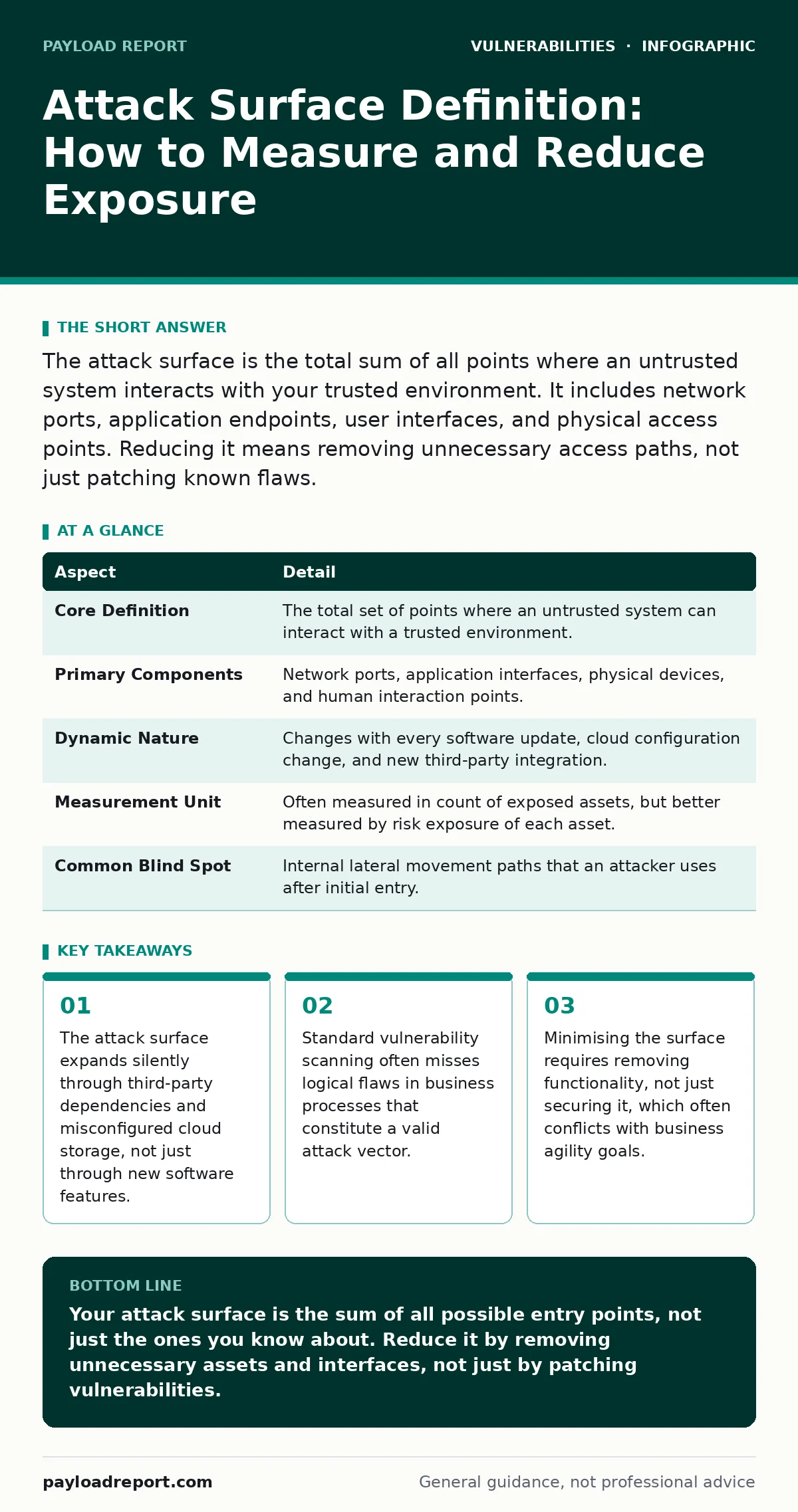
The attack surface is the total sum of all points where an untrusted system interacts with your trusted environment. It includes network ports, application endpoints, user interfaces, and physical access points. Reducing it means removing unnecessary access paths, not just patching known flaws.
The Perimeter Is No Longer a Wall
Imagine your organisation is a house. The walls, doors, and windows are the traditional perimeter. But you also have a smart thermostat connected to the internet, a delivery person with a key to the back door, and a family member who leaves the garage door open. The attack surface is every single one of those entry points combined. It is not just the front door. It is the sum of all ways an outsider can interact with your systems.
In modern infrastructure, this concept has moved far beyond physical walls. It now includes cloud configurations, API endpoints, and third-party integrations. You cannot defend what you cannot see. If you only look at the front door, you will miss the open garage. The goal is not to make every lock unbreakable. The goal is to remove the doors that do not need to exist.
At a Glance: Defining the Scope
| Aspect | Detail |
|---|---|
| Core Definition | The total set of points where an untrusted system can interact with a trusted environment. |
| Primary Components | Network ports, application interfaces, physical devices, and human interaction points. |
| Dynamic Nature | Changes with every software update, cloud configuration change, and new third-party integration. |
| Measurement Unit | Often measured in count of exposed assets, but better measured by risk exposure of each asset. |
| Common Blind Spot | Internal lateral movement paths that an attacker uses after initial entry. |
Where the Term Comes From
The term originates from military strategy and physical security. In those fields, defenders focus on protecting the largest possible area with limited resources. They identify every point where an enemy could cross a boundary. In cybersecurity, this translated to network ports and server interfaces. Early defenders focused on firewalls and port scanning.
Today, the definition has expanded because the boundary has dissolved. Cloud computing removes the physical perimeter. Software as a Service (SaaS) introduces external dependencies. A single misconfigured storage bucket can expose terabytes of data. The attack surface now includes the supply chain. If your vendor has a weak login page, that page is part of your attack surface. You must map these connections explicitly. Relying on vendor security assurances is insufficient. You need visibility into their public-facing assets.
How Teams Use It Day to Day
Operations teams use the attack surface as a prioritisation tool. You cannot patch everything at once. Resources are finite. By mapping the surface, you identify which assets are exposed to the internet and which are not. Internet-facing assets get immediate attention. Internal assets get scheduled reviews. This creates a risk-based workflow.
Teams also use it to measure progress. If you reduce the number of open ports, you have reduced the surface. If you decommission a legacy application, you have reduced the surface. This metric is more useful than counting vulnerabilities. A system with ten vulnerabilities but no external access is safer than a system with zero vulnerabilities but an open management port. The surface tells you who can reach the vulnerabilities. It contextualises the risk.
What People Usually Get Wrong
Many teams confuse vulnerability management with attack surface management. Vulnerability management finds flaws in existing assets. Attack surface management determines which assets should exist and be exposed. You can have a perfectly patched server that should not be on the internet. Keeping it online maintains a risk. Taking it offline removes the risk.
Another common error is ignoring the human element. Phishing targets are part of the attack surface. If your employees can receive emails from anyone, your users are an entry point. Training is a mitigation, but it does not remove the surface. Restricting email domains or implementing strict authentication controls reduces the surface. You must treat people as systems with interfaces.
Finally, teams often focus only on technology. They miss business logic flaws. A feature that allows users to export their data may be implemented correctly. But if the logic allows a user to export another user’s data by changing a parameter, that is a surface flaw. Standard tools miss this. It requires manual analysis.
The Hidden Costs of Expansion
Every new feature adds to the attack surface. A new API endpoint, a new login method, a new integration. Each addition increases the complexity of defence. Developers often view security as a blocker. They want to ship features. Security teams view every new feature as a new door to lock. This tension slows delivery.
The hidden cost is technical debt. When you add a feature, you add code. That code must be maintained. It must be monitored. If you do not have the resources to monitor it, it becomes a liability. You should ask whether the feature is necessary. If it is not, do not build it. If it is, build it with the smallest possible surface. Use standard protocols. Avoid custom authentication mechanisms. Custom code is harder to secure than standard implementations.
Practical Steps for Reduction
Start by inventorying your external-facing assets. Use automated tools to discover public IPs, domains, and subdomains. Compare this list against your approved asset register. Any asset not on the register is a candidate for removal. This process is often called shadow IT discovery. It reveals assets that teams created without formal approval.
Next, review your cloud configurations. Check for public storage buckets, open database ports, and overly permissive firewall rules. Use Infrastructure as Code to enforce standards. This prevents manual misconfigurations. Finally, review your third-party dependencies. Map which vendors have access to your data. Limit that access to the minimum required. Revoke access when the business relationship ends.
Integrating with Broader Security Practices
You cannot manage the attack surface in isolation. It connects to other security disciplines. For instance, vulnerability scanning is less effective if you do not know what to scan. Knowing your surface tells the scanner where to look. Similarly, penetration testing becomes more targeted when testers know the likely entry points. They can focus on the most exposed assets.
Secure code review helps reduce the surface at the source. Developers can identify unnecessary endpoints before they are deployed. Authentication bypass vulnerabilities are often found in hidden interfaces. If you have removed those interfaces, you have eliminated the risk. This is more effective than trying to secure them. Consider software bill of materials (SBOM) to understand the components in your applications. Each component adds to the surface. Knowing them allows you to monitor for specific risks.
The Role of Legacy and IoT
Legacy systems often remain online because they are difficult to replace. They become high-value targets. They are part of your attack surface, even if they are not connected to the internet directly. Internal networks are not safe havens. Attackers move laterally. IoT device vulnerabilities are a growing concern. Many IoT devices cannot be patched. They must be segmented. If they cannot be removed, isolate them from critical systems.
Security regression testing ensures that new changes do not reopen old holes. When you patch a system, you must verify that the patch does not introduce new exposure. This is part of maintaining the surface. You are not just fixing bugs. You are ensuring the surface does not expand inadvertently. Bug bounty programs can help find hidden surface areas. External researchers may find interfaces you missed. Treat their findings as opportunities to reduce the surface, not just to patch code.
Key takeaways
- The attack surface expands silently through third-party dependencies and misconfigured cloud storage, not just through new software features.
- Standard vulnerability scanning often misses logical flaws in business processes that constitute a valid attack vector.
- Minimising the surface requires removing functionality, not just securing it, which often conflicts with business agility goals.
Your attack surface is the sum of all possible entry points, not just the ones you know about. Reduce it by removing unnecessary assets and interfaces, not just by patching vulnerabilities.
Frequently asked questions
Is the attack surface the same as the attack vector?
No. The attack surface is the total area of exposure. An attack vector is the specific path an attacker uses to exploit a vulnerability within that surface.
How do I measure my attack surface size?
Count the number of externally accessible assets, open ports, and API endpoints. Prioritise by the sensitivity of the data they access.
Can I eliminate my attack surface completely?
No. As long as you interact with the outside world, you have a surface. The goal is minimisation, not elimination.
Does cloud computing increase or decrease the attack surface?
It increases it by adding new configuration options and third-party dependencies. It decreases it by removing physical hardware. The net effect is usually an increase in complexity.
How this guide was produced: written by the Payload Report editorial team with AI assistance, checked against the public references listed below, and reviewed when the facts change. See our editorial policy or report an error.