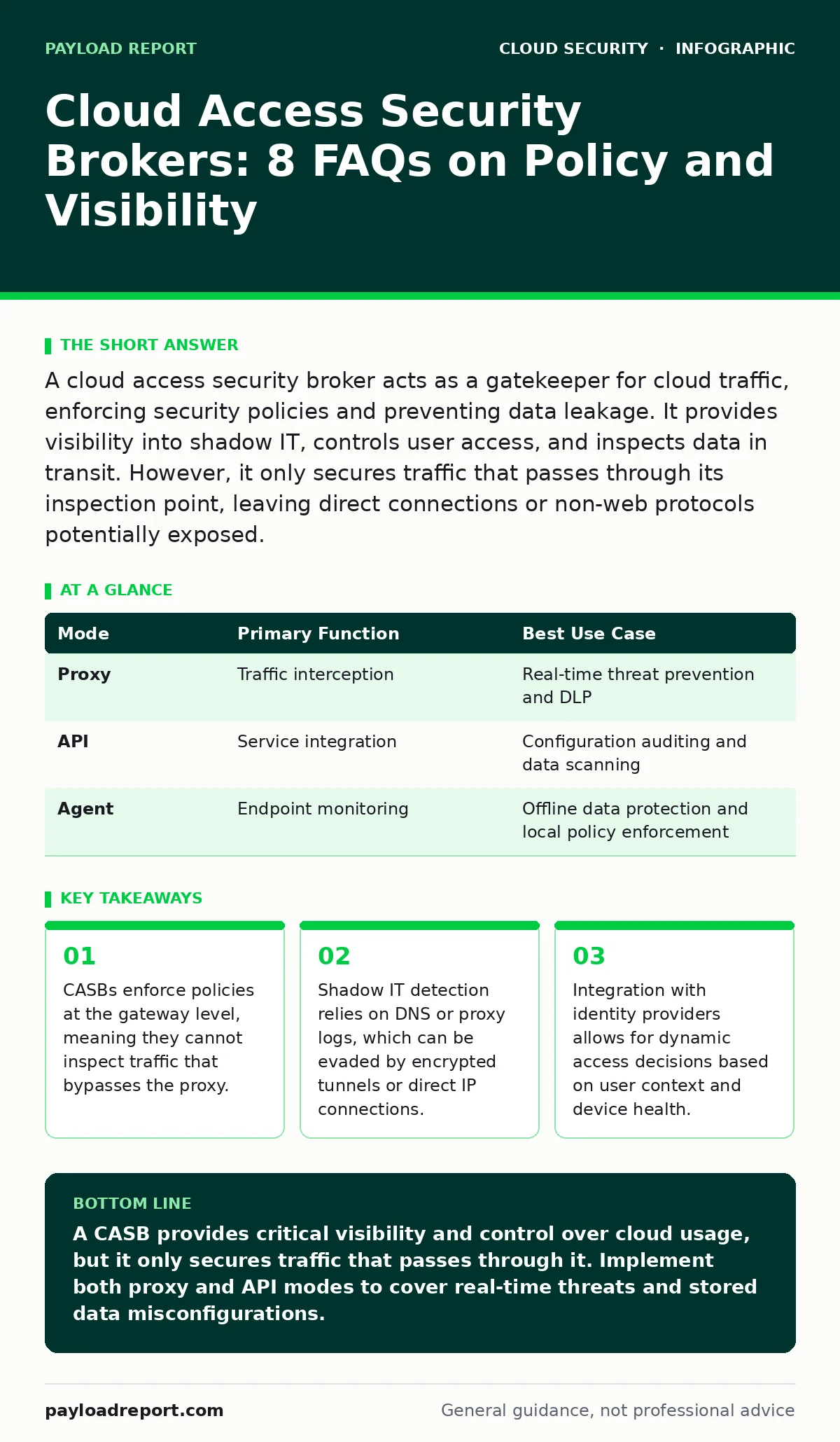
A cloud access security broker acts as a gatekeeper for cloud traffic, enforcing security policies and preventing data leakage. It provides visibility into shadow IT, controls user access, and inspects data in transit. However, it only secures traffic that passes through its inspection point, leaving direct connections or non-web protocols potentially exposed.
What exactly does a CASB do?
A cloud access security broker sits between your users and cloud services to enforce security policies. It inspects traffic to ensure data is not leaving your organisation in an unauthorised way. The broker can block risky applications, encrypt sensitive files, and prevent users from sharing data with untrusted parties. It acts as a central control point for cloud usage, giving you visibility into which services are being accessed and how. Without this layer, you rely on the cloud provider’s own security controls, which are often broad and not tailored to your specific compliance needs.
How does it detect shadow IT?
Shadow IT refers to cloud applications used by employees without the knowledge or approval of the IT department. A CASB detects this by analysing DNS queries, proxy logs, and SSL inspection data. It looks for patterns that match known cloud services, even if the user accesses them through an unusual domain. The system maintains a database of legitimate cloud providers and flags any connection to an unknown or suspicious host. This visibility allows you to assess the risk of unapproved tools and decide whether to block them or bring them under management.
Can it stop data leaks?
Yes, but only for data that passes through the broker’s inspection engine. The CASB uses data loss prevention rules to identify sensitive information such as credit card numbers or personal identifiers. When it detects this data in transit, it can block the upload, redact the information, or encrypt it before it reaches the cloud. This prevents accidental sharing of confidential files with external parties. However, if a user copies data to a local USB drive or takes a screenshot, the CASB cannot intercept that action. Its protection is limited to the network path it controls.
What is the difference between proxy and API modes?
Proxy mode intercepts and inspects traffic as it flows through the CASB, much like a traditional firewall. This allows for real-time blocking of malicious activity and detailed inspection of file contents. API mode, on the other hand, connects directly to the cloud service’s application programming interface to audit configurations and scan stored data. Proxy mode is better for preventing active threats, while API mode is superior for discovering misconfigurations and historical data exposure. Most mature deployments use both modes to cover real-time traffic and static data at rest.
How does it handle user identity?
A CASB integrates with your identity provider to understand who is accessing the cloud. It checks the user’s identity against policies that consider factors such as location, device type, and time of day. If a user logs in from an unusual country or an unmanaged device, the CASB can require additional verification or block access entirely. This dynamic approach ensures that access rights are granted based on the current risk context, not just a static password. It reduces the likelihood of compromised credentials leading to a successful breach.
See also: Denial of Wallet Attacks: Debunking Common Myths About Cloud Cost Abuse · Secure Access Service Edge for Small Teams: A Practical Setup
What are the performance implications?
Inspecting every byte of cloud traffic introduces latency, which can slow down user experience. The CASB must decrypt SSL traffic, inspect it for threats, and then re-encrypt it before sending it to the cloud. This processing time adds delay, particularly for large file transfers or streaming applications. To mitigate this, you can configure the CASB to bypass inspection for low-risk traffic or internal communications. Balancing security with performance requires careful tuning of inspection rules to avoid hindering productivity.
| Mode | Primary Function | Best Use Case |
|---|---|---|
| Proxy | Traffic interception | Real-time threat prevention and DLP |
| API | Service integration | Configuration auditing and data scanning |
| Agent | Endpoint monitoring | Offline data protection and local policy enforcement |
Does it protect against insider threats?
A CASB can detect anomalous behaviour that suggests an insider threat, such as a user downloading large volumes of data at unusual hours. It correlates user activity with baseline behaviour to flag deviations that warrant investigation. However, it cannot stop a determined insider who has legitimate access and uses approved channels to exfiltrate data. The broker can alert security teams to suspicious patterns, but it cannot fully prevent malicious intent from within the organisation. Combining CASB alerts with user behaviour analytics provides a more complete picture of insider risk.
How does it fit with SASE?
Secure access service edge combines cloud security with wide area networking to provide a unified security architecture. A CASB is a core component of SASE, handling cloud-specific security policies while the networking layer manages connectivity. In a SASE model, the CASB sits closer to the user, reducing latency and improving performance. This integration simplifies management by consolidating multiple security tools into a single platform. If you are adopting a SASE strategy, ensure your CASB integrates seamlessly with the network functions to avoid gaps in protection.
Key takeaways
- CASBs enforce policies at the gateway level, meaning they cannot inspect traffic that bypasses the proxy.
- Shadow IT detection relies on DNS or proxy logs, which can be evaded by encrypted tunnels or direct IP connections.
- Integration with identity providers allows for dynamic access decisions based on user context and device health.
A CASB provides critical visibility and control over cloud usage, but it only secures traffic that passes through it. Implement both proxy and API modes to cover real-time threats and stored data misconfigurations.
Frequently asked questions
Does a CASB replace a firewall?
No, a CASB focuses on cloud application security and data protection, while a firewall protects network perimeters and general traffic. They serve different purposes and should be used together.
Can a CASB protect against zero-day attacks?
A CASB can block known malicious files and suspicious behaviour, but it may not detect entirely new, unknown threats. It relies on signatures and behavioural analysis, which have limitations against novel attacks.
How does a CASB handle encrypted traffic?
It decrypts SSL/TLS traffic at the proxy level to inspect the contents for threats and sensitive data. This requires installing a trusted certificate on user devices to avoid security warnings.
How this guide was produced: written by the Payload Report editorial team with AI assistance, checked against the public references listed below, and reviewed when the facts change. See our editorial policy or report an error.