Most cloud compliance failures stem from treating infrastructure as static. You must shift from manual audits to continuous monitoring, enforce least privilege via identity, and automate configuration checks to catch drift before it becomes a breach.
Cloud environments change faster than traditional audit cycles can track. A configuration that passes a compliance check at 09:00 may be vulnerable by 09:05 due to an automated deployment. This speed creates a gap between what your security posture looks like on paper and what it actually is. You must align your security operations with the pace of your infrastructure.
Mistake 1: Treating Compliance as a One-Time Audit
Many teams treat compliance as a quarterly event. They configure resources to pass a scan, take a snapshot, and then move on. This approach assumes that infrastructure remains static. In reality, cloud resources are ephemeral. Containers start and stop, servers scale up and down, and permissions change via code. A snapshot tells you nothing about the state of your environment between audits.
Why it hurts:
Attackers do not wait for your audit window. If a developer deploys a misconfigured storage bucket during a sprint, it remains exposed until the next manual review. This window of exposure can last weeks or months. Auditors will see the clean snapshot, but the risk remains active in production.
The fix:
Implement continuous compliance monitoring. Use tools that query your cloud provider’s API regularly to check resource states against your policy baseline. Alert when drift occurs. This shifts your posture from point-in-time validation to ongoing assurance. Refer to our guide on cloud access security brokers (CASB) for patterns on enforcing these checks at the data layer.
Mistake 2: Ignoring the Shared Responsibility Model
Cloud providers secure the infrastructure. You secure what you put on it. A common error is assuming that because the provider is compliant, your data is safe. This misunderstanding leads teams to neglect encryption at rest, access logging, and application-level security. The provider’s responsibility ends at the hypervisor or the managed service boundary.
Why it hurts:
If you store sensitive data in a database managed by the provider but fail to encrypt it or restrict access, a breach is your fault. Auditors will cite you for failing to protect data, regardless of the provider’s certifications. You cannot outsource liability for your configuration choices.
The fix:
Map every service to the responsibility matrix. Identify which controls fall to you. For managed databases, this usually means encryption keys, access policies, and network rules. Automate the application of these controls during provisioning. See our section on identity and access management for details on managing these permissions effectively.
Mistake 3: Using Broad Administrative Privileges
It is convenient to give developers full admin access to cloud consoles. This practice violates the principle of least privilege. Compliance frameworks require that access be limited to what is necessary for a role. Broad permissions allow accidental deletion, data exfiltration, and lateral movement by attackers who compromise a single account.
Why it hurts:
A single compromised credential with admin rights gives an attacker full control. They can disable logging, create backdoor accounts, and exfiltrate data before detection. Compliance audits will fail immediately upon finding overprivileged accounts. The blast radius of a breach becomes your entire tenant.
The fix:
Implement role-based access control (RBAC). Define roles based on job functions, not individuals. Use just-in-time access for administrative tasks, where permissions are granted temporarily and revoked automatically. This reduces the window of opportunity for attackers. For complex environments, consider secure access service edge (SASE) architectures to centralise access policies.
Mistake 4: Neglecting Infrastructure as Code (IaC) Security
Many teams write infrastructure code without scanning it for security issues. They rely on manual checks after deployment. This is too late. Misconfigurations in IaC templates propagate across environments. If a template allows public access to a database, every deployment inherits that flaw.
Why it hurts:
Fixing misconfigurations after deployment is costly and risky. You must tear down and rebuild resources, causing downtime. Compliance frameworks increasingly require security checks in the development pipeline. Ignoring this step means you are deploying known vulnerabilities repeatedly.
The fix:
Scan IaC templates as part of your CI/CD pipeline. Use static analysis tools to detect misconfigurations before they reach production. Block deployments that fail security checks. This shifts security left, catching issues when they are cheap to fix. Review our guide on Kubernetes misconfigurations for specific patterns in container orchestration code.
Mistake 5: Failing to Encrypt Data in Transit and at Rest
Some teams encrypt data at rest but neglect transit. Others use default encryption keys managed by the provider. While provider-managed keys are convenient, they may not meet strict compliance requirements for key ownership and rotation. Data in transit between services is often unencrypted if internal network security is assumed.
Why it hurts:
Unencrypted data in transit can be intercepted via man-in-the-middle attacks. If you lose control of encryption keys, you cannot prove data confidentiality to auditors. Regulatory frameworks often require customer-managed keys for sensitive data. Default settings rarely meet these standards.
The fix:
Enforce encryption everywhere. Use customer-managed keys for sensitive data. Ensure all internal communication uses TLS. Automate key rotation policies. This ensures that even if infrastructure is compromised, data remains unreadable.
See also: Denial of Wallet Attacks: Debunking Common Myths About Cloud Cost Abuse · Secure Access Service Edge for Small Teams: A Practical Setup
Mistake 6: Overlooking Third-Party SaaS Risks
Organisations often focus on their own infrastructure while ignoring third-party applications. Employees connect SaaS tools to corporate data without security review. These connections can expose sensitive information if the SaaS provider is misconfigured or breached. Compliance frameworks require visibility into all data processing.
Why it hurts:
A misconfigured SaaS app can leak data to the public internet. You have no control over the provider’s security posture. Auditors will question your ability to protect data flowing through third parties. This is a blind spot in many security programs.
The fix:
Implement SaaS security posture management to monitor third-party connections. Enforce single sign-on and multi-factor authentication for all SaaS apps. Restrict data sharing to approved applications. This extends your security boundary beyond your own infrastructure.
Mistake 7: Assuming Serverless Is Secure by Default
Serverless computing removes infrastructure management, but not application security. Teams often assume the provider handles all security. This leads to unprotected functions, exposed APIs, and insecure dependencies. Serverless functions can be invoked by anyone if endpoint security is misconfigured.
Why it hurts:
Exposed serverless functions can be abused for computation or data access. Attackers can invoke functions to exfiltrate data or perform denial-of-wallet attacks by triggering expensive operations. Compliance frameworks require application-level controls, which serverless does not provide automatically.
The fix:
Treat serverless functions like any other application. Secure endpoints, validate inputs, and manage dependencies. Use API gateways to enforce authentication and rate limiting. Monitor function invocations for anomalies. Read our guide on serverless security risks for deeper insights.
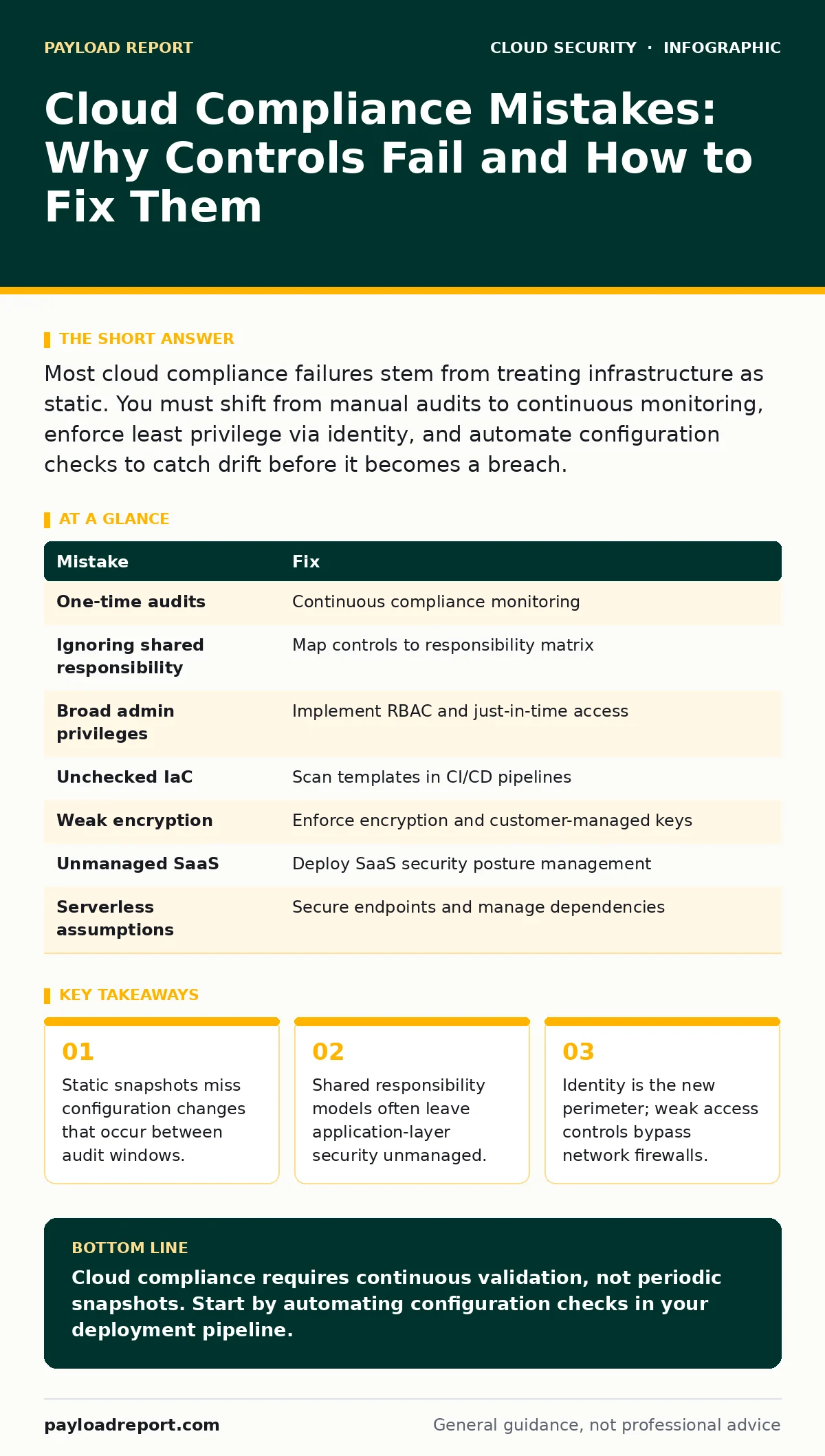
| Mistake | Fix |
|---|---|
| One-time audits | Continuous compliance monitoring |
| Ignoring shared responsibility | Map controls to responsibility matrix |
| Broad admin privileges | Implement RBAC and just-in-time access |
| Unchecked IaC | Scan templates in CI/CD pipelines |
| Weak encryption | Enforce encryption and customer-managed keys |
| Unmanaged SaaS | Deploy SaaS security posture management |
| Serverless assumptions | Secure endpoints and manage dependencies |
Key takeaways
- Static snapshots miss configuration changes that occur between audit windows.
- Shared responsibility models often leave application-layer security unmanaged.
- Identity is the new perimeter; weak access controls bypass network firewalls.
Cloud compliance requires continuous validation, not periodic snapshots. Start by automating configuration checks in your deployment pipeline.
Frequently asked questions
How often should I run compliance scans?
Run scans continuously or at least every few minutes. Cloud infrastructure changes rapidly, and manual weekly checks are insufficient.
Does compliance guarantee security?
No. Compliance meets regulatory requirements but does not prevent all attacks. Security is a broader discipline that includes threat detection and response.
Can I use default encryption for compliance?
It depends on the framework. Some accept provider-managed keys, but others require customer-managed keys for strict data control.
How do I handle third-party SaaS apps?
Use SaaS security posture management tools to monitor access and data flow. Enforce strict authentication and data loss prevention policies.
How this guide was produced: written by the Payload Report editorial team with AI assistance, checked against the public references listed below, and reviewed when the facts change. See our editorial policy or report an error.