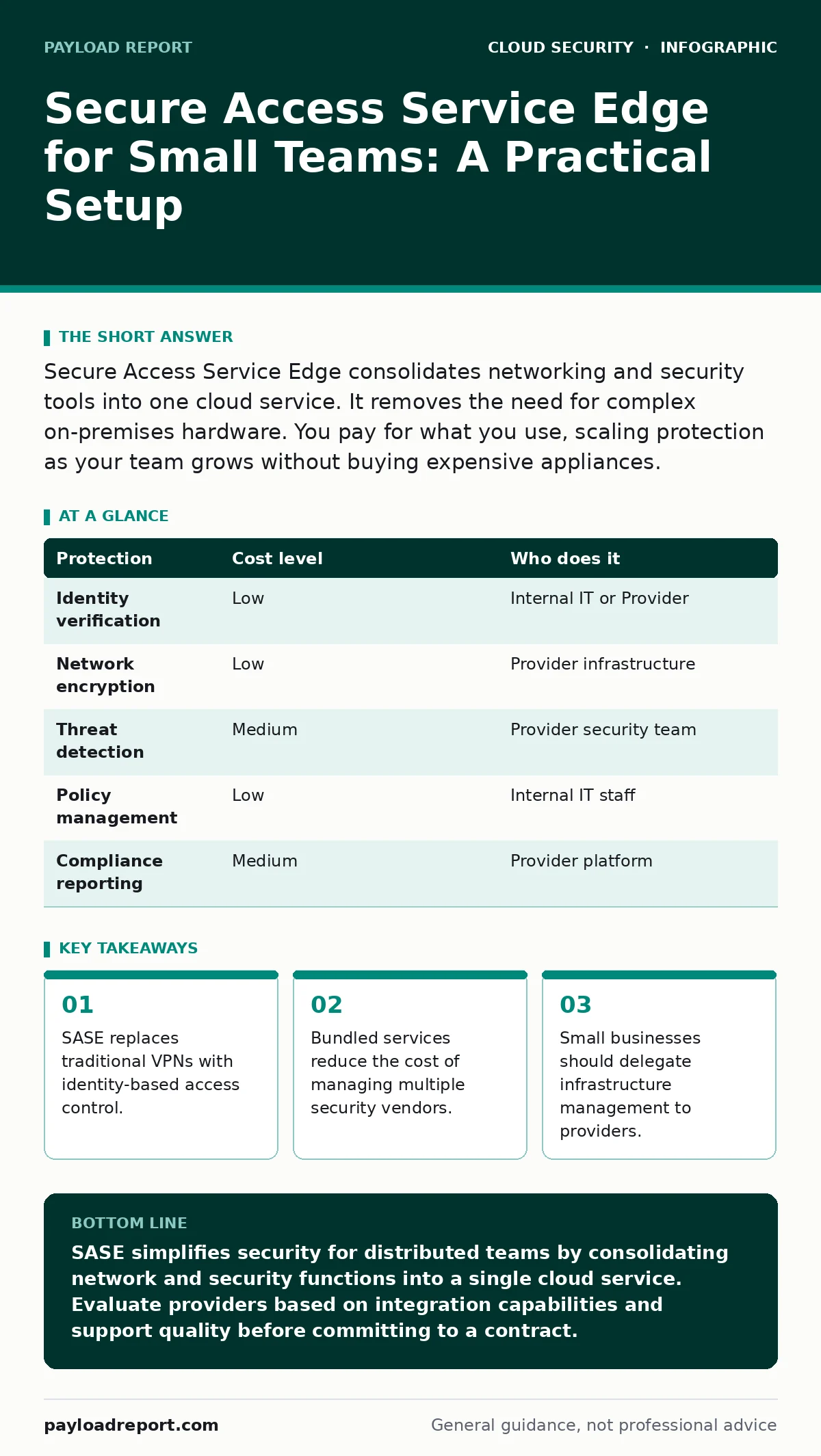
Secure Access Service Edge consolidates networking and security tools into one cloud service. It removes the need for complex on-premises hardware. You pay for what you use, scaling protection as your team grows without buying expensive appliances.
Moving Beyond the Perimeter
Traditional security models assume users connect through a single, fortified gateway. This assumption breaks down when work happens everywhere. A firewall at the office protects the building, not the laptop. When a designer opens a file at a train station, that traffic bypasses the office defence entirely.
Secure Access Service Edge, or SASE, shifts the protection model. It moves security controls to the cloud edge, close to where users connect. This architecture ensures that access policies follow the user, not the device location. You no longer need to route all traffic back to a central data centre.
This approach reduces latency for global teams. It also simplifies the network topology. Instead of managing multiple point solutions, you manage one integrated service. The trade-off is a dependency on the provider’s network performance and reliability.
Why Scale Changes the Equation
Large enterprises build SASE architectures to handle thousands of users and complex compliance needs. Small teams adopt it for simplicity and cost efficiency. Buying separate appliances for firewalling, web filtering and data loss prevention is expensive. Each device requires configuration, monitoring and patching.
For a small team, the administrative burden is the real cost. One person cannot effectively manage five different security consoles. SASE bundles these functions into a single management plane. This consolidation reduces the time spent on configuration and troubleshooting.
It also improves security consistency. Policies apply uniformly across all access points. A rule blocking malicious domains works whether the user is in London or Lisbon. This uniformity prevents gaps that often appear in fragmented security setups.
Affordable Implementation Strategies
You do not need to build a SASE architecture from scratch. Most small businesses subscribe to a managed service. Look for providers that offer a unified platform rather than a bundle of disconnected tools. Integrated platforms share threat intelligence and policy settings.
Start with a pilot group. Do not roll out the service to all users immediately. Select a small team to test connectivity and policy enforcement. Monitor for performance issues and access denials. Adjust policies based on real-world usage patterns.
Consider the licensing model carefully. Some providers charge per user, while others charge by bandwidth. Calculate your expected usage before signing a contract. Avoid over-provisioning capacity that you will not use. Under-provisioning leads to expensive upgrades later.
| Protection | Cost level | Who does it |
|---|---|---|
| Identity verification | Low | Internal IT or Provider |
| Network encryption | Low | Provider infrastructure |
| Threat detection | Medium | Provider security team |
| Policy management | Low | Internal IT staff |
| Compliance reporting | Medium | Provider platform |
Delegating Infrastructure Management
Small teams lack the depth of security expertise found in large organisations. You should delegate the heavy lifting to your provider. This includes maintaining the underlying network infrastructure and updating threat signatures.
Do not delegate policy definition. You must define who can access what resources. The provider enforces the rules, but you write them. Clear policies prevent accidental exposure of sensitive data. Regular reviews ensure policies match current business needs.
Identity and access management remains your responsibility. You must maintain accurate user directories and enforce multi-factor authentication. SASE relies on strong identity signals to make access decisions. Weak identity management undermines the entire security model.
Integrating with Existing Tools
SASE does not replace all existing security tools. You still need endpoint detection and response on laptops and servers. These tools protect the device itself, while SASE protects the connection. They work together to provide layered defence.
Ensure your SASE provider integrates with your identity provider. Single sign-on simplifies the user experience and improves security. It allows for automated account disabling when an employee leaves. This reduces the risk of orphaned accounts accessing corporate data.
Cloud compliance frameworks often require specific logging and monitoring capabilities. Verify that your provider supports these requirements. You may need to forward logs to a separate security information and event management system. This adds complexity but ensures audit readiness.
See also: Identity and Access Management Best Practices for Secure Cloud Infrastructure · Denial of Wallet Attacks: Debunking Common Myths About Cloud Cost Abuse
Common Configuration Pitfalls
Overly broad access rules are a common mistake. Granting access to entire subnets instead of specific applications increases risk. Use application-aware policies to limit exposure. This principle of least privilege reduces the attack surface.
Ignoring user experience leads to shadow IT. If the security controls are too slow or restrictive, users will find ways around them. Balance security with usability. Test policies with real users before enforcing them broadly.
Failing to monitor policy effectiveness is another risk. Regularly review access logs and alert thresholds. Look for patterns that indicate misconfiguration or abuse. Adjust policies based on these insights to maintain effective protection.
Evaluating Provider Capabilities
Not all SASE providers are equal. Some offer basic connectivity with limited security features. Others provide advanced threat protection and data loss prevention. Understand what is included in the base price.
Ask about the provider’s global network footprint. More points of presence mean lower latency for remote users. Check if they have partnerships with major cloud providers. Direct connections to cloud services improve performance and security.
Review the provider’s incident response capabilities. How quickly do they detect and block threats? Do they provide visibility into blocked traffic? You need transparency to trust the service.
- Does the provider offer a unified management console?
- What is the process for updating security policies?
- How does the provider handle data privacy and residency?
- What support SLAs are included in the contract?
- Can you integrate with existing identity providers?
Balancing Cost and Control
SASE offers a compelling value proposition for small businesses. It provides enterprise-grade security without the enterprise price tag. However, you must manage the relationship carefully.
Regularly review your usage and costs. Ensure you are paying for value, not just capacity. Engage with the provider’s support team to resolve issues quickly. Build a strong partnership to maximise the benefits of the service.
Remember that security is a process, not a product. SASE is a tool that enables better security practices. It does not replace the need for strong policies and user awareness. Combine technology with process for effective protection.
Key takeaways
- SASE replaces traditional VPNs with identity-based access control.
- Bundled services reduce the cost of managing multiple security vendors.
- Small businesses should delegate infrastructure management to providers.
SASE simplifies security for distributed teams by consolidating network and security functions into a single cloud service. Evaluate providers based on integration capabilities and support quality before committing to a contract.
Frequently asked questions
Does SASE replace the need for a firewall?
SASE includes firewall capabilities, but you may still need local firewalls for on-premises infrastructure. It replaces the traditional perimeter firewall for cloud and remote access.
How does SASE handle multi-factor authentication?
SASE integrates with identity providers to enforce multi-factor authentication. It checks the user’s identity before granting access to resources.
Is SASE suitable for remote workers?
Yes, SASE is designed for remote access. It secures connections from any location without requiring a VPN.
What happens if the SASE provider goes down?
You lose connectivity to cloud resources. Ensure you have a backup plan for critical operations.
How this guide was produced: written by the Payload Report editorial team with AI assistance, checked against the public references listed below, and reviewed when the facts change. See our editorial policy or report an error.