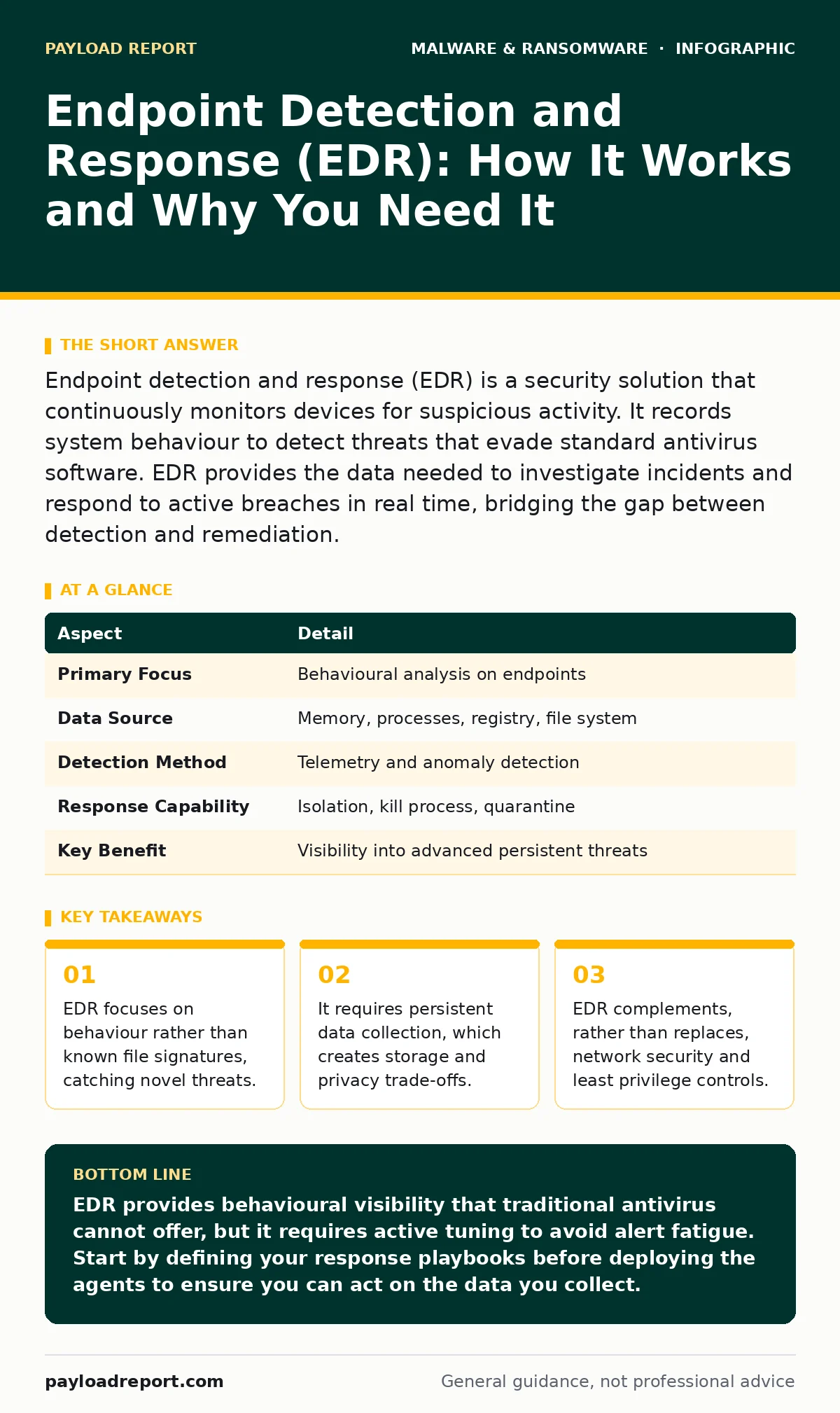
Endpoint detection and response (EDR) is a security solution that continuously monitors devices for suspicious activity. It records system behaviour to detect threats that evade standard antivirus software. EDR provides the data needed to investigate incidents and respond to active breaches in real time, bridging the gap between detection and remediation.
The Smoke Detector Analogy
Imagine your security infrastructure is a house. Traditional antivirus is a lock on the front door. It stops anyone who does not have the key. However, if a thief picks the lock or enters through an open window, the lock does nothing. Endpoint detection and response (EDR) is the system of cameras and motion sensors inside the house. It does not care how the intruder entered. It records what they do once they are inside. If they start breaking windows or moving furniture, the system alerts you. This shift from blocking entry to monitoring activity is the core of EDR.
| Aspect | Detail |
|---|---|
| Primary Focus | Behavioural analysis on endpoints |
| Data Source | Memory, processes, registry, file system |
| Detection Method | Telemetry and anomaly detection |
| Response Capability | Isolation, kill process, quarantine |
| Key Benefit | Visibility into advanced persistent threats |
The Problem With Static Signatures
Traditional security tools rely on signatures. A signature is a unique digital fingerprint of a known malicious file. If the tool sees that fingerprint, it blocks the file. This works well for common threats like computer viruses that spread in large numbers. It fails against new or custom-made malware. Attackers easily change the code of a program slightly to create a new fingerprint. This is called polymorphism. The tool does not recognise the new version, so it allows it to run. EDR solves this by ignoring the fingerprint. It looks at what the program does. If a calculator application tries to contact a remote server and encrypt files, it is suspicious, regardless of its signature.
How EDR Collects Evidence
EDR agents sit on every device, known as endpoints. These include laptops, servers, and mobile devices. The agent collects telemetry. Telemetry is data about system activity. It records which processes start, which files are modified, and which network connections are made. This data is sent to a central console. The console uses rules and machine learning to find patterns. For example, a rule might flag a script running from a temporary folder. This folder is rarely used for legitimate software. The agent can also inspect memory. Many modern threats live only in memory to avoid being written to disk. Traditional scanners miss these because they only look at files on the hard drive.
Detection Versus Response
Detection is finding the threat. Response is stopping it. EDR combines both. Once the system flags an anomaly, it can trigger automated actions. These actions are predefined playbooks. A common playbook isolates the infected device from the network. This prevents the malware from spreading to other devices. The agent can also kill the malicious process or delete the malicious file. Some systems allow remote command execution. This lets analysts investigate the device without touching it physically. However, automation carries risk. If the detection is wrong, you might isolate a clean device or kill a critical business process. You must tune these rules carefully to avoid false positives.
Where EDR Fits in Your Defences
EDR is not a standalone solution. It is part of a layered defence strategy. It sits at the edge of your infrastructure. It works alongside network firewalls and email filters. If those layers fail, EDR provides the next line of defence. It also informs other security tools. For instance, if EDR detects crypto-stealing malware, it can update firewall rules to block that specific communication channel. It does not replace identity management. It does not replace patching. It assumes that breaches will happen and focuses on limiting the damage. Think of it as the insurance policy that pays out when the locks fail.
See also: Honeytokens: Silent Traps for Insider Threats and Breaches · Purple Teaming FAQs: How to Run Effective Security Tests
The Hidden Costs of Visibility
The main trade-off of EDR is resource usage. Collecting telemetry requires CPU and memory. On older devices, this can slow down performance. Users may notice lag or battery drain. There is also a data cost. Storing detailed logs for every device requires significant storage capacity. You must decide what to keep and for how long. Keeping too much data makes investigation difficult. Keeping too little misses the evidence you need. Privacy is another concern. EDR sees everything the user does on the device. You must have clear policies on what data is collected and who can access it. This is especially relevant if you monitor personal devices used for work.
Common Misconceptions About EDR
Many organisations believe EDR replaces antivirus. This is incorrect. EDR adds a layer of intelligence on top of existing protections. It does not scan every file in real time like traditional antivirus. It focuses on suspicious behaviour. Another mistake is assuming EDR is set-and-forget. It requires active management. You must review alerts, update rules, and investigate incidents. Without human oversight, EDR is just a data collector. Some teams also confuse EDR with managed detection and response (MDR). EDR is the technology. MDR is a service where a third party monitors the EDR data for you. You can buy EDR without MDR, but you need the staff to use it.
Integrating With Other Security Layers
EDR works best when it shares data with other tools. For example, it can integrate with security information and event management (SIEM) systems. This allows you to correlate endpoint data with network logs. If EDR sees a suspicious process and the firewall sees unusual outbound traffic, the combined picture is clearer. It can also help with patch management. If EDR detects a vulnerability being exploited, it can trigger a patch deployment. This closes the loop between detection and remediation. It also helps identify potentially unwanted programs that may not be malicious but pose a risk. These programs often behave like malware by injecting ads or tracking users.
The Future of Endpoint Security
Endpoint security is evolving. EDR is merging with extended detection and response (XDR). XDR expands the scope beyond endpoints. It includes email, cloud workloads, and network traffic. This provides a unified view of security. It reduces the complexity of managing multiple tools. However, the core principles remain the same. You still need to monitor behaviour, not just signatures. You still need to respond quickly. And you still need to accept that no tool is perfect. The goal is to make it harder for attackers to succeed. EDR is a powerful tool in that effort. It gives you the visibility you need to protect your organisation. But it requires discipline and resources to use effectively.
Key takeaways
- EDR focuses on behaviour rather than known file signatures, catching novel threats.
- It requires persistent data collection, which creates storage and privacy trade-offs.
- EDR complements, rather than replaces, network security and least privilege controls.
- Effective use demands dedicated analyst time or automated response playbooks.
EDR provides behavioural visibility that traditional antivirus cannot offer, but it requires active tuning to avoid alert fatigue. Start by defining your response playbooks before deploying the agents to ensure you can act on the data you collect.
Frequently asked questions
Does EDR replace antivirus software?
No, EDR complements antivirus by focusing on behaviour rather than signatures. You should use both to cover different types of threats.
Is EDR suitable for small businesses?
It depends on your resources. EDR requires staff to investigate alerts. If you lack security personnel, consider MDR services instead.
How much data does EDR collect?
It collects detailed logs of system activity. The volume depends on your configuration and the number of endpoints.
Can EDR stop ransomware?
It can detect ransomware behaviour and isolate the device, limiting the spread. It does not prevent the initial infection but reduces the impact.
How this guide was produced: written by the Payload Report editorial team with AI assistance, checked against the public references listed below, and reviewed when the facts change. See our editorial policy or report an error.