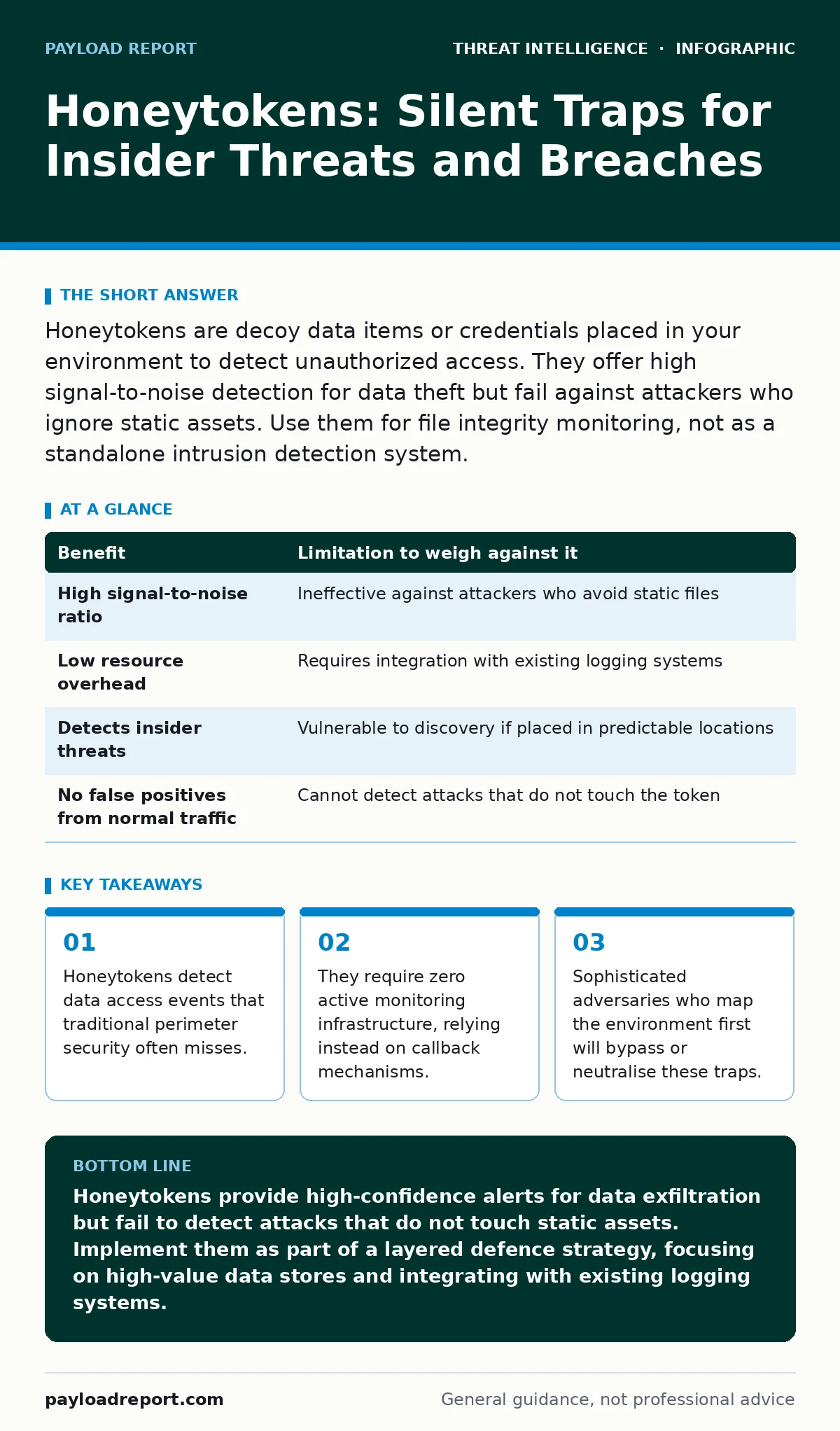
Honeytokens are decoy data items or credentials placed in your environment to detect unauthorized access. They offer high signal-to-noise detection for data theft but fail against attackers who ignore static assets. Use them for file integrity monitoring, not as a standalone intrusion detection system.
The Mechanics of Silent Detection
Honeytokens are pieces of data or credentials that serve no legitimate business purpose. You place them in databases, file shares, or source code repositories where an attacker might look. When someone accesses a honeytoken, it triggers an alert. Unlike honeypots, which are entire systems designed to attract attackers, honeytokens are lightweight. They do not run services. They do not open ports. They sit quietly in your existing infrastructure.
The core mechanism is simple. The token contains a unique identifier. When that identifier is read, copied, or transmitted, a callback is sent to your monitoring system. This callback confirms that the token has been accessed. You do not need to analyse network traffic patterns to spot the breach. The act of accessing the token is the breach.
This approach shifts the detection burden. Instead of trying to distinguish between normal and malicious user behaviour, you wait for an interaction with something that should never be touched. Any interaction is, by definition, anomalous. This creates a high-confidence alert. False positives are rare because no legitimate process should ever need to read a honeytoken.
Benefits and Limitations
Honeytokens offer distinct advantages in detecting lateral movement and data exfiltration. However, they are not a panacea. They have specific blind spots that security teams must understand. The table below weighs the primary benefits against their corresponding limitations.
| Benefit | Limitation to weigh against it |
|---|---|
| High signal-to-noise ratio | Ineffective against attackers who avoid static files |
| Low resource overhead | Requires integration with existing logging systems |
| Detects insider threats | Vulnerable to discovery if placed in predictable locations |
| No false positives from normal traffic | Cannot detect attacks that do not touch the token |
The high signal-to-noise ratio is the most significant advantage. Traditional intrusion detection systems generate thousands of alerts daily. Most are noise. Honeytokens generate almost none. When an alert fires, it is actionable. This reduces alert fatigue for your security operations team. You can respond immediately rather than triaging dozens of low-priority events.
However, this precision comes at a cost. Honeytokens only detect access to the specific assets they protect. If an attacker bypasses the token, you see nothing. They do not monitor network traffic. They do not inspect processes. They are blind to anything that does not directly interact with the decoy data.
The Hidden Cost of Placement
Where you place a honeytoken determines its value. If you place it in a random directory, an attacker will likely never find it. If you place it in a common location, such as the root of a shared drive, it becomes predictable. Attackers often look for sensitive data in standard locations. If you hide your honeytokens there, they may be ignored or flagged as decoys by sophisticated malware.
You must balance visibility with stealth. The token needs to be visible enough to be found by an attacker searching for sensitive data. It must also be hidden enough to avoid casual discovery by legitimate users. This requires a deep understanding of your data architecture. You need to know where attackers look. You also need to know where legitimate users never go.
Another hidden cost is maintenance. Honeytokens can expire or become stale. If a database schema changes, a honeytoken might be deleted or moved. If the callback mechanism fails, you lose detection capability. You must audit your honeytokens regularly. Ensure they are still in place. Ensure the callback infrastructure is functioning. This adds operational overhead that is often underestimated.
When It Is Worth It
Honeytokens are most effective in environments with high-value static data. If you store intellectual property, customer records, or financial data in databases or file shares, honeytokens provide an extra layer of detection. They catch attackers who exfiltrate data rather than just executing code. This is particularly useful for detecting insider threats. Legitimate users rarely need to access every file in a database. An attacker copying large volumes of data will likely trigger a token.
They are also valuable when you lack advanced monitoring capabilities. If you cannot afford or manage complex behavioural analytics, honeytokens offer a low-cost alternative. They work with basic logging systems. You do not need expensive sensors on every endpoint. The token itself performs the detection. This makes them suitable for smaller organisations or those with limited budgets.
Imagine a scenario where an attacker gains access to a database. They begin copying customer records. A honeytoken embedded in the customer table triggers an alert. You detect the exfiltration in real-time. Without the token, you might only discover the breach months later, after the data has left your network. The token acts as a tripwire. It tells you exactly when the data was touched.
When It Is Not Worth It
Honeytokens are less effective against advanced persistent threats that conduct thorough reconnaissance. These attackers map the environment before taking action. They identify file structures and database schemas. If they see a file that looks out of place, they may ignore it. They may also use tools that scan for known honeytoken formats. If your tokens use standard patterns, they will be detected and avoided.
They are also poor at detecting initial access. If an attacker exploits a vulnerability to gain entry, they may not touch any files immediately. They might establish persistence or move laterally. Honeytokens do not detect network exploits. They do not detect brute-force attacks. They only detect data access. You need other controls to catch the initial breach.
Suppose an attacker uses process injection to hide their activity. They execute code within a legitimate process. They do not read any files. Your honeytokens remain silent. The attacker achieves their goal without triggering any alerts. In this case, honeytokens provide a false sense of security. You must combine them with other detection methods. Do not rely on them as your sole defence.
See also: EDR vs MDR: How to Choose the Right Security Model · Encryption at Rest Checklist for Data Protection
Integration with Existing Controls
Honeytokens work best when integrated with broader security controls. They complement, rather than replace, other detection methods. For example, they can enhance Windows event log monitoring. By correlating token alerts with logon events, you can identify the user or system responsible. This provides context that the token alone cannot offer.
They also support purple teaming exercises. You can use honeytokens to test your detection capabilities. Place tokens in specific locations. Attempt to access them using simulated attack techniques. Measure how quickly your team responds. This helps you refine your incident response procedures. It also validates that your monitoring infrastructure is working correctly.
Do not use honeytokens in isolation. They are a single data point. Combine them with network monitoring, endpoint detection, and user behaviour analytics. This creates a layered defence. If one control fails, another may catch the attacker. Honeytokens add a unique layer focused on data access. They fill a gap that other controls often miss.
Maintaining Detection Hygiene
Like any security control, honeytokens require maintenance. You must update them periodically. Change the token values. Move them to new locations. This prevents attackers from learning your patterns. If an attacker discovers a token, they will note its location. They will avoid it in future attacks. By rotating tokens, you keep the defence dynamic.
You must also monitor the callback infrastructure. Ensure that alerts are being received and processed. If the callback service goes down, your detection is blind. Set up health checks for the callback mechanism. Alert if tokens are not reporting. This ensures that your detection capability remains active.
Regularly review your token placement strategy. As your infrastructure changes, so do the attack surfaces. New databases may be added. Old file shares may be decommissioned. Update your honeytokens to reflect these changes. Keep your detection aligned with your current risk profile.
Key takeaways
- Honeytokens detect data access events that traditional perimeter security often misses.
- They require zero active monitoring infrastructure, relying instead on callback mechanisms.
- Sophisticated adversaries who map the environment first will bypass or neutralise these traps.
Honeytokens provide high-confidence alerts for data exfiltration but fail to detect attacks that do not touch static assets. Implement them as part of a layered defence strategy, focusing on high-value data stores and integrating with existing logging systems.
Frequently asked questions
Do honeytokens slow down database performance?
No, honeytokens are lightweight data entries. They do not require active processing or additional queries. They have negligible impact on performance.
Can attackers easily detect and remove honeytokens?
Sophisticated attackers may identify honeytokens through pattern recognition. However, removing them requires elevated privileges and knowledge of the data structure. Most attackers will simply avoid them.
How long do honeytokens remain effective?
Honeytokens remain effective as long as they are hidden and the callback mechanism works. Regular rotation and placement in high-value areas extend their usefulness.
Are honeytokens legal to use?
Yes, honeytokens are legal. They are decoy data within your own systems. Ensure you comply with local data protection laws regarding the content of the tokens.
How this guide was produced: written by the Payload Report editorial team with AI assistance, checked against the public references listed below, and reviewed when the facts change. See our editorial policy or report an error.