
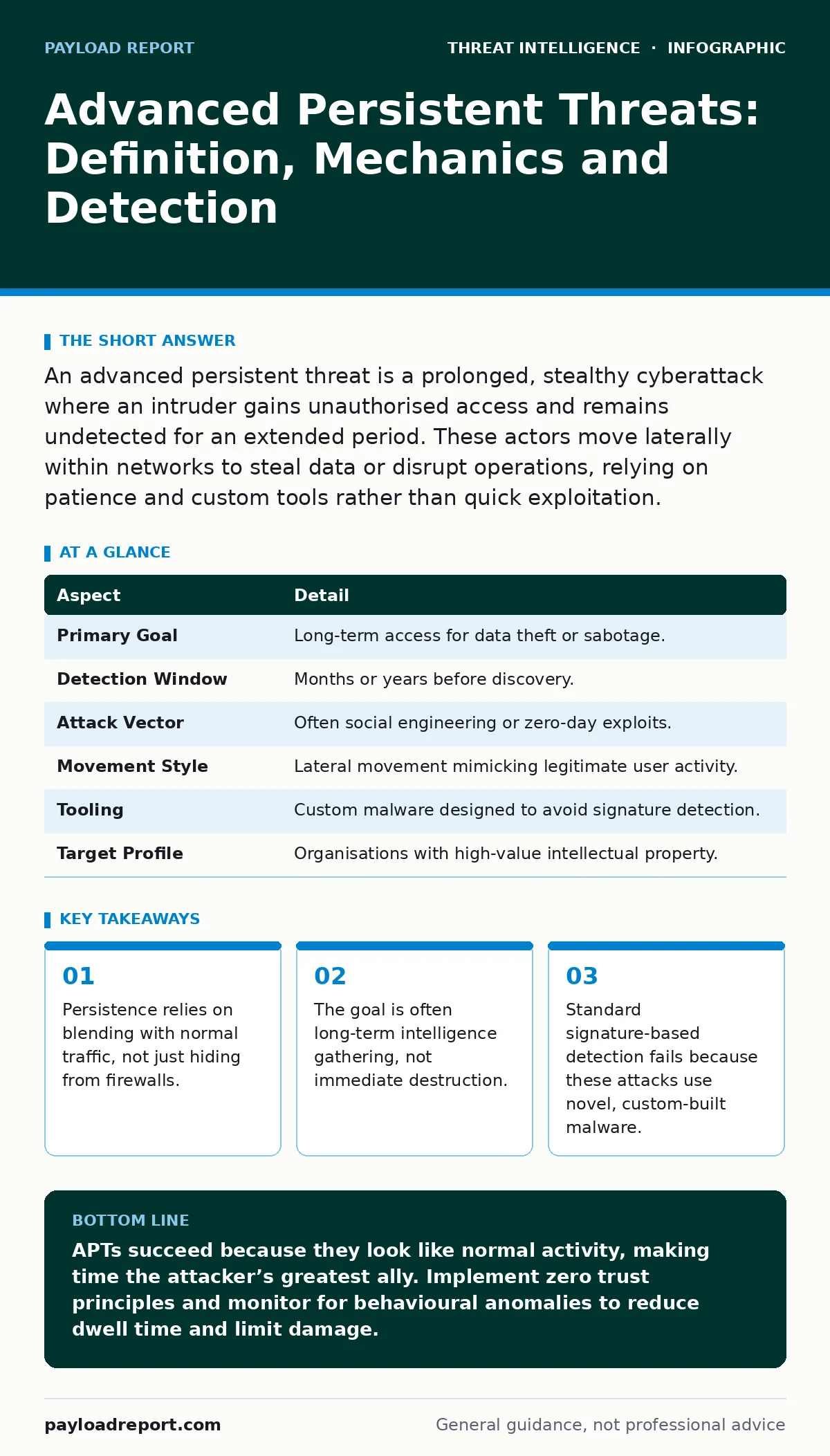
An advanced persistent threat is a prolonged, stealthy cyberattack where an intruder gains unauthorised access and remains undetected for an extended period. These actors move laterally within networks to steal data or disrupt operations, relying on patience and custom tools rather than quick exploitation.
The Trojan Horse in the Server Room
Imagine a burglar who does not smash a window. Instead, they pose as a delivery driver, walk in through the front door, and spend months rearranging papers in the office. They do not steal the safe immediately. They wait for the right moment, learning the layout and habits of the staff. This is the essence of an advanced persistent threat (APT).
The term describes a specific type of intrusion. The advanced component refers to the sophistication of the tools used. The persistent component refers to the duration of the intrusion. The threat is the actor or group behind the operation. Unlike script kiddies who spray and pray with known malware, APT operators tailor their approach to a specific target.
They prioritise stealth over speed. If they are detected, they abort and try again later. This patience allows them to map the network, identify high-value assets and establish multiple backup access points. They are not trying to break in once. They are trying to never leave.
At a Glance: How APTs Operate
| Aspect | Detail |
|---|---|
| Primary Goal | Long-term access for data theft or sabotage. |
| Detection Window | Months or years before discovery. |
| Attack Vector | Often social engineering or zero-day exploits. |
| Movement Style | Lateral movement mimicking legitimate user activity. |
| Tooling | Custom malware designed to avoid signature detection. |
| Target Profile | Organisations with high-value intellectual property. |
Who Is on the Receiving End
APT groups do not attack everyone. They select targets based on the value of the information held. Governments, defence contractors and large technology firms are frequent targets. However, the supply chain is equally vulnerable.
Attacking a smaller vendor that services a large corporation is often easier. The small vendor has weaker defences but trusted access to the larger network. This indirect approach allows attackers to reach high-value targets without facing the strongest security controls directly. Understanding this dynamic is central to initial access brokers, who specialise in selling these entry points to other criminal groups.
Financial institutions and healthcare providers are also prime targets. Patient records and financial data have high resale value on the deep web. The motive is not always espionage. Sometimes it is purely financial gain, executed with the same patience and stealth as state-sponsored operations.
The Lifecycle of an Intrusion
The attack begins with reconnaissance. The attacker studies the target’s public footprint, employee profiles on professional networks and software architecture. They look for weak links. A misconfigured server or an employee with administrative privileges who falls for a phishing email is a perfect entry point.
Once inside, the attacker establishes persistence. They modify system settings or create new user accounts to ensure they can return even if the initial entry method is closed. They then begin lateral movement. This involves moving from the compromised machine to other systems within the network.
During this phase, they escalate privileges. They move from a standard user account to an administrator account. This allows them to install software, disable security tools and access sensitive data. They do this slowly, often one step at a time, to avoid triggering alarms.
Why Standard Defences Fail
Most security tools are designed to stop known threats. They look for specific signatures or patterns associated with common malware. APTs do not use common malware. They write their own code. This custom software has no signature in any database.
Furthermore, APTs mimic legitimate behaviour. If an administrator normally accesses a server at 9 am, the attacker will also access it at 9 am. They use the same protocols and tools as the staff. This makes anomaly detection difficult. The traffic looks normal. The actions are authorised. The only difference is the intent.
This is why Windows event log monitoring is often insufficient on its own. Logs will show successful logins and file access. Without context, these events look like normal business activity. You need to correlate events across multiple systems to see the unusual pattern of lateral movement.
See also: Windows Event Log Monitoring: Implementation Steps and Verification · Defense Evasion Explained: How Attackers Hide in Plain Sight
What People Usually Get Wrong
Many organisations believe that if they have a firewall and antivirus, they are safe from APTs. This is a dangerous misconception. Firewalls control traffic at the perimeter. Once the attacker is inside, the firewall is largely irrelevant. Antivirus scans for known bad files. Custom APT tools are unknown.
Another common error is assuming that APTs are only state-sponsored actors. While many are, criminal syndicates also adopt APT tactics. The distinction matters less than the technique. Whether motivated by politics or profit, the method of slow, stealthy intrusion remains the same.
Finally, teams often focus too much on the initial breach. They try to stop the first click. While prevention is ideal, it is not foolproof. A better strategy assumes breach. You must design your network to detect and contain intruders who have already passed the perimeter. This mindset shift is central to effective purple teaming, where offensive and defensive teams work together to test detection capabilities.
Reducing the Risk of Persistence
You cannot prevent every intrusion. You can, however, reduce the time an attacker remains undetected. This is known as dwell time. The shorter the dwell time, the less damage can be done.
Implement strict least privilege access. Users and systems should only have the permissions necessary for their role. This limits lateral movement. If an attacker compromises a standard user account, they cannot easily jump to critical servers.
Use network segmentation. Divide your network into smaller zones. If one zone is compromised, the attacker cannot easily move to others. Monitor traffic between these zones. Unusual data flows between segments are strong indicators of lateral movement.
Consider using honeytokens. These are fake credentials or files placed in the network. Legitimate users never access them. If an attacker touches a honeytoken, you know immediately that an intrusion is occurring. This provides a clear, unambiguous signal of compromise.
Share threat intelligence with peers. ISACs (Information Sharing and Analysis Centers) allow organisations to share indicators of compromise and attack tactics. Learning from others’ breaches helps you anticipate what attackers might do next.
The Role of Trust and Verification
The biggest vulnerability in any APT scenario is trust. Systems trust each other. Users trust emails. Administrators trust logs. Attackers exploit this trust.
Zero trust architecture challenges this assumption. It verifies every request as if it comes from an untrusted network. Even internal traffic is inspected. This makes lateral movement significantly harder for attackers.
Regularly audit your access controls. Review who has administrative privileges. Remove accounts that are no longer needed. Check for dormant accounts that may have been created by attackers. These accounts are often used to maintain persistence long after the initial intrusion vector is closed.
Key takeaways
- Persistence relies on blending with normal traffic, not just hiding from firewalls.
- The goal is often long-term intelligence gathering, not immediate destruction.
- Standard signature-based detection fails because these attacks use novel, custom-built malware.
APTs succeed because they look like normal activity, making time the attacker’s greatest ally. Implement zero trust principles and monitor for behavioural anomalies to reduce dwell time and limit damage.
Frequently asked questions
How do I know if I have an APT?
Look for unusual lateral movement, privileged account usage at odd hours, and data transfers to unknown external IPs. Custom tools will not trigger standard antivirus alerts.
Can network segmentation stop an APT?
It slows them down. Segmentation limits lateral movement, forcing the attacker to find new ways to jump between network zones, increasing the chance of detection.
How this guide was produced: written by the Payload Report editorial team with AI assistance, checked against the public references listed below, and reviewed when the facts change. See our editorial policy or report an error.