Defense evasion is the technique attackers use to hide their presence. They alter logs, inject code into legitimate processes, or use standard tools for malicious purposes. This prevents detection systems from raising alerts, allowing the intrusion to persist undetected for extended periods.
The Camouflage of the Office Worker
Imagine a large corporate office building with strict security. A guard checks every visitor’s badge at the entrance. Now suppose an intruder enters wearing a uniform that looks identical to the cleaning staff. They carry a vacuum cleaner instead of weapons. To the guard, they look like part of the daily routine. This is the core concept of defense evasion. It is not about breaking down the door; it is about looking so ordinary that no one questions your presence once you are inside.
In cybersecurity, the "guard" is your detection software. The "uniform" is legitimate system behaviour. Attackers spend significant effort ensuring their actions mimic normal computer operations. If they can convince the monitoring systems that their activity is benign, they avoid triggering alarms. This allows them to move deeper into the network without immediate interference.
Blending In with Standard Tools
One common method is using living-off-the-land binaries. These are standard programs installed on every operating system, such as command-line utilities or scripting tools. Because these tools are necessary for system administration, security software rarely blocks them. An attacker might use a standard PowerShell script to download malicious files. To an observer, it looks like an administrator performing routine maintenance.
This technique exploits the trust placed in system utilities. Security teams often configure rules to allow these tools because blocking them would break legitimate workflows. The attacker leverages this necessary openness. They perform malicious actions using the same commands a system administrator might use. The difference lies in the intent and the target, which are difficult to distinguish in real-time traffic.
Hiding Inside Trusted Processes
Another layer of evasion involves process injection. This is a technique where malicious code is inserted into the memory space of a running, legitimate program. Suppose an attacker injects code into the web browser process. The browser continues to function normally, but it also executes the attacker’s hidden instructions.
Security tools often whitelist known applications like browsers or office suites. If the malicious code runs inside the browser’s memory, it inherits the browser’s trust status. The security software sees the browser running and assumes the activity is safe. The attacker’s code is effectively hiding inside a trusted vessel. This bypasses controls that only check the executable file itself, ignoring what happens in memory.
Erasing the Footprints
Once inside, the attacker needs to stay hidden. Log tampering is the act of modifying or deleting system records. Operating systems keep detailed logs of who logged in, what files were accessed, and what commands were run. These logs are the primary source of truth for security analysts.
If an attacker deletes the log entries that show their initial login, they remove the starting point of their intrusion. Analysts reviewing the system later will see no record of the breach. It is like erasing the entry in the visitor book. The attacker is still present, but the historical evidence of their arrival is gone. This forces defenders to rely on other, less reliable indicators to detect the compromise.
The Cost of Normalcy
The difficulty in detecting defense evasion lies in the definition of "normal". Computers generate millions of events daily. Distinguishing a malicious PowerShell script from a legitimate one requires deep context. This creates a hidden cost for security teams. They must maintain complex behavioural baselines.
If the baseline is too strict, it generates false positives, alerting on harmless activity. This leads to alert fatigue, where analysts ignore warnings. If the baseline is too loose, malicious activity slips through. Finding the balance is a constant struggle. Attackers adapt their techniques to match the observed normal behaviour of the target environment.
See also: Windows Event Log Monitoring: Implementation Steps and Verification · Advanced Persistent Threats: Definition, Mechanics and Detection
What This Means for You
For an ordinary user, the implications are subtle. You may not notice any immediate signs of a breach. The computer works as expected. Files are accessible. The internet connection is stable. The evasion techniques are designed to be silent.
However, the risk is prolonged exposure. While the attacker remains hidden, they can steal data, install further tools, or move to other systems. The damage accumulates over time. By the time detection occurs, the intrusion may have been ongoing for months. This delay increases the potential impact on your personal or professional data.
Simple Safety Habits
You can reduce the effectiveness of these evasion techniques through specific habits. First, keep your operating system and applications updated. Patches often close vulnerabilities that allow process injection. Second, limit the use of administrative privileges. If your account has limited rights, attackers cannot easily tamper with system logs or install persistent backdoors.
Third, use multi-factor authentication. This adds a layer of security that is harder to bypass, even if credentials are stolen. While this does not stop evasion directly, it makes the initial entry more difficult. Reducing the likelihood of initial access reduces the opportunity for evasion techniques to take hold.
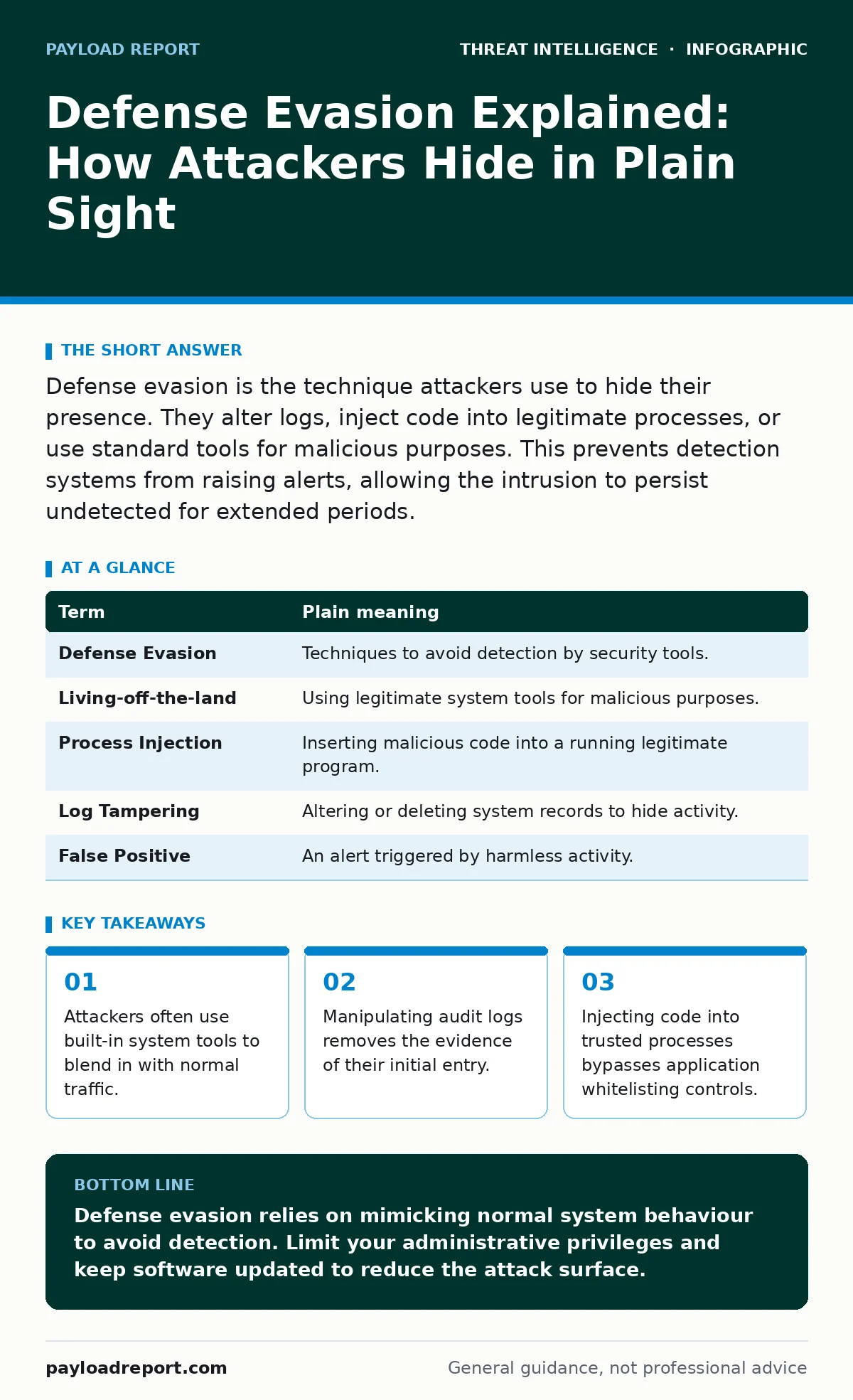
| Term | Plain meaning |
|---|---|
| Defense Evasion | Techniques to avoid detection by security tools. |
| Living-off-the-land | Using legitimate system tools for malicious purposes. |
| Process Injection | Inserting malicious code into a running legitimate program. |
| Log Tampering | Altering or deleting system records to hide activity. |
| False Positive | An alert triggered by harmless activity. |
- [ ] Review your user account privileges and remove administrative rights from daily-use accounts.
- [ ] Enable automatic updates for your operating system and critical applications.
- [ ] Verify that multi-factor authentication is active on all important accounts.
Key takeaways
- Attackers often use built-in system tools to blend in with normal traffic.
- Manipulating audit logs removes the evidence of their initial entry.
- Injecting code into trusted processes bypasses application whitelisting controls.
Defense evasion relies on mimicking normal system behaviour to avoid detection. Limit your administrative privileges and keep software updated to reduce the attack surface.
Frequently asked questions
Can antivirus software stop defense evasion?
Traditional antivirus often fails because it looks for known malicious files. Evasion techniques use legitimate files, so signature-based detection misses them. Behavioural analysis is more effective.
How do attackers know what looks normal?
They observe the target environment during the initial breach. They study which tools are used, how logs are structured, and what processes run. This reconnaissance allows them to tailor their camouflage.
Is log tampering permanent?
Not necessarily. If logs are sent to a central, read-only server, local tampering leaves the central record intact. Centralised logging is a key countermeasure.
What is the difference between evasion and exploitation?
Exploitation is the act of breaking in using a vulnerability. Evasion is what happens after entry, where the attacker hides their presence to avoid being caught.
How this guide was produced: written by the Payload Report editorial team with AI assistance, checked against the public references listed below, and reviewed when the facts change. See our editorial policy or report an error.