
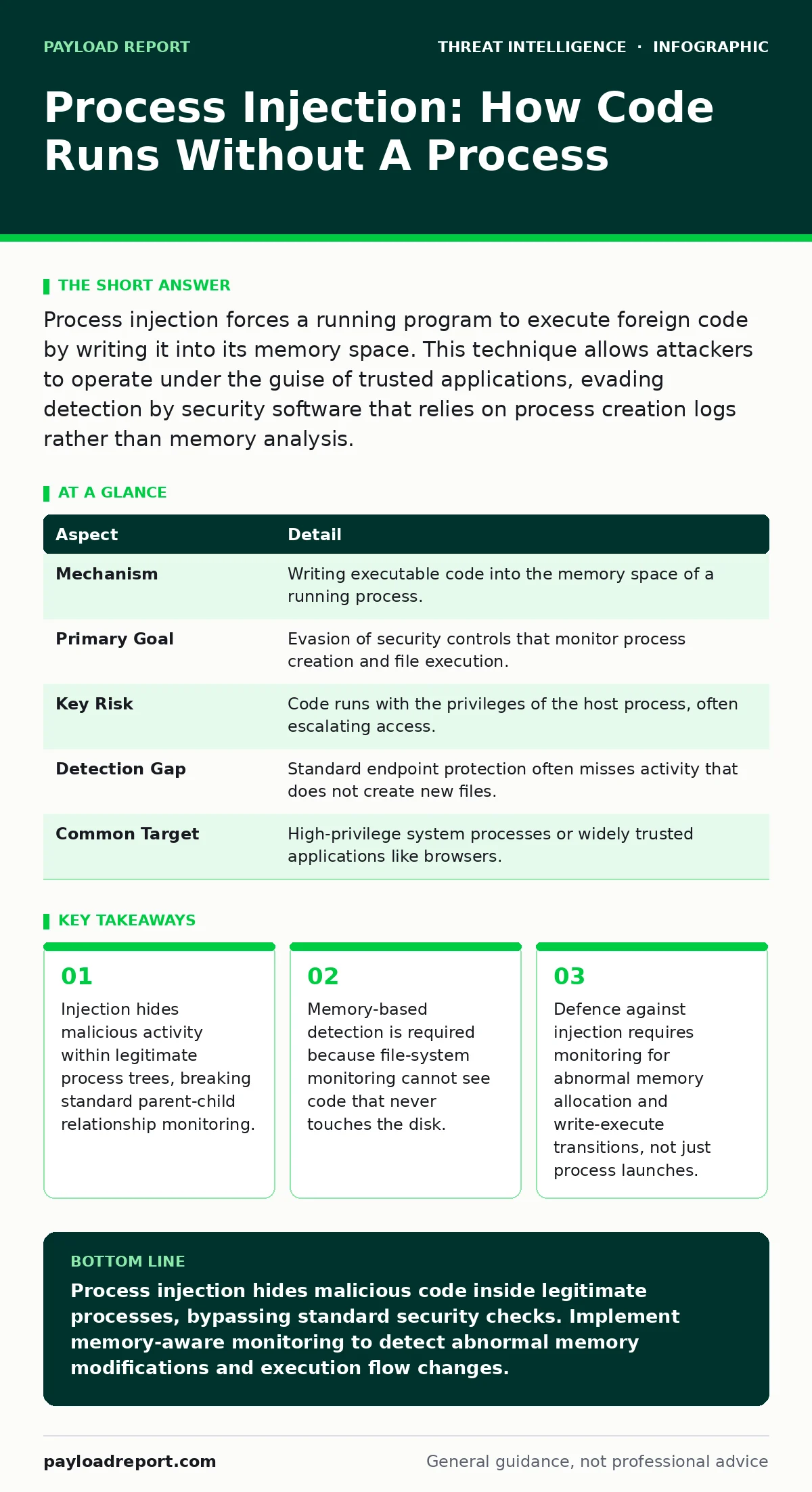
Process injection forces a running program to execute foreign code by writing it into its memory space. This technique allows attackers to operate under the guise of trusted applications, evading detection by security software that relies on process creation logs rather than memory analysis.
The Parasite Analogy
Imagine a secure building with strict entry checks. Guards inspect every person at the door, checking badges and searching bags. Once inside, the guards assume everyone is trustworthy. Process injection is like a visitor slipping a dangerous tool into the pocket of an authorised employee. The employee walks through the turnstiles without raising alarms. The tool is used inside the secure zone, but the guards only see the employee, not the contraband.
In computing, the "building" is the operating system. The "employee" is a legitimate process, such as a web browser or a system service. The "tool" is the malicious code. By placing code inside an existing process, an attacker avoids the scrutiny applied to new process creations.
| Aspect | Detail |
|---|---|
| Mechanism | Writing executable code into the memory space of a running process. |
| Primary Goal | Evasion of security controls that monitor process creation and file execution. |
| Key Risk | Code runs with the privileges of the host process, often escalating access. |
| Detection Gap | Standard endpoint protection often misses activity that does not create new files. |
| Common Target | High-privilege system processes or widely trusted applications like browsers. |
How Memory Manipulation Works
Operating systems allocate memory to processes in pages. These pages have attributes that define what can happen to them. A page might be marked as readable, writable, or executable. Standard security relies on the principle that data is written to, and code is read from, separate areas.
Process injection breaks this separation. An attacker finds a running process and requests memory allocation within it. They write their malicious code into this memory space. Then, they change the memory attributes to make that specific block executable. Finally, they redirect the process’s execution flow to jump to this new code. The original process continues to run, but it is now executing instructions it did not originally contain.
This mechanism exploits the trust the operating system places in the process. The process already has permissions to access certain files and network resources. The injected code inherits these permissions. If the host process runs as an administrator, the injected code runs as an administrator.
Common Forms of Injection
There are several techniques to achieve this, each with different levels of complexity and stealth.
Remote Thread Creation is one of the oldest methods. The attacker allocates memory in a remote process, writes their code there, and creates a new thread in that process. This thread begins executing the injected code immediately. It is straightforward but leaves distinct traces in system calls.
Hollowing involves creating a new process in a suspended state. The attacker unmaps the original code from the process memory and replaces it with their own payload. They then resume the process. To the operating system, it looks like a legitimate application launched, but it is running entirely different code. This is often used to disguise malware as system processes.
DLL Injection forces a process to load a dynamic link library. A DLL is a file containing code and data that can be used by multiple programs. By injecting a malicious DLL, the attacker gains execution context within the target process. This is common in software cracking and malware distribution.
Who Is Affected
Process injection affects any system that allows processes to interact with each other’s memory. This includes Windows, Linux, and macOS. The risk is highest on servers and workstations that run complex applications with high privileges.
Security operations teams face a specific challenge. Traditional detection rules look for new processes. If a tool only logs when a process starts, it misses injection entirely. The process was already running. The malicious activity happens silently within the existing memory space. This makes the technique particularly dangerous for environments that rely on process creation logging as their primary detection method.
What People Usually Get Wrong
Many defenders believe that blocking unsigned executables prevents injection. This is incorrect. Injection often uses code that is never saved to disk as a file. It exists only in memory. File integrity monitoring cannot see it.
Another common misconception is that sandboxing prevents injection. Sandboxes isolate processes, but if the sandboxed application itself is compromised, the injection happens inside the sandbox. The malicious code is still isolated, but the attacker has achieved execution. If the sandbox has any way to communicate with the host, the injected code can use that channel.
Defenders also often focus on the attacker’s initial access. While stopping the first step is ideal, assuming that initial access is always blocked leaves the system vulnerable. Attackers often gain access through phishing or software vulnerabilities. Once inside, they use injection to persist and escalate.
See also: Advanced Persistent Threats: Definition, Mechanics and Detection · Honeytokens: Silent Traps for Insider Threats and Breaches
Reducing The Risk
To reduce the risk, you must shift focus from process creation to process behaviour. This requires monitoring memory allocations and changes to memory protection attributes.
Enable Windows event log monitoring for specific system calls. Look for events that indicate a process is writing to another process’s memory. Look for changes in memory protection flags, such as a page changing from "write" to "execute". These are strong indicators of injection.
Use defense evasion detection rules that look for anomalies in process trees. If a process that never creates threads suddenly creates one, or if a browser process starts executing code that looks like a command shell, this is suspicious.
Implement purple teaming exercises to test your detection capabilities. Have your red team use injection techniques against your blue team’s monitoring. This reveals gaps in your visibility. You may find that your tools log the process start but not the memory modification.
The Hidden Cost of Detection
Monitoring for process injection has a cost. It requires deep visibility into system memory. This can impact performance. If every memory allocation is logged, the volume of data becomes unmanageable. You must filter carefully.
There is also the risk of false positives. Legitimate software, such as debuggers or performance monitoring tools, uses similar techniques. You must tune your alerts to distinguish between legitimate tooling and malicious activity. This requires deep knowledge of your environment’s baseline behaviour.
Another hidden cost is the complexity of response. When injection is detected, you often cannot simply kill the process. The process may be critical to business operations. Killing it causes disruption. You may need to isolate the machine or terminate the specific thread, which is technically difficult.
Beyond Process Injection
Process injection is often part of a larger attack chain. Attackers may use it to facilitate pass-the-hash attacks, where they steal credential hashes from memory. They may use it to perform log tampering, deleting evidence of their activity from system logs. Understanding these connections helps you build a more complete defence.
Sharing information with ISACs can provide early warning of new injection techniques. However, you must verify this information against your own environment. Generic threats may not apply to your specific configuration.
For deeper analysis of memory-resident threats, consider exploring resources on deep web threat intelligence, where advanced techniques are often discussed. However, be cautious of unverified claims. Stick to well-established knowledge and verified indicators.
Key takeaways
- Injection hides malicious activity within legitimate process trees, breaking standard parent-child relationship monitoring.
- Memory-based detection is required because file-system monitoring cannot see code that never touches the disk.
- Defence against injection requires monitoring for abnormal memory allocation and write-execute transitions, not just process launches.
Process injection hides malicious code inside legitimate processes, bypassing standard security checks. Implement memory-aware monitoring to detect abnormal memory modifications and execution flow changes.
Frequently asked questions
Can antivirus software detect process injection?
Traditional antivirus software often misses injection because it focuses on files on disk. Modern endpoint detection and response tools can detect it by monitoring memory and behaviour, but they require careful tuning.
Does disabling remote desktop prevent injection?
No. Injection is a local technique. An attacker can inject code into a process on the same machine without using remote desktop. Disabling remote access reduces the attack surface but does not stop local exploitation.
How do I know if my system is vulnerable?
Most modern operating systems are vulnerable to some form of injection by design, as processes need to interact. The key is not to eliminate the vulnerability, but to detect the abuse of it through monitoring and behavioural analysis.
Is process injection illegal?
The technique itself is a neutral mechanism used by legitimate software. Using it to execute unauthorised code or bypass security controls is illegal in most jurisdictions. The legality depends on the intent and the context of the use.
How this guide was produced: written by the Payload Report editorial team with AI assistance, checked against the public references listed below, and reviewed when the facts change. See our editorial policy or report an error.