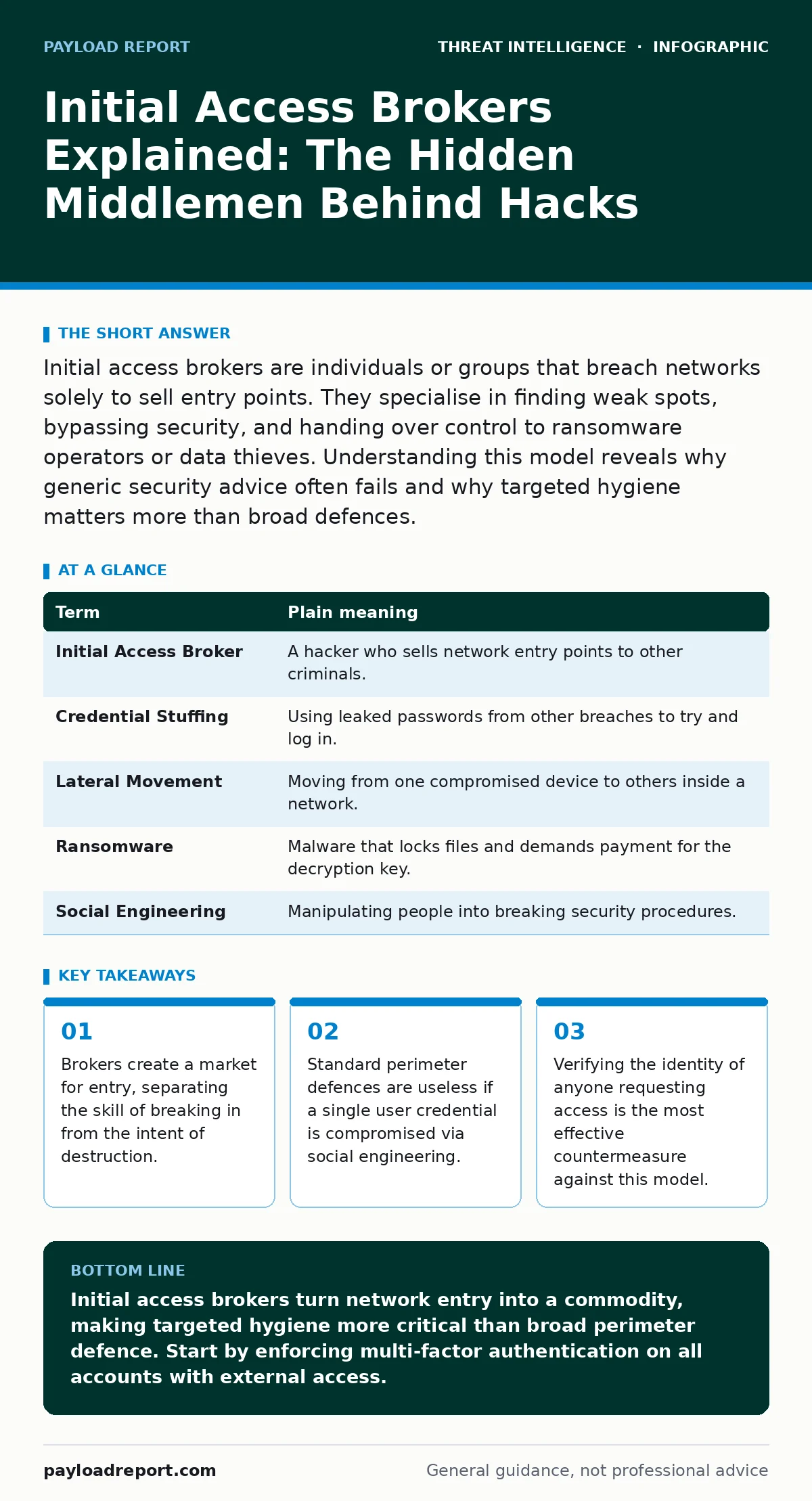
Initial access brokers are individuals or groups that breach networks solely to sell entry points. They specialise in finding weak spots, bypassing security, and handing over control to ransomware operators or data thieves. Understanding this model reveals why generic security advice often fails and why targeted hygiene matters more than broad defences.
The Key Cuts by Others
Imagine a high-security warehouse. The owner installs alarms, reinforced doors, and guards. A professional thief cannot pick the lock, so they bribe a night shift worker to leave a side door unlocked. This worker does not steal anything. They simply leave the door ajar and take a photograph. They sell that photograph to a gang of looters who arrive later to strip the place bare.
The worker is the initial access broker. The looters are the ransomware operators. The broker has no interest in what happens inside the warehouse. They only care about selling the entry.
This separation of roles changes how attacks happen. It allows criminals with different skills to specialise. One group focuses on social engineering or exploiting unpatched software. Another focuses on encrypting files for extortion. The broker connects them.
How the Brokerage Model Works
Brokers operate like real estate agents for illegal access. They scan the internet for vulnerable systems. They might use phishing emails to trick staff into revealing passwords. They might exploit a misconfigured cloud storage bucket.
Once they have a foothold, they verify it is stable. They ensure they can move around the network without being detected. They then list this access on hidden forums. They provide details: the size of the network, the type of data available, and the strength of the security controls.
Buyers bid on the access. The broker hands over the credentials or remote control session. The buyer then deploys malware, exfiltrates data, or holds systems hostage. The broker washes their hands of the crime.
Why This Matters for You
You might think you are too small to be targeted. Initial access brokers do not care about your company size. They care about your security posture. A small firm with weak multi-factor authentication is easier to breach than a large bank with strong controls.
The danger is not the broker themselves. It is what they sell. Once a buyer has access, they can do anything. They can install ransomware that locks your computers. They can steal customer data. They can remain hidden for months, stealing small amounts of money or intellectual property.
This model increases the volume of attacks. Because entry is commoditised, more criminals can buy access without learning how to hack. This floods your security teams with more incidents.
The Hidden Cost of Convenience
Many users assume that if they do not click suspicious links, they are safe. This is a false sense of security. Brokers often use legitimate credentials. They might log in from a new location. They might use a password you forgot you created for a secondary service.
This is where the concept of pass-the-hash attacks becomes relevant. Attackers can reuse cryptographic hashes of passwords to move laterally within a network. They do not need to know your actual password. They just need the hash. This means changing your password may not stop an attacker who already has your hash.
You must assume that any single point of failure can be exploited. If one device is compromised, the broker can use it to reach others. This is why network segmentation is vital. It limits the damage a broker can sell.
What Brokers Look For
Brokers scan for specific weaknesses. They look for systems that are not updated. They look for employees who are likely to respond to urgent requests. They look for exposed admin panels.
They also look for log tampering opportunities. If they can alter the records of their activity, they can stay hidden longer. This makes the access more valuable to buyers. A clean entry is worth more than a noisy one.
Suppose you ignore software updates. A broker scans for that known vulnerability. They exploit it. They now have access. They sell it. The update you ignored became the product.
See also: Advanced Persistent Threats: Definition, Mechanics and Detection · Process Injection: How Code Runs Without A Process
Simple Safety Habits
You cannot stop every broker. But you can make your network less attractive. Here are three steps you can take today.
- Enforce Multi-Factor Authentication. This stops attackers who steal passwords. Even if a broker gets your password, they cannot log in without the second factor. Use hardware keys or authenticator apps. Avoid SMS codes if possible, as these can be intercepted.
- Principle of Least Privilege. Do not give every user admin rights. Most staff do not need to change system settings. If a broker compromises a standard user account, they have limited access. This slows down the attack.
- Monitor Unusual Activity. Look for logins from strange locations. Look for access at odd hours. Use Windows event log monitoring to track who logs in and when. If you see a spike in failed logins followed by a success, investigate immediately.
| Term | Plain meaning |
|---|---|
| Initial Access Broker | A hacker who sells network entry points to other criminals. |
| Credential Stuffing | Using leaked passwords from other breaches to try and log in. |
| Lateral Movement | Moving from one compromised device to others inside a network. |
| Ransomware | Malware that locks files and demands payment for the decryption key. |
| Social Engineering | Manipulating people into breaking security procedures. |
The Role of Community Defence
One organisation cannot fight this alone. Brokers adapt quickly. What works today may fail tomorrow. You need to share information.
Join industry groups like ISACs (Information Sharing and Analysis Centers). These groups allow companies to share details about attacks. If one firm is targeted by a specific broker, others can prepare. This collective defence raises the cost for attackers.
You can also participate in purple teaming. This involves your defenders and attackers working together. They simulate breaches to find gaps. This helps you see your network through the eyes of a broker.
Living with the Risk
You will never eliminate the risk of initial access brokers. They are part of the deep web economy. They will always find weak points.
Your goal is not perfection. It is resilience. You want to detect breaches quickly. You want to contain them before they spread. You want to recover without paying ransoms.
This means accepting that some breaches will happen. You must have a plan for when they do. Test your backups. Ensure you can restore data without the attackers’ permission.
Final Thoughts on Brokerage
The rise of initial access brokers shows that hacking is now a business. It is efficient and scalable. It exploits human behaviour and technical debt.
You must treat every credential as a potential product. Protect them fiercely. Monitor their use. Assume they will be stolen.
By understanding this model, you can adjust your defences. You can focus on the right controls. You can protect your organisation from the hidden middlemen of cybercrime.
Key takeaways
- Brokers create a market for entry, separating the skill of breaking in from the intent of destruction.
- Standard perimeter defences are useless if a single user credential is compromised via social engineering.
- Verifying the identity of anyone requesting access is the most effective countermeasure against this model.
Initial access brokers turn network entry into a commodity, making targeted hygiene more critical than broad perimeter defence. Start by enforcing multi-factor authentication on all accounts with external access.
Frequently asked questions
Are initial access brokers legal?
No, they operate illegally by breaching systems and selling unauthorised access. Their activities violate computer fraud laws in most jurisdictions.
How do brokers verify access before selling?
They test the stability of the connection, check the level of privileges, and ensure they can move laterally without triggering alarms.
How this guide was produced: written by the Payload Report editorial team with AI assistance, checked against the public references listed below, and reviewed when the facts change. See our editorial policy or report an error.