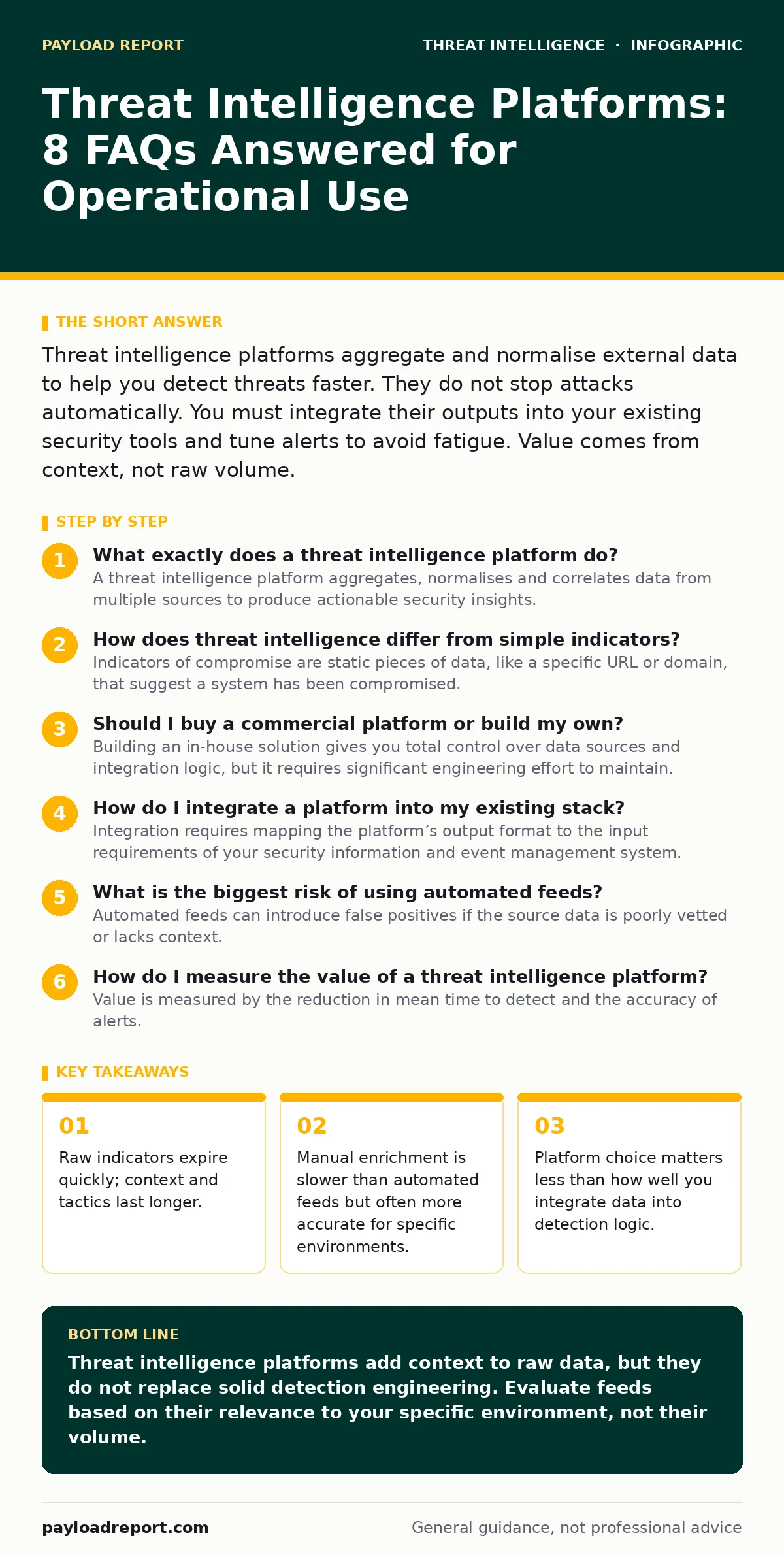
Threat intelligence platforms aggregate and normalise external data to help you detect threats faster. They do not stop attacks automatically. You must integrate their outputs into your existing security tools and tune alerts to avoid fatigue. Value comes from context, not raw volume.
What exactly does a threat intelligence platform do?
A threat intelligence platform aggregates, normalises and correlates data from multiple sources to produce actionable security insights. It transforms raw data, such as malicious IP addresses or file hashes, into structured reports that align with known attack frameworks. The system does not block traffic or patch vulnerabilities itself. Instead, it provides the context needed for your other tools to make decisions.
How does threat intelligence differ from simple indicators?
Indicators of compromise are static pieces of data, like a specific URL or domain, that suggest a system has been compromised. Threat intelligence adds context, such as the attacker’s motivation, the tools they use and the sectors they target. This distinction matters because indicators expire quickly, often within days. Intelligence about tactics and procedures remains relevant for months or years. Focusing only on indicators leads to alert fatigue without reducing risk.
Should I buy a commercial platform or build my own?
Building an in-house solution gives you total control over data sources and integration logic, but it requires significant engineering effort to maintain. Commercial platforms offer pre-built connectors and curated feeds, reducing the initial setup time. The hidden cost of commercial tools is often the inability to tailor the data to your specific environment. If your team lacks dedicated data engineers, a commercial platform is usually more sustainable.
How do I integrate a platform into my existing stack?
Integration requires mapping the platform’s output format to the input requirements of your security information and event management system. Most platforms support standard protocols like OpenC2 or STIX for sharing cyber threat information. You must verify that the fields in the intelligence feed match the fields in your logs. Misaligned data creates gaps in detection. Regular testing ensures the integration continues to work after updates.
What is the biggest risk of using automated feeds?
Automated feeds can introduce false positives if the source data is poorly vetted or lacks context. A high-volume feed might flag a legitimate domain as malicious because it is also used by attackers. This noise distracts analysts and can lead to missed signals. You must tune your thresholds based on your environment’s baseline activity. Blindly trusting every alert from a feed undermines the credibility of your security operations.
| Integration Method | Speed of Setup | Customisation Level | Maintenance Burden |
|---|---|---|---|
| API Push | Fast | Low | Low |
| API Pull | Medium | Medium | Medium |
| Manual Import | Slow | High | High |
| Native Connector | Fast | Low | Low |
See also: What Is Managed Detection and Response (MDR): How It Works · Log Tampering: How Attackers Erase Their Footprints
How do I measure the value of a threat intelligence platform?
Value is measured by the reduction in mean time to detect and the accuracy of alerts. If the platform helps you find threats that previously went unnoticed, it is delivering value. Track the number of alerts that lead to confirmed incidents versus those that are false positives. A platform that generates thousands of alerts with no confirmed hits is costing you time. Review these metrics quarterly to adjust your data sources.
Can a platform protect against advanced persistent threats?
A platform can provide early warning signs of advanced persistent threats, such as new command and control servers. It cannot prevent the initial compromise or stop lateral movement within your network. Protection against these long-term campaigns requires strong internal monitoring and segmentation. Intelligence helps you recognise the tactics, but your defences must stop the actions. Reliance on external data alone leaves critical gaps.
How do I handle the cost of data subscriptions?
Data subscriptions often scale with the number of users or the volume of queries. To control costs, limit access to essential teams and cache results to reduce repeated queries. Evaluate each feed’s contribution to your detection capabilities before renewing. If a source adds no new context, cut it. The cheapest platform is the one that provides exactly what you need and nothing else.
What happens when a platform vendor goes out of business?
If a vendor ceases operations, you lose access to their proprietary data and integration support. This is why standard data formats are critical. Export your historical data and configuration before the shutdown. Have a backup plan for migrating to a new provider. Vendor lock-in is a real risk when using proprietary formats. Plan for continuity from day one.
Key takeaways
- Raw indicators expire quickly; context and tactics last longer.
- Manual enrichment is slower than automated feeds but often more accurate for specific environments.
- Platform choice matters less than how well you integrate data into detection logic.
Threat intelligence platforms add context to raw data, but they do not replace solid detection engineering. Evaluate feeds based on their relevance to your specific environment, not their volume.
Frequently asked questions
Do threat intelligence platforms replace SIEM systems?
No, they complement SIEM systems by providing external context. The SIEM correlates logs, while the platform enriches those logs with threat data.
How fast is threat intelligence data updated?
Updates range from real-time to daily, depending on the source. Automated feeds are faster but may contain more noise than curated reports.
Can I use open-source threat intelligence instead of paid platforms?
Yes, open-source data is free and valuable. However, it requires more manual effort to verify and integrate into your workflows.
Does a platform help with insider threats?
Primarily no, as insider threats do not involve external indicators. Intelligence platforms focus on external attack data and known malicious actors.
How this guide was produced: written by the Payload Report editorial team with AI assistance, checked against the public references listed below, and reviewed when the facts change. See our editorial policy or report an error.