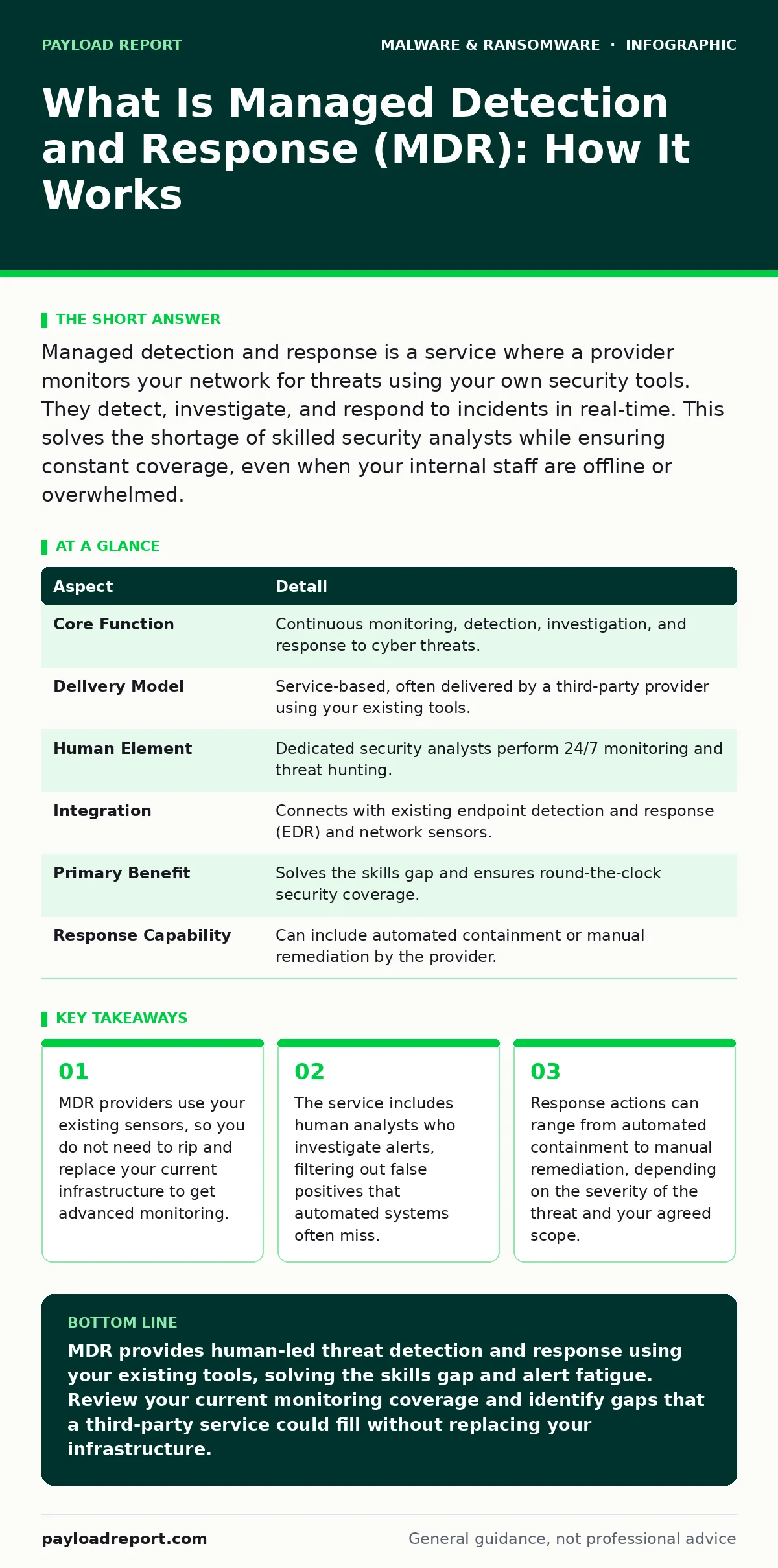
Managed detection and response is a service where a provider monitors your network for threats using your own security tools. They detect, investigate, and respond to incidents in real-time. This solves the shortage of skilled security analysts while ensuring constant coverage, even when your internal staff are offline or overwhelmed.
The Air Traffic Control Analogy
Imagine an air traffic control tower. The radar systems represent your security tools. They provide data, but they do not make decisions. The controllers are the analysts who interpret that data, identify conflicts, and issue instructions to pilots. In many organisations, the radar is sophisticated, but the tower is understaffed or closed at night. Managed detection and response (MDR) provides the controllers. It ensures someone is always watching the screens, interpreting the blips, and taking action when a collision course is detected.
This model recognises that technology alone cannot secure an environment. You need human judgment to distinguish between a benign anomaly and a genuine attack. Without that human layer, alerts pile up until they become noise, a phenomenon known as alert fatigue. MDR removes that noise by having experts filter and act on data continuously.
At a Glance
| Aspect | Detail |
|---|---|
| Core Function | Continuous monitoring, detection, investigation, and response to cyber threats. |
| Delivery Model | Service-based, often delivered by a third-party provider using your existing tools. |
| Human Element | Dedicated security analysts perform 24/7 monitoring and threat hunting. |
| Integration | Connects with existing endpoint detection and response (EDR) and network sensors. |
| Primary Benefit | Solves the skills gap and ensures round-the-clock security coverage. |
| Response Capability | Can include automated containment or manual remediation by the provider. |
The Problem MDR Solves
Security tools generate thousands of alerts daily. Most of these are false positives or low-priority events. Your internal team cannot investigate every signal without burning out. This is the detection gap. You have the data, but you lack the time or expertise to process it effectively. MDR closes this gap by outsourcing the analysis. It provides a team that is always awake, always working, and always looking for threats that automated rules miss.
This is particularly relevant for organisations that cannot hire enough senior analysts. The market for skilled security professionals is tight. MDR allows you to access deep expertise without the full-time salary and training costs. It turns a fixed cost into a variable service cost. You pay for the outcome, not just the software licence.
How MDR Fits With Other Defences
MDR does not replace your existing security stack. It sits on top of it. Think of it as the central nervous system that connects disparate sensors. It integrates with your firewall logs, endpoint detection and response (EDR) agents, and identity providers. It correlates data from these sources to find patterns that single tools cannot see.
For example, a computer virus might be quarantined by an antivirus solution. However, if the same user account suddenly tries to access a sensitive database from an unusual location, MDR connects those two events. It sees the broader context. This is different from a standalone tool that only looks at one type of data. MDR provides a unified view of the attack surface.
You should also consider how MDR interacts with other threats. While screen locker ransomware is loud and obvious, crypto-stealing malware operates silently in the background. MDR helps detect these subtle behavioural changes before funds are moved. It also complements strategies for handling Android malware, which often bypasses traditional desktop-focused security controls. By monitoring mobile device management logs alongside desktop data, MDR provides a holistic view of device health.
The Main Parts of the Service
An MDR service typically consists of four main components. First is integration. The provider connects to your existing security tools via APIs or agents. This ensures you do not need to install new software on every device. Second is monitoring. The provider’s platform ingests logs and telemetry data in real-time. It uses machine learning to baseline normal behaviour and flag deviations.
Third is analysis. Human analysts review alerts. They determine if an alert is a true positive or a false alarm. They investigate the scope of the incident. This human touch is what separates MDR from automated security operations centres. Fourth is response. Depending on your agreement, the provider may take action. This could mean isolating an infected device, disabling a compromised user account, or blocking malicious traffic at the firewall.
See also: Bug Bounty Best Practices: Build a Program That Catches Real Threats · Potentialy Unwanted Programs: Response and Recovery Steps
What People Usually Get Wrong
Many organisations believe MDR is a replacement for their security team. It is not. It is a force multiplier. Your internal team still needs to define policies, manage access, and handle strategic decisions. MDR handles the tactical workload. It frees your team to focus on high-value tasks like architecture and compliance.
Another common mistake is expecting MDR to fix poor security hygiene. If you have unpatched systems and weak access controls, no amount of monitoring will stop every attack. MDR detects and responds, but it does not prevent vulnerabilities. You still need to manage your risks proactively. For instance, using golden images for system deployment reduces the attack surface by ensuring all devices start from a known, secure state. MDR can verify that these images remain uncompromised, but it cannot create them.
The Hidden Costs and Trade-offs
There is a trade-off in visibility. To provide effective monitoring, the MDR provider needs access to your data. This means sensitive logs and network traffic are processed by a third party. You must trust their security practices and data handling procedures. This is a significant consideration for regulated industries.
Additionally, MDR can create a dependency. If your internal team relies too heavily on the provider, skills may atrophy. You need to ensure your staff remains engaged and informed. The provider should share findings and lessons learned. This knowledge transfer is vital for long-term resilience. Without it, you are merely paying for a service without building internal capability.
Integrating With Your Existing Strategy
MDR works best when it is part of a layered defence. It should complement, not duplicate, other efforts. For example, while MDR detects active threats, you need preventive controls to stop them from entering. This includes email filtering, web gateways, and user training.
Consider how spyware often enters through social engineering. MDR can detect the behavioural anomalies of spyware once it is installed, but it cannot stop the initial click. You need awareness programmes to reduce that initial risk. Similarly, understanding the ransomware attack chain helps you place MDR sensors at critical junctions. If you know where the chain breaks, you can focus your monitoring on those points. This targeted approach is more efficient than watching everything with equal intensity.
Key takeaways
- MDR providers use your existing sensors, so you do not need to rip and replace your current infrastructure to get advanced monitoring.
- The service includes human analysts who investigate alerts, filtering out false positives that automated systems often miss.
- Response actions can range from automated containment to manual remediation, depending on the severity of the threat and your agreed scope.
- MDR is distinct from pure software solutions because it outsources the labour-intensive work of analysis and triage to a specialised team.
MDR provides human-led threat detection and response using your existing tools, solving the skills gap and alert fatigue. Review your current monitoring coverage and identify gaps that a third-party service could fill without replacing your infrastructure.
Frequently asked questions
Does MDR replace endpoint detection and response (EDR)?
No, MDR uses EDR as a data source. MDR is the service and human analysis; EDR is the software agent on the device. They work together to provide visibility and response capabilities.
Can MDR stop a breach from happening?
MDR aims to detect and contain breaches early. It does not prevent all attacks, especially those that exploit zero-day vulnerabilities or social engineering. Its strength is in reducing the time an attacker remains undetected.
How long does it take to set up MDR?
Setup times vary, but integration with existing tools usually takes weeks, not months. The provider connects to your APIs and begins ingesting data. Full tuning and baseline establishment may take additional time.
Is MDR suitable for small businesses?
Yes, MDR is often more cost-effective for small businesses than hiring a full-time security team. It provides enterprise-level monitoring at a fraction of the labour cost, ensuring 24/7 coverage without the overhead.
How this guide was produced: written by the Payload Report editorial team with AI assistance, checked against the public references listed below, and reviewed when the facts change. See our editorial policy or report an error.