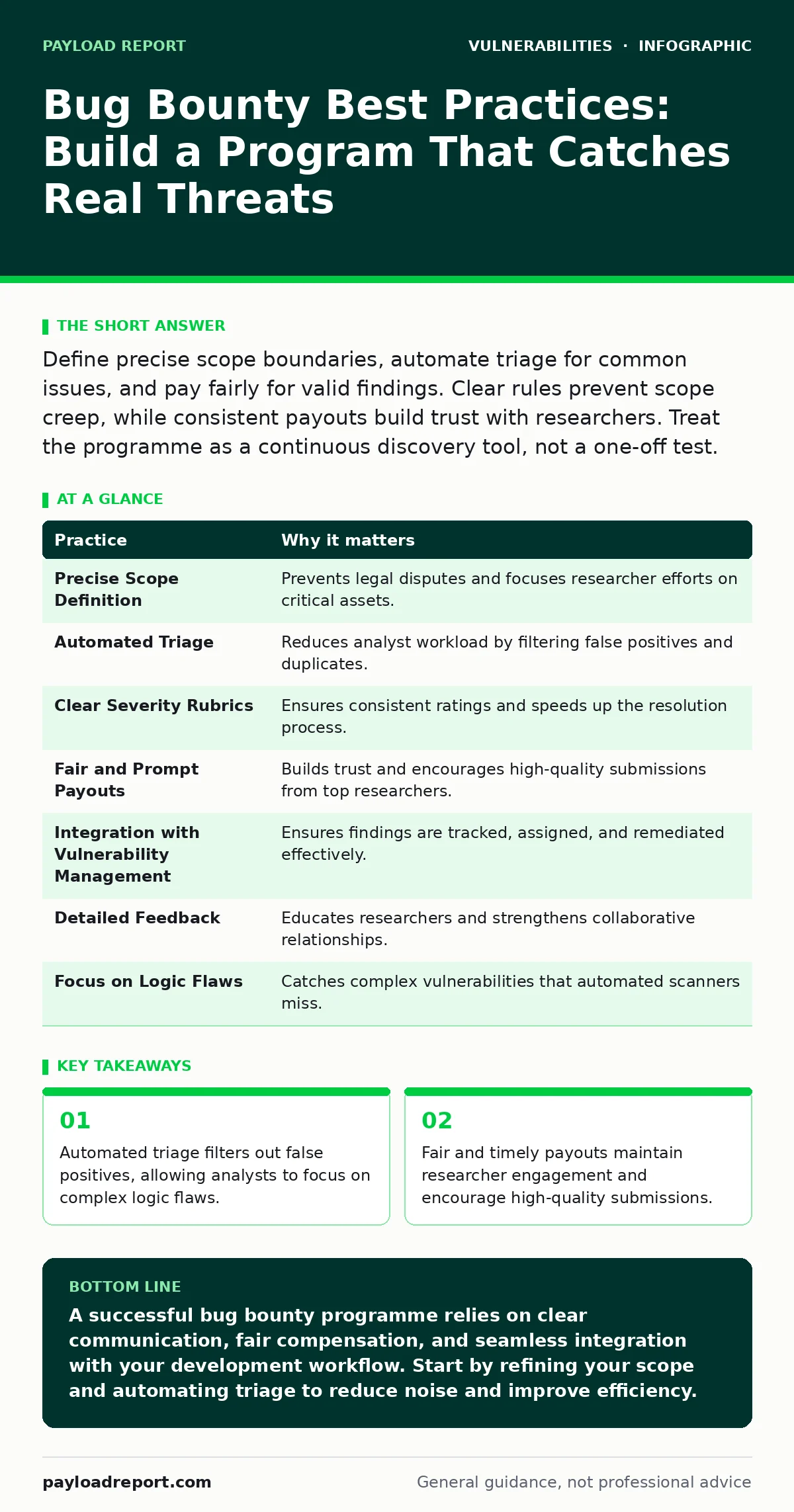
Define precise scope boundaries, automate triage for common issues, and pay fairly for valid findings. Clear rules prevent scope creep, while consistent payouts build trust with researchers. Treat the programme as a continuous discovery tool, not a one-off test.
1. Define Scope with Surgical Precision
Vague scope definitions invite confusion and legal disputes. If you list an entire domain without excluding administrative panels or third-party integrations, researchers may inadvertently disrupt production services. This creates friction between your operations team and the security community. Clear boundaries tell researchers exactly where to look and where to stay away.
You must distinguish between in-scope assets, out-of-scope assets, and excluded vulnerability classes. This clarity protects your infrastructure from accidental damage during testing. It also ensures that researchers focus their efforts on the most valuable targets.
- List every subdomain and API endpoint explicitly.
- Exclude non-critical environments like staging or development servers unless specifically tested.
- State clearly which vulnerability types are out of scope, such as low-impact SEO issues.
2. Automate Initial Triage and Filtering
Human analysts cannot manually verify every submission. Without automation, your team will drown in duplicate reports and false positives. Automated tools can instantly check if a reported vulnerability is already known or if it fails basic validation criteria. This frees your human experts to investigate complex issues that require deep contextual understanding.
Integrate your bounty platform with your existing ticketing system and vulnerability scanning tools. This creates a seamless workflow where obvious issues are closed automatically. It reduces the mean time to triage and prevents analyst burnout.
3. Establish Clear Severity Rubrics
Disputes over severity ratings cause delays and dissatisfaction. If your internal team rates a vulnerability as low while the researcher argues for critical, the process stalls. A predefined rubric based on industry standards like CVSS ensures consistency. It removes subjective arguments and speeds up the resolution process.
Your rubric should account for context, not just technical severity. A vulnerability in a public-facing API may warrant a higher rating than the same flaw in an internal tool. Define clear criteria for impact, exploitability, and scope.
- Map CVSS scores to specific payout tiers.
- Include examples of edge cases in your policy documentation.
- Review and update the rubric annually to reflect new threat models.
4. Pay Fairly and Promptly
Delayed payouts erode trust and discourage high-quality submissions. Researchers are professionals who expect timely compensation for their work. If payment takes months, they will move to programmes with better operational hygiene. Fair compensation attracts top talent and encourages thorough testing.
Set realistic SLAs for validation and payment. Communicate these timelines clearly in your programme policy. If a delay is unavoidable, inform the researcher immediately. Transparency builds long-term relationships with the security community.
5. Integrate with Vulnerability Management
Bug findings should not live in isolation. If bounty reports are not integrated into your central vulnerability management system, they will be ignored. This leads to security regression testing failures, where fixes are overwritten by new code. Seamless integration ensures that bounty findings are tracked alongside other security issues.
Use APIs to sync data between your bounty platform and your ticketing system. Assign ownership of each finding to a specific development team. Track the remediation progress from discovery to deployment.
- Ensure every valid finding has a unique identifier in your tracking system.
- Link bounty reports to specific code commits for audit trails.
- Monitor remediation timelines to identify bottlenecks in your development process.
See also: Log Tampering: How Attackers Erase Their Footprints · Threat Intelligence Platforms: 8 FAQs Answered for Operational Use
6. Provide Detailed Feedback and Recognition
Researchers want to know how their findings were handled. Generic acknowledgements feel dismissive and reduce future engagement. Detailed feedback helps researchers improve their techniques and understand your architecture. Public recognition, such as hall of fame lists, adds social value to the financial reward.
Share technical details about how the vulnerability was fixed, without revealing sensitive information. This educational exchange strengthens the relationship between your team and the researcher. It turns a transactional interaction into a collaborative partnership.
- Publish anonymised case studies of interesting vulnerabilities.
- Offer private feedback on rejected reports to help researchers improve.
- Recognise top contributors in your company newsletter or blog.
7. Monitor for Logic Flaws and Business Logic Errors
Automated scanners miss business logic errors. These vulnerabilities often require human intuition to identify. For example, a scanner may not detect that a user can manipulate a transaction value by altering a hidden form field. Your programme must explicitly encourage testing for these complex issues.
Define business logic vulnerabilities in your scope. Provide examples of what you consider valid logic flaws. This guides researchers to look beyond standard technical vulnerabilities.
- Include examples of price manipulation, privilege escalation, and workflow bypasses.
- Encourage researchers to document the exact steps to reproduce logic flaws.
- Reward creative exploitation paths that demonstrate real-world impact.
8. Conduct Regular Programme Reviews
A bug bounty programme is not a set-and-forget solution. Your attack surface changes as you deploy new features and retire old ones. Regular reviews ensure that your scope, payouts, and policies remain relevant. Ignoring these updates leads to stale programmes that fail to detect new threats.
Review your programme metrics quarterly. Analyse the types of vulnerabilities found, the time to triage, and the satisfaction of researchers. Use this data to refine your approach.
- Compare bounty findings with results from penetration testing to identify gaps.
- Adjust payouts based on the current market rate and the complexity of findings.
- Update scope regularly to include new assets and exclude decommissioned ones.
| Practice | Why it matters |
|---|---|
| Precise Scope Definition | Prevents legal disputes and focuses researcher efforts on critical assets. |
| Automated Triage | Reduces analyst workload by filtering false positives and duplicates. |
| Clear Severity Rubrics | Ensures consistent ratings and speeds up the resolution process. |
| Fair and Prompt Payouts | Builds trust and encourages high-quality submissions from top researchers. |
| Integration with Vulnerability Management | Ensures findings are tracked, assigned, and remediated effectively. |
| Detailed Feedback | Educates researchers and strengthens collaborative relationships. |
| Focus on Logic Flaws | Catches complex vulnerabilities that automated scanners miss. |
| Regular Programme Reviews | Keeps the programme aligned with evolving business needs and threats. |
Key takeaways
- Automated triage filters out false positives, allowing analysts to focus on complex logic flaws.
- Fair and timely payouts maintain researcher engagement and encourage high-quality submissions.
A successful bug bounty programme relies on clear communication, fair compensation, and seamless integration with your development workflow. Start by refining your scope and automating triage to reduce noise and improve efficiency.
Frequently asked questions
How do I handle duplicate submissions?
Award the full payout to the first valid submission and offer partial credit or recognition to subsequent reporters. This encourages speed without penalising later discoveries.
Should I include third-party dependencies in my scope?
Generally, no. Focus on code and infrastructure you control. Including third-party libraries shifts responsibility and complicates remediation.
How do I prevent scope creep?
Define explicit boundaries and update them only through formal change requests. Communicate any changes clearly to all active researchers.
What if a researcher discloses a vulnerability publicly before I fix it?
Have a clear policy on responsible disclosure. Offer safe harbour provisions to protect researchers who follow your guidelines, and address breaches firmly.
How this guide was produced: written by the Payload Report editorial team with AI assistance, checked against the public references listed below, and reviewed when the facts change. See our editorial policy or report an error.