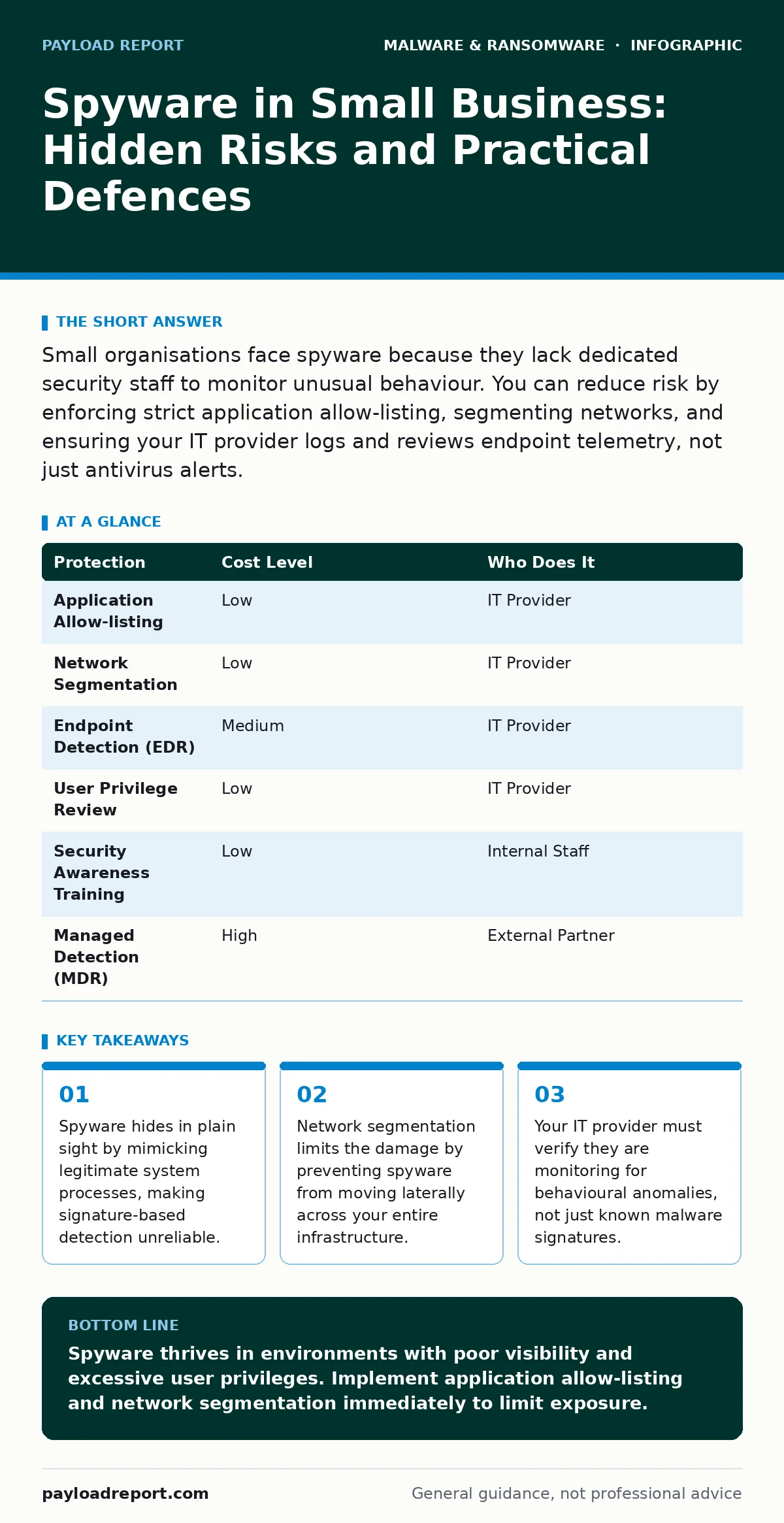
Small organisations face spyware because they lack dedicated security staff to monitor unusual behaviour. You can reduce risk by enforcing strict application allow-listing, segmenting networks, and ensuring your IT provider logs and reviews endpoint telemetry, not just antivirus alerts.
The Ten-Person Trap
Small organisations are exposed not because they are careless, but because they are invisible. Large corporations are obvious targets for high-profile attacks, so attackers often pivot to smaller entities where security controls are weaker and detection is slower. You likely rely on a single IT provider or a generalist administrator. This person manages servers, helps with printer issues, and resets passwords. They do not have the bandwidth to hunt for stealthy threats that leave no trace on a traditional antivirus dashboard.
Spyware differs from ransomware in its goal. Ransomware demands payment for access; spyware demands silence while it steals. It records keystrokes, captures screenshots, and exfiltrates data over long periods. The danger is the delay. By the time you notice a performance dip or a strange network connection, the attacker may have already copied your financial records or intellectual property.
Why Standard Defences Fail
Most small businesses rely on a perimeter firewall and a basic antivirus solution. This approach assumes that threats come from outside and look like known bad files. Spyware often arrives through legitimate channels. It might be bundled with software you intentionally installed, or it might exploit a vulnerability in a web browser you use daily. This is known as a supply chain compromise.
When spyware executes, it often uses living-off-the-land techniques. It uses built-in system tools, such as PowerShell or Windows Management Instrumentation, to perform its tasks. These tools are necessary for your IT staff to manage the network, so security software cannot simply block them. The spyware blends in with normal administrative activity. This makes the usual advice of "keep your software updated" insufficient. Updates fix known holes, but they do not stop an attacker from abusing legitimate tools.
You must assume that your perimeter has been breached. The goal shifts from keeping attackers out to detecting what they do once inside. This requires monitoring behaviour, not just file signatures. If a legitimate font manager suddenly starts sending large amounts of encrypted data to an unknown server, that is a behavioural anomaly. Standard antivirus often ignores this because the file itself is signed and trusted.
Low-Cost Protective Measures
You do need expensive enterprise software to improve your posture. Several low-cost measures significantly raise the barrier for spyware. The most effective is application allow-listing. This security mechanism permits only pre-approved software to run on your devices. Any program not on the list is blocked, regardless of whether it looks malicious. This stops spyware from executing even if it bypasses your email filters.
Network segmentation is another critical step. You should divide your network into separate zones. Your finance team’s devices should not have direct access to the engineering servers. If spyware infects a marketing laptop, segmentation prevents it from reaching your core database. This limits the blast radius. You can achieve basic segmentation using VLANs on your existing router, which costs nothing but configuration time.
Finally, enforce least privilege. Users should not have administrator rights on their daily drivers. Spyware often requires elevated privileges to install itself deeply into the operating system. If the user account is standard, the spyware cannot modify system files or install keyloggers. This simple change stops many persistent threats in their tracks. It may frustrate users who want to install their own apps, but it is a necessary trade-off for security.
Understanding Endpoint Detection
Traditional antivirus looks for known bad patterns. Endpoint Detection and Response (EDR) looks for suspicious behaviour. EDR agents record system calls, process creations, and network connections. They build a timeline of activity on the device. When an anomaly occurs, such as a script launching from a temporary folder, the EDR alerts you.
For small teams, managing EDR alerts can be overwhelming. You may not have the skill to distinguish between a false positive and a real threat. This is where the choice of IT provider becomes critical. You need a partner who can interpret these signals. Without analysis, EDR is just noise. With it, you gain visibility into the hidden activities of spyware.
What to Ask Your IT Provider
Your IT provider is your first line of defence. You must verify that their services include proactive threat hunting, not just reactive fixes. Do not accept vague assurances. Ask specific questions about their monitoring capabilities and response procedures.
- Do you use allow-listing or block-listing for application control?
- How do you detect threats that do not have a known signature?
- What is your process for investigating unusual network traffic?
- Do you segment the network to isolate critical assets?
- How quickly can you isolate an infected device from the network?
- Do you provide regular reports on security posture, not just uptime?
If the provider cannot answer these questions clearly, they are likely not equipped to handle spyware. You need a partner who understands that security is an ongoing process, not a product you install and forget.
See also: Potentialy Unwanted Programs: Response and Recovery Steps · Golden Image Mistakes That Let Malware Persist in Your Fleet
Protection Strategy Overview
| Protection | Cost Level | Who Does It |
|---|---|---|
| Application Allow-listing | Low | IT Provider |
| Network Segmentation | Low | IT Provider |
| Endpoint Detection (EDR) | Medium | IT Provider |
| User Privilege Review | Low | IT Provider |
| Security Awareness Training | Low | Internal Staff |
| Managed Detection (MDR) | High | External Partner |
Beyond Basic Security
Spyware often works in tandem with other threats. For example, an attacker might use spyware to gather credentials and then deploy ransomware. Understanding the ransomware attack chain helps you see how data theft precedes encryption. Similarly, screen locker ransomware variants may use spyware to verify that the victim has valuable data before locking them out.
You should also be aware of potentially unwanted programs. These are not strictly malicious, but they often include adware or tracking components that can be exploited by spyware. Crypto-stealing malware is a specific type of spyware that targets wallet files and clipboard data. Keyloggers are the most common tool used by spyware to capture credentials. Each of these represents a different facet of the same problem: unauthorised data access.
Maintaining Vigilance
Security is not a destination. It is a continuous cycle of assessment and improvement. You must regularly review your allow-lists and network segments. New software is added, and new threats emerge. Your IT provider should conduct periodic reviews of your security settings.
Do not rely on a single layer of defence. Spyware is designed to bypass one control. By stacking multiple controls, you force the attacker to overcome each hurdle. This increases their effort and reduces their chance of success. You cannot stop every attack, but you can make your organisation a difficult target.
Key takeaways
- Spyware hides in plain sight by mimicking legitimate system processes, making signature-based detection unreliable.
- Network segmentation limits the damage by preventing spyware from moving laterally across your entire infrastructure.
- Your IT provider must verify they are monitoring for behavioural anomalies, not just known malware signatures.
Spyware thrives in environments with poor visibility and excessive user privileges. Implement application allow-listing and network segmentation immediately to limit exposure.
Frequently asked questions
Can spyware survive a operating system reinstall?
If the spyware has access to your backup drives or cloud storage, it can reinfect your system after a reinstall. Ensure backups are isolated and scanned before restoration.
Is cloud storage safe from spyware?
Cloud storage is not immune. If spyware captures your credentials, it can access your cloud data directly. Use multi-factor authentication to protect these accounts.
How do I know if I have spyware?
Look for unusual network traffic, unexpected battery drain, or strange system behaviour. However, spyware is designed to be invisible, so rely on EDR tools for detection.
Should I use a VPN for protection?
A VPN encrypts your traffic, but it does not stop spyware from running on your device. If your device is infected, the spyware sends encrypted data through the VPN.
How this guide was produced: written by the Payload Report editorial team with AI assistance, checked against the public references listed below, and reviewed when the facts change. See our editorial policy or report an error.