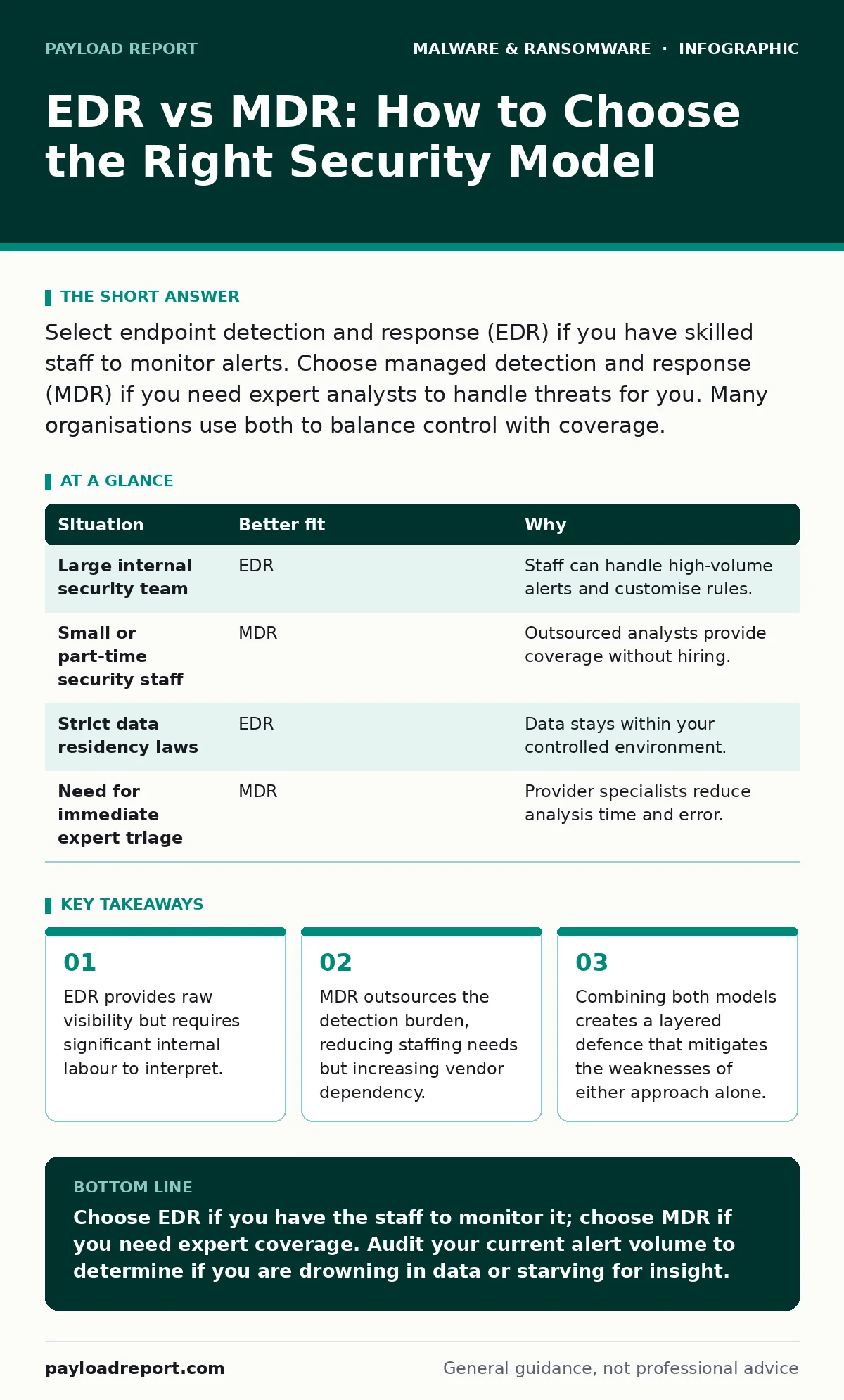
Select endpoint detection and response (EDR) if you have skilled staff to monitor alerts. Choose managed detection and response (MDR) if you need expert analysts to handle threats for you. Many organisations use both to balance control with coverage.
Do you have analysts available around the clock?
Endpoint detection and response (EDR) tools collect telemetry from devices. They do not automatically fix problems. You must have staff ready to investigate alerts as they happen. If your security team works standard hours, threats emerging at night will sit unaddressed until morning. This delay allows malware to spread.
Managed detection and response (MDR) includes a team of analysts who watch your environment continuously. They triage alerts and respond to incidents while you sleep. This model shifts the labour burden from your internal staff to the provider. You gain coverage without hiring more people.
Can your staff interpret complex alert data?
EDR generates high volumes of data. Not every alert represents a real threat. Many are false positives caused by normal software behaviour. Distinguishing noise from genuine attacks requires experience. Junior staff may struggle to identify subtle indicators of compromise.
MDR providers employ specialists who understand attack patterns. They apply context to the data your endpoints send. This expertise reduces the cognitive load on your team. You receive concise reports on actual threats rather than raw logs. This allows your staff to focus on strategy rather than triage.
Suppose your team is small and generalist. They may miss sophisticated attacks that blend in with normal traffic. An MDR provider acts as an extension of your team, bringing specialised knowledge that is hard to hire locally.
How fast must you contain an active threat?
Speed matters when malware is executing. Computer viruses can replicate quickly. Screen locker ransomware encrypts files in minutes. The time between detection and containment determines the damage. EDR tools can isolate devices automatically, but only if rules are configured correctly. Misconfigured rules may block legitimate work.
MDR services often include automated response playbooks. These playbooks trigger actions based on confirmed threats. The provider handles the technical steps to isolate or remediate. This reduces the mean time to respond. Your team gains time to assess the broader impact.
What is your risk tolerance for vendor dependency?
Using MDR means trusting a third party with your data. They see your network traffic and file activities. This raises privacy concerns. You must ensure the provider complies with relevant data protection standards. A breach at the provider could expose your sensitive information.
EDR keeps data within your control. You decide who accesses the logs. This reduces external risk but increases internal responsibility. You must secure your own storage and access controls. If your internal security is weak, keeping data local offers little protection.
| Situation | Better fit | Why |
|---|---|---|
| Large internal security team | EDR | Staff can handle high-volume alerts and customise rules. |
| Small or part-time security staff | MDR | Outsourced analysts provide coverage without hiring. |
| Strict data residency laws | EDR | Data stays within your controlled environment. |
| Need for immediate expert triage | MDR | Provider specialists reduce analysis time and error. |
See also: Honeytokens: Silent Traps for Insider Threats and Breaches · Purple Teaming FAQs: How to Run Effective Security Tests
When does combining both models make sense?
Using both EDR and MDR is not redundant. It creates depth. EDR provides the sensors and local control. MDR provides the brain and continuous monitoring. This hybrid approach balances autonomy with expertise. You retain control over local actions while benefiting from global threat intelligence.
Imagine a scenario where a keylogger is detected. The EDR tool isolates the device immediately. The MDR team investigates the source and checks for lateral movement. They then advise on long-term remediation. This combines speed with depth. It addresses the immediate threat and the underlying cause.
This model also protects against vendor failure. If the MDR provider misses a threat, your EDR logs provide evidence. If your internal team is overwhelmed, the MDR team steps in. It adds resilience to your security posture. You are not reliant on a single point of failure.
Consider how this fits with other threats. Android malware often bypasses traditional desktop controls. Crypto-stealing malware targets specific wallets. Potentially unwanted programs may not trigger high-priority alerts. A combined approach ensures that diverse threats receive appropriate attention. It covers the gaps that a single solution might leave open.
Key takeaways
- EDR provides raw visibility but requires significant internal labour to interpret.
- MDR outsources the detection burden, reducing staffing needs but increasing vendor dependency.
- Combining both models creates a layered defence that mitigates the weaknesses of either approach alone.
Choose EDR if you have the staff to monitor it; choose MDR if you need expert coverage. Audit your current alert volume to determine if you are drowning in data or starving for insight.
Frequently asked questions
Can I switch from EDR to MDR later?
Yes, most MDR providers can integrate with existing EDR sensors. You do not need to replace your hardware.
Does MDR replace my security team?
No, it augments your team by handling routine detection. Your staff still manages strategy and local policies.
Is MDR more expensive than EDR?
MDR often has higher subscription costs but saves on hiring and training expenses. The total cost depends on your team size.
How do I verify MDR provider quality?
Check their response times and analyst qualifications. Ask for sample reports to see the depth of their analysis.
How this guide was produced: written by the Payload Report editorial team with AI assistance, checked against the public references listed below, and reviewed when the facts change. See our editorial policy or report an error.