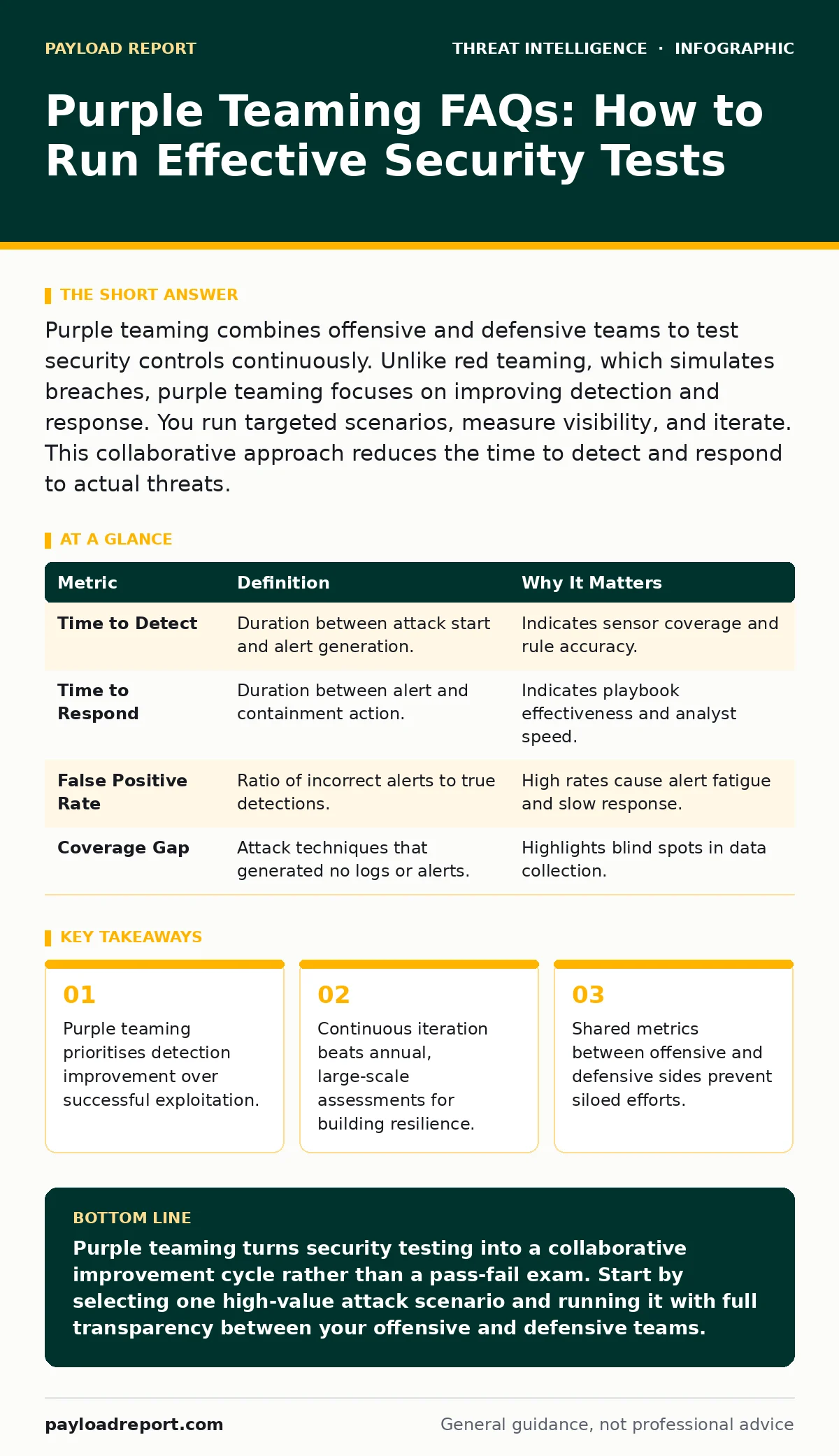
Purple teaming combines offensive and defensive teams to test security controls continuously. Unlike red teaming, which simulates breaches, purple teaming focuses on improving detection and response. You run targeted scenarios, measure visibility, and iterate. This collaborative approach reduces the time to detect and respond to actual threats.
What is purple teaming?
Purple teaming is a collaborative security exercise where offensive and defensive teams work together to improve an organisation’s security posture. Unlike traditional penetration testing, which ends with a report, purple teaming is an iterative process focused on detection and response capabilities. You run a specific attack scenario, the defensive team attempts to detect it, and then both teams review the results to tune controls. This cycle repeats until the organisation can reliably detect and mitigate that specific threat vector.
How does purple teaming differ from red teaming?
Red teaming simulates a full-scale adversary to test the organisation’s overall resilience, often operating in secrecy to surprise defenders. Purple teaming is transparent and collaborative, with the offensive side acting as a coach rather than a hidden adversary. The goal of red teaming is to find a path to the crown jewels; the goal of purple teaming is to ensure the sensors and responders catch that path. Red teaming answers "Can we be breached?", while purple teaming answers "Do we see the breach happening?"
Who participates in a purple team?
A purple team consists of members from both the offensive security group and the security operations centre. The offensive members design and execute attack simulations based on realistic threats. The defensive members monitor logs, alerts, and network traffic to identify the activity. Both sides must have equal standing in the room to ensure honest feedback. You need engineers who understand the tools and analysts who understand the business context to make the exercise valuable.
What scenarios should you prioritise?
You should prioritise scenarios that reflect the tactics, techniques, and procedures used by threat actors targeting your industry. Avoid generic scans and focus on complex, multi-stage attacks that bypass basic perimeter controls. For example, testing how your systems handle pass-the-hash attacks reveals weaknesses in identity management and lateral movement detection. You might also evaluate how well your environment detects process injection techniques, which often evade signature-based antivirus. These scenarios test the depth of your monitoring rather than the strength of your firewall.
How do you measure success?
Success is measured by the reduction in mean time to detect and mean time to respond to specific attack patterns. You track whether the defensive team noticed the activity during the exercise and how quickly they escalated it. If the team missed the attack, you measure how long it took to find the evidence in the logs after the fact. The metric is not whether the attacker succeeded, but whether the defenders gained the ability to see it next time. This shifts the focus from blame to capability improvement.
| Metric | Definition | Why It Matters |
|---|---|---|
| Time to Detect | Duration between attack start and alert generation. | Indicates sensor coverage and rule accuracy. |
| Time to Respond | Duration between alert and containment action. | Indicates playbook effectiveness and analyst speed. |
| False Positive Rate | Ratio of incorrect alerts to true detections. | High rates cause alert fatigue and slow response. |
| Coverage Gap | Attack techniques that generated no logs or alerts. | Highlights blind spots in data collection. |
See also: Endpoint Detection and Response (EDR): How It Works and Why You Need It · EDR vs MDR: How to Choose the Right Security Model
What are the common pitfalls?
A major pitfall is treating purple teaming as a one-off project rather than a continuous practice. Security controls change, software updates, and new vulnerabilities emerge, rendering previous tests obsolete. Another failure point is the lack of trust between teams, where defenders hide their mistakes to avoid criticism. You must create a blame-free environment where finding a gap is celebrated as an opportunity to improve. Without psychological safety, the feedback loop breaks, and the exercise becomes a performance rather than a learning tool.
How does threat intelligence inform these tests?
Threat intelligence platforms provide context on which adversaries are active and what tools they are using. You use this intelligence to select attack scenarios that are relevant to your current risk environment. For instance, if intelligence indicates a rise in initial access brokers targeting your sector, you might simulate their specific phishing or credential harvesting techniques. This ensures your tests are not abstract exercises but reflections of real-world pressure. You can also consult ISACs to understand sector-specific trends and adjust your testing focus accordingly.
How do you handle sensitive data during tests?
You must establish strict rules of engagement that define what systems can be tested and what data cannot be touched. Live production data should never be used in attack simulations unless absolutely necessary and fully sanitised. Instead, use synthetic data or isolated test environments that mirror production configurations. This prevents accidental data corruption or privacy violations. Clearly document these boundaries and have both teams sign off on them before any activity begins. This legal and operational clarity allows the offensive team to push boundaries without risking business continuity.
How does this relate to the deep web?
While the deep web contains hidden services and data, purple teaming focuses on your internal visibility. However, understanding how adversaries operate in hidden spaces can inform your detection strategies. You might simulate how an attacker would use encrypted channels or hidden services to exfiltrate data. This tests your network monitoring capabilities for unusual outbound traffic patterns. By modelling these external threats internally, you ensure your defences are ready for sophisticated, covert operations.
Key takeaways
- Purple teaming prioritises detection improvement over successful exploitation.
- Continuous iteration beats annual, large-scale assessments for building resilience.
- Shared metrics between offensive and defensive sides prevent siloed efforts.
Purple teaming turns security testing into a collaborative improvement cycle rather than a pass-fail exam. Start by selecting one high-value attack scenario and running it with full transparency between your offensive and defensive teams.
Frequently asked questions
How often should we run purple teaming exercises?
Run them continuously, focusing on one or two specific techniques per month. This allows for rapid iteration and tuning of detection rules without overwhelming the security operations centre.
Do we need dedicated purple team members?
No, existing red and blue team members can rotate into purple team roles. The key is the mindset shift from adversarial to collaborative, not necessarily new headcount.
Can purple teaming replace penetration testing?
No, it complements it. Penetration testing validates control strength at a point in time, while purple teaming validates detection and response capabilities over time.
How do we start if we have no offensive team?
Partner with external consultants who specialise in collaborative testing. Ensure they are willing to share their methodology and work transparently with your internal defenders.
How this guide was produced: written by the Payload Report editorial team with AI assistance, checked against the public references listed below, and reviewed when the facts change. See our editorial policy or report an error.