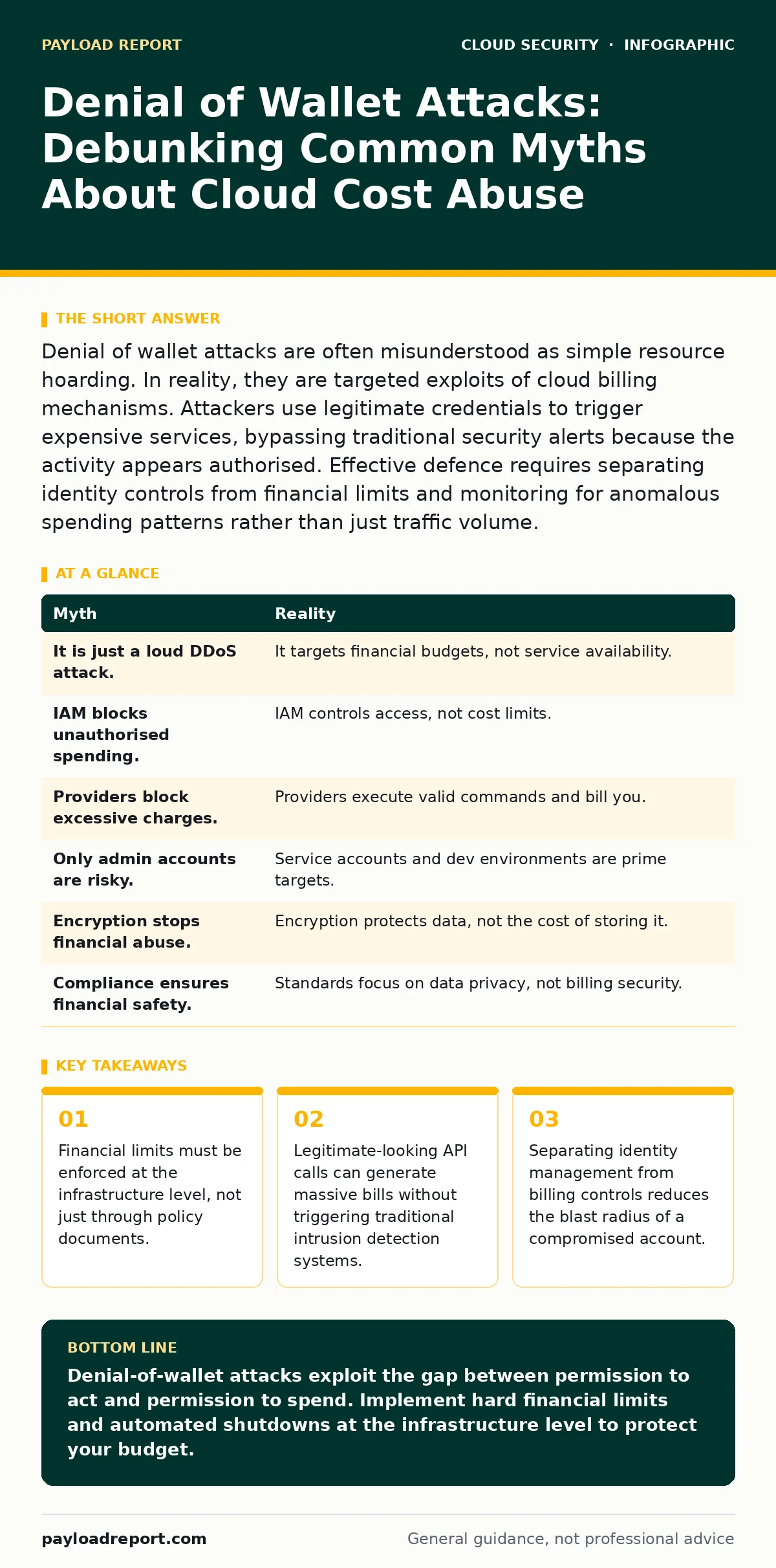
Denial of wallet attacks are often misunderstood as simple resource hoarding. In reality, they are targeted exploits of cloud billing mechanisms. Attackers use legitimate credentials to trigger expensive services, bypassing traditional security alerts because the activity appears authorised. Effective defence requires separating identity controls from financial limits and monitoring for anomalous spending patterns rather than just traffic volume.
Myth: Denial of wallet is just a louder version of denial of service
Reality: This belief conflates two distinct attack vectors with different goals and mechanics. A traditional denial-of-service attack aims to exhaust server resources, making a service unavailable to legitimate users. A denial-of-wallet attack aims to exhaust the victim’s financial budget, leaving the service available but financially crippling the organisation.
The attacker does not care if your website remains online. They care that every request you process incurs a cost that you, not they, must pay. This distinction matters because your monitoring tools are likely tuned for traffic spikes, not billing anomalies.
Imagine a botnet sending low-volume requests to a cloud function that processes heavy data. The traffic looks normal to your firewall. The compute time, however, accumulates rapidly. By the time your security team notices the latency, the bill has already grown.
Myth: Identity and access management stops all unauthorised spending
Reality: Identity and access management (IAM) controls who can access resources, but it does not inherently control how much those resources cost. An attacker who compromises a valid IAM credential inherits the permissions of that identity. If that identity has permission to launch large instances or run expensive data transfers, the IAM system considers this a legitimate action.
The gap exists because security teams often focus on least privilege for data access, neglecting least privilege for compute and storage costs. An account with read-only access to a database is secure from data theft but may still have the permission to spin up a thousand virtual machines if not explicitly restricted.
This is where the separation of duties becomes critical. You need a layer that says "you can launch this instance, but only up to this cost limit." Without that specific constraint, IAM is a key to the door, not a limiter of what happens inside the room.
For deeper context on managing these permissions, refer to the principles outlined in our guide on identity and access management. It details how granular permission sets can reduce the impact of a credential compromise.
Myth: Cloud providers will automatically block excessive charges
Reality: Cloud providers operate on a trust model where they execute the commands authorised by your credentials. They do not act as financial gatekeepers for individual accounts. If your credentials allow a service to run, the provider will run it and send you the bill.
Some providers offer safety limits for new accounts, but these are often low and can be raised easily. Once an account is established, or if an attacker uses a compromised account with a history of high spending, these automatic blocks rarely trigger. The provider sees a valid customer performing valid actions.
Assuming the cloud provider will save you from a massive bill is a dangerous strategy. You must implement your own hard limits. This means setting budget alerts that trigger automated shutdowns or credential revocation when spending exceeds a threshold.
Myth: Only high-privilege accounts are at risk
Reality: Attackers often target service accounts or development environments because they are less monitored than production administrative accounts. A service account used for automated backups might have broad permissions to create storage buckets. If an attacker compromises this account, they can fill those buckets with data, incurring massive egress fees when they exfiltrate it.
These accounts are often overlooked in security audits because they do not have human users logging in. They run in the background, and their activity blends into normal operational noise. This makes them prime targets for denial-of-wallet attacks.
The assumption that only admins matter is a blind spot. Every account with the ability to create or consume resources is a potential vector for financial loss. You must audit the permissions of service accounts with the same rigour as human user accounts.
Myth: Encryption prevents financial abuse
Reality: Encryption protects the confidentiality and integrity of data, but it does not prevent the creation of encrypted data. An attacker can generate random data, encrypt it, and store it in your cloud environment. The cost comes from the storage and the compute power used to encrypt and transfer the data, not from the content of the data itself.
Even if you cannot read the attacker’s data, you still pay for the space it occupies and the bandwidth it consumes. Encryption adds a layer of security for privacy, but it adds no layer of protection against resource exhaustion or billing fraud.
This misconception leads teams to believe that securing data content is sufficient. It is not. You must monitor the volume and velocity of data creation, regardless of whether that data is encrypted or plaintext.
See also: Identity and Access Management Best Practices for Secure Cloud Infrastructure · Secure Access Service Edge for Small Teams: A Practical Setup
Myth: Compliance frameworks cover financial security risks
Reality: Standards like ISO 27001 or SOC 2 focus heavily on data privacy, availability, and access control. They rarely include specific controls for financial abuse or billing security. Passing a compliance audit does not mean your cloud environment is protected against denial-of-wallet attacks.
Compliance frameworks are often backward-looking, assessing whether policies exist and are followed. They do not typically test whether those policies prevent an attacker from draining your budget. A compliant system can still be financially vulnerable.
You need to go beyond compliance. Implement specific financial controls that are not part of standard security audits. This includes regular reviews of billing permissions and the implementation of hard spending limits at the infrastructure level.
For a broader view of regulatory requirements, see our guide on cloud compliance. It explains how to align security practices with legal obligations, though it also highlights where financial risks fall outside standard scope.
Myth: Containerised environments are immune to cost abuse
Reality: Containers run on infrastructure that incurs costs. If an attacker gains control of a container, they can exploit the underlying host or the container orchestration platform to launch expensive resources. Misconfigurations in container security can lead to both data breaches and financial loss.
Kubernetes clusters, for example, can be abused to request excessive CPU or memory, or to initiate data exfiltration that triggers high egress fees. The ephemeral nature of containers can also make it difficult to trace the source of the abuse.
Securing containers requires more than just patching images. You must enforce resource limits and network policies that prevent containers from consuming unlimited resources or communicating with external endpoints in a way that generates high costs.
Refer to our guide on Kubernetes security basics for an overview of securing container orchestration. Additionally, the Pod Security Standards provide specific guidelines for preventing privilege escalation within containers, which can indirectly mitigate some financial risks.
| Myth | Reality |
|---|---|
| It is just a loud DDoS attack. | It targets financial budgets, not service availability. |
| IAM blocks unauthorised spending. | IAM controls access, not cost limits. |
| Providers block excessive charges. | Providers execute valid commands and bill you. |
| Only admin accounts are risky. | Service accounts and dev environments are prime targets. |
| Encryption stops financial abuse. | Encryption protects data, not the cost of storing it. |
| Compliance ensures financial safety. | Standards focus on data privacy, not billing security. |
Key takeaways
- Financial limits must be enforced at the infrastructure level, not just through policy documents.
- Legitimate-looking API calls can generate massive bills without triggering traditional intrusion detection systems.
- Separating identity management from billing controls reduces the blast radius of a compromised account.
Denial-of-wallet attacks exploit the gap between permission to act and permission to spend. Implement hard financial limits and automated shutdowns at the infrastructure level to protect your budget.
Frequently asked questions
How do I detect a denial-of-wallet attack in real-time?
Monitor for sudden spikes in resource creation, data egress, or compute usage that deviate from baseline patterns. Integrate billing metrics into your security information and event management system.
Can I use a cloud access security broker (CASB) to prevent these attacks?
A CASB can help monitor and control cloud usage, but it must be configured with specific financial policies. It is not a silver bullet and requires careful tuning to distinguish between legitimate surges and attacks.
What is the first step to securing my cloud environment financially?
Audit all IAM roles and service accounts to ensure they have the minimum necessary permissions. Then, implement hard spending limits and automated alerts for all accounts.
Do exposed Docker APIs increase the risk of denial-of-wallet?
Yes, exposed APIs can allow attackers to directly control container creation and resource allocation, leading to rapid cost accumulation. Ensure these APIs are never exposed to the public internet.
How this guide was produced: written by the Payload Report editorial team with AI assistance, checked against the public references listed below, and reviewed when the facts change. See our editorial policy or report an error.