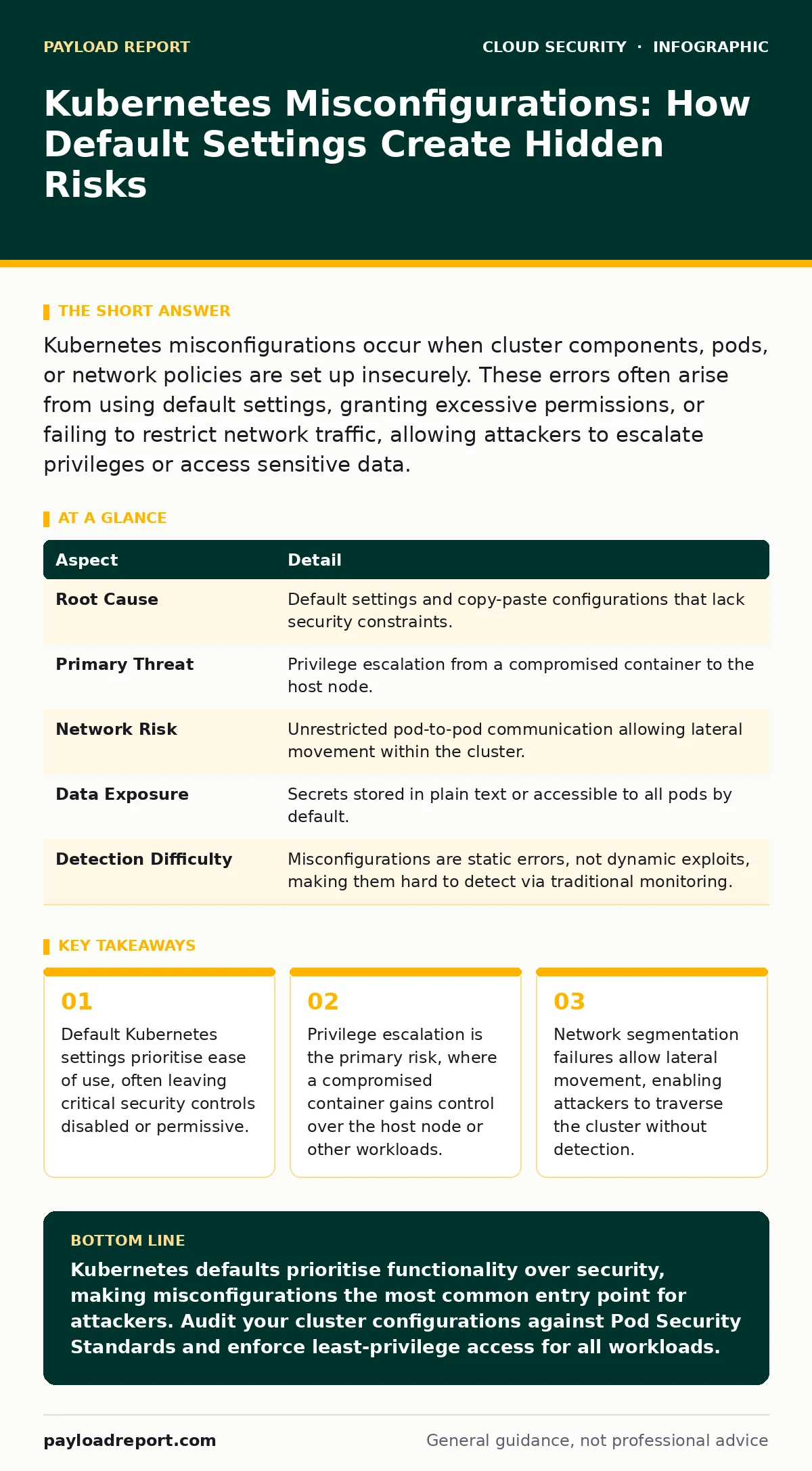
Kubernetes misconfigurations occur when cluster components, pods, or network policies are set up insecurely. These errors often arise from using default settings, granting excessive permissions, or failing to restrict network traffic, allowing attackers to escalate privileges or access sensitive data.
The Open Door Analogy
Imagine a high-security warehouse where every employee has a master key to every room. The system works efficiently for daily operations, but if a single key is stolen, the thief can access the server room, the cash vault, and the executive offices. Kubernetes clusters often resemble this warehouse. By default, the platform is designed for developer velocity and operational simplicity, not security isolation. This design choice means that the path of least resistance usually leads to an insecure state.
You are not fighting a broken lock. You are fighting a design that assumes trust. When you deploy a workload, the platform expects you to explicitly define what it can and cannot do. If you do not define these boundaries, the platform assumes the workload needs everything. This assumption is the root of most misconfigurations.
At a Glance: Misconfiguration Risks
| Aspect | Detail |
|---|---|
| Root Cause | Default settings and copy-paste configurations that lack security constraints. |
| Primary Threat | Privilege escalation from a compromised container to the host node. |
| Network Risk | Unrestricted pod-to-pod communication allowing lateral movement within the cluster. |
| Data Exposure | Secrets stored in plain text or accessible to all pods by default. |
| Detection Difficulty | Misconfigurations are static errors, not dynamic exploits, making them hard to detect via traditional monitoring. |
How Defaults Create Vulnerabilities
Kubernetes is complex. It manages thousands of components, from the API server to etcd, the distributed key-value store that holds the cluster state. Configuring each component securely requires deep knowledge. Most organisations do not have this expertise in-house. Instead, they rely on automated tools or tutorials that prioritise getting the cluster running over securing it.
The danger lies in the silence. A misconfigured cluster does not crash. It does not throw errors. It simply operates with wider permissions than necessary. You might deploy a database pod that can read all secrets in the namespace, or a web server that can modify system-level kernel parameters. These errors are invisible until an attacker exploits them.
Common Forms of Misconfiguration
The most frequent error is running containers as the root user. Root users have unrestricted access to the container’s filesystem and processes. This practice ignores the principle of least privilege, which states that every entity should operate with the minimum permissions necessary to perform its function. When a container runs as root, a breach in the application layer becomes a breach of the container layer.
Another common failure is insecure network policies. By default, Kubernetes allows all pods to communicate with all other pods. This flat network topology means that if one pod is compromised, the attacker can scan and attack every other service in the cluster. You must define network policies to restrict traffic to only what is strictly required. Without these policies, the cluster acts as a wide-open arena.
Secrets management is also frequently mishandled. Many teams store database passwords, API keys, and certificates in ConfigMaps or environment variables. These are stored in plain text within the cluster’s state. Any user with read access to the namespace can retrieve these secrets. You should use dedicated secrets management tools or Kubernetes Secrets with encryption at rest, though even Secrets are not encrypted by default in many installations.
The Privilege Escalation Path
Attackers rarely target the Kubernetes API server directly. It is well-defended and monitored. Instead, they look for the weakest link: a misconfigured pod. Once inside a pod, the goal is privilege escalation. This involves moving from a limited user context to a more powerful one, such as the host system or the cluster admin.
One vector for this is the use of hostPath volumes. These volumes mount a directory from the host node directly into the container. If a container mounts the host’s /etc/kubernetes directory, it can read the kubelet’s authentication tokens. These tokens allow the container to authenticate with the API server as the kubelet, a service account with high privileges. From here, the attacker can create new pods, deploy malicious workloads, or exfiltrate data.
See also: Exposed Docker APIs: Questions Asked, Answers Given · Early Warning Signs of Serverless Security Risks
What People Usually Get Wrong
Many teams believe that securing the perimeter is enough. They install a web application firewall and assume the internal cluster is safe. This is a fundamental misunderstanding of modern cloud architecture. In a containerised environment, the perimeter is porous. Attackers move laterally inside the network. You must assume that an attacker is already inside and plan your defences accordingly.
Another misconception is that using a managed Kubernetes service automatically secures the cluster. Managed services handle the control plane, which is the brain of the cluster. However, you are still responsible for the worker nodes, the pods, and the network policies. The provider secures the infrastructure, but you secure the configuration. Leaving these settings at default is a choice, not an accident.
You should also avoid relying solely on runtime protection tools. These tools detect anomalous behaviour, such as a process trying to access a file it shouldn’t. However, they cannot prevent a misconfiguration from existing. A pod with excessive permissions will not trigger an alert simply by having those permissions. It will only alert if it uses them. You need to audit configurations before deployment, not just monitor behaviour after the fact.
Reducing the Risk
The first step is to enforce policies as code. Define security standards in your infrastructure-as-code templates. Use tools that scan your configurations for known misconfigurations before they are applied to the cluster. This shifts security left, catching errors in the development phase rather than in production.
Implement Pod Security Standards to restrict what pods can do. These standards define three levels of restriction: baseline, restricted, and privileged. By enforcing the restricted profile, you prevent pods from running as root, mounting host paths, or using privileged capabilities. This creates a hard barrier against privilege escalation.
Regularly audit your network policies. Ensure that every pod has an explicit policy defining its allowed traffic. If a pod has no policy, it is likely accepting all traffic. Use network mapping tools to visualise the actual traffic flows and compare them against your intended architecture. This helps identify gaps where services are communicating unexpectedly.
Integrating with Broader Security
Securing Kubernetes does not happen in isolation. It must align with your broader security strategy. For instance, ensuring that your cloud compliance frameworks account for containerised workloads is necessary. Traditional compliance checks often miss the dynamic nature of containers. You need to adapt your audits to include cluster configurations and pod permissions.
Similarly, managing insecure container images is a prerequisite for secure configurations. Even with perfect cluster settings, a vulnerable image can be exploited. You must scan images for known vulnerabilities before deployment. Combining image security with configuration security creates a layered defence.
Finally, consider how Kubernetes security basics fit into your access management. Ensure that only authorised users can modify cluster settings. Implement role-based access control to limit who can deploy pods or change network policies. This reduces the risk of accidental misconfiguration by human error.
Key takeaways
- Default Kubernetes settings prioritise ease of use, often leaving critical security controls disabled or permissive.
- Privilege escalation is the primary risk, where a compromised container gains control over the host node or other workloads.
- Network segmentation failures allow lateral movement, enabling attackers to traverse the cluster without detection.
Kubernetes defaults prioritise functionality over security, making misconfigurations the most common entry point for attackers. Audit your cluster configurations against Pod Security Standards and enforce least-privilege access for all workloads.
Frequently asked questions
Does a managed Kubernetes service secure my workloads?
No. Managed services secure the control plane infrastructure, but you remain responsible for securing the worker nodes, pods, network policies, and application configurations.
How do I know if my pods are running as root?
You can check the pod specifications in your YAML files or use a Kubernetes dashboard to inspect the security context of each container. Tools like Falco or Trivy can also scan for this issue.
What is the principle of least privilege in Kubernetes?
It means granting each pod and service account only the permissions it strictly needs to function, such as limiting which APIs it can call or which files it can access.
Can network policies stop all attacks?
Network policies restrict traffic flow between pods, but they do not protect against vulnerabilities within the application code or compromised credentials. They are one layer of defence, not a complete solution.
How this guide was produced: written by the Payload Report editorial team with AI assistance, checked against the public references listed below, and reviewed when the facts change. See our editorial policy or report an error.