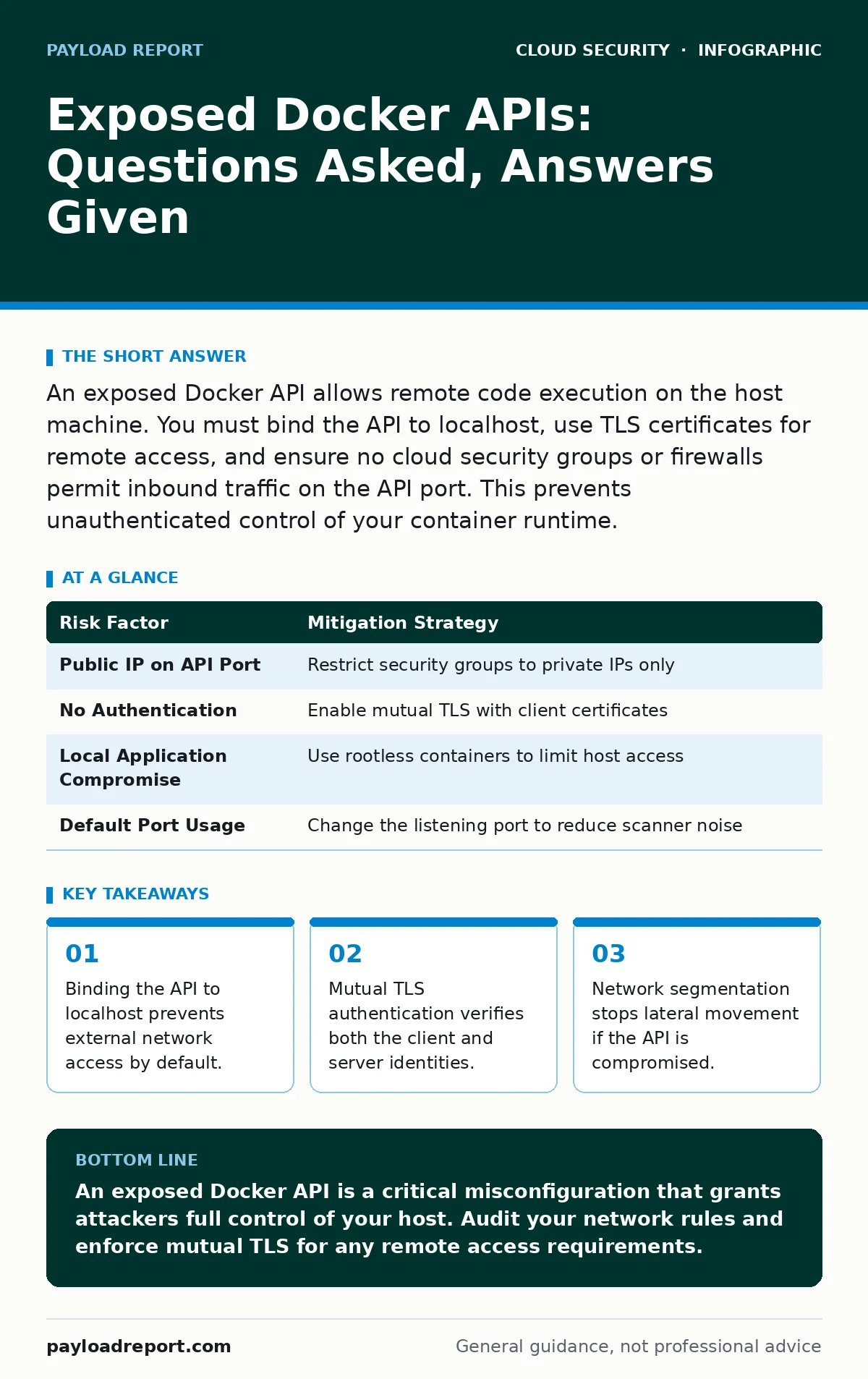
An exposed Docker API allows remote code execution on the host machine. You must bind the API to localhost, use TLS certificates for remote access, and ensure no cloud security groups or firewalls permit inbound traffic on the API port. This prevents unauthenticated control of your container runtime.
Does exposing the Docker API give attackers root access?
Yes, an unauthenticated Docker API grants full control over the container runtime, which effectively provides root access to the underlying host. The Docker daemon runs with high privileges to manage kernel namespaces and cgroups. When you send a request to create a container with a volume mount pointing to the host’s root filesystem, the attacker can read and write any file on the server. This bypasses traditional operating system user permissions entirely. The API does not distinguish between a legitimate administrator and a malicious script if no authentication is configured.
Why does binding to localhost not stop all attacks?
Binding the API to 127.0.0.1 restricts access to processes running on the same machine, but it does not protect against compromised local applications. If a web application running on that host suffers from a command injection vulnerability, an attacker can execute commands locally. Those commands can then interact with the Docker socket or API endpoint. The assumption that local binding equals safety fails when the host itself is breached. This is a common blind spot in server hardening strategies.
Can I use passwords to secure the Docker API?
No, the Docker API does not support password-based authentication for its REST endpoints. Passwords are weak for machine-to-machine communication because they are prone to interception and brute-force attacks. Instead, you must use Transport Layer Security with mutual authentication. This requires generating a Certificate Authority and issuing client certificates. The daemon verifies the client’s certificate before processing any request. This method is cryptographically stronger and aligns with standard infrastructure security practices.
What is the difference between the Unix socket and the TCP API?
The Unix socket is a local inter-process communication mechanism that does not traverse the network stack. It relies on file system permissions for access control. The TCP API listens on a network port, allowing remote connections from any device that can reach that port. Exposing the TCP API without mutual TLS is the primary cause of accidental public exposure. Many cloud instances have public IP addresses by default, making the TCP port visible to the internet if the firewall is misconfigured.
How do cloud security groups contribute to exposure?
Cloud providers use security groups as virtual firewalls that filter inbound and outbound traffic. A common misconfiguration is allowing inbound traffic from 0.0.0.0/0 on the Docker API port, often port 2375 or 2376. This rule makes the API accessible from any IP address on the internet. Even if the API uses TLS, an attacker can still enumerate containers and potentially exploit vulnerabilities in the container images. You must restrict inbound rules to specific trusted IP ranges or private subnets. This relates directly to broader issues of cloud compliance and network hygiene.
See also: Cloud Compliance Mistakes: Why Controls Fail and How to Fix Them · Cloud Access Security Brokers: 8 FAQs on Policy and Visibility
Is mutual TLS difficult to implement in production?
Implementing mutual TLS requires managing certificates, which adds operational overhead but is necessary for security. You need to generate a root certificate authority, server certificates, and client certificates. The Docker daemon must be configured to require client certificates for incoming connections. Clients must present their certificate and private key when making API calls. While this setup is more complex than leaving the API open, it ensures that only authorised entities can manage containers. Automated certificate management tools can reduce the manual effort involved.
Do container images affect API security?
The security of the container image does not mitigate the risk of an exposed API, but it affects the impact of a breach. If an attacker gains access to the API, they can pull and run arbitrary images. If those images contain vulnerabilities, the attacker can exploit them to escalate privileges. However, the primary risk is the API exposure itself, which allows the attacker to run any image they choose. Securing your insecure container images is a separate defence layer that reduces the attack surface once access is gained. It does not prevent the initial compromise of the daemon.
How does this relate to Kubernetes misconfigurations?
Kubernetes abstracts the Docker API, but misconfigurations in Kubernetes can still expose underlying container runtimes. If a Kubernetes node’s Docker API is exposed, an attacker can bypass Kubernetes’ admission controllers and RBAC policies. They can directly manipulate containers on that node, potentially escaping the pod sandbox. This highlights the importance of securing the host infrastructure, not just the orchestration layer. Understanding Kubernetes misconfigurations helps you see how host-level exposures undermine cluster-level security controls.
| Risk Factor | Mitigation Strategy |
|---|---|
| Public IP on API Port | Restrict security groups to private IPs only |
| No Authentication | Enable mutual TLS with client certificates |
| Local Application Compromise | Use rootless containers to limit host access |
| Default Port Usage | Change the listening port to reduce scanner noise |
Can I monitor for exposed Docker APIs?
Yes, you can monitor network traffic and configuration drift to detect exposure. Tools that inspect cloud security group changes can alert you when a port is opened to the public internet. Regular audits of Docker daemon configuration files ensure that binding addresses remain restricted. Integrating this monitoring with your identity and access management systems helps correlate API access with user identities. This proactive approach reduces the window of exposure when misconfigurations occur.
What if I need remote access for CI/CD pipelines?
Remote access for continuous integration and deployment requires secure tunnelling or authenticated API access. Do not expose the API directly to the internet. Instead, use a secure bastion host or a private link to connect the CI/CD server to the Docker host. Ensure the CI/CD service uses client certificates for mutual TLS authentication. This maintains the security boundary while allowing automation. It avoids the risk of exposing the API to the wider internet for the sake of convenience.
How does this impact serverless security risks?
Serverless architectures abstract away the container runtime, reducing the surface area for Docker API exposure. However, hybrid environments often mix serverless functions with traditional containers. If a serverless function interacts with a containerised service, the security of that service becomes part of the serverless trust chain. Exposing the Docker API of the backend service can compromise the entire workflow. Understanding serverless security risks helps you identify where traditional container management still applies in hybrid setups.
Are there alternatives to the Docker API?
Yes, higher-level orchestration platforms provide their own APIs that are more secure by design. Kubernetes, for example, uses RBAC and audit logging to control access to container operations. These platforms do not expose the raw container runtime API to end users. Migrating to such platforms reduces the risk of direct API exposure. However, the underlying nodes still require hardening to prevent local privilege escalation. This shift aligns with broader trends in secure access service edge (SASE) and zero-trust architectures.
How do I verify my API is not exposed?
You can verify exposure by attempting to connect to the API from an external network. Use a tool that checks for open ports on your public IP address. If the port responds, you are exposed. Additionally, review your cloud provider’s security group rules and host-based firewalls. Ensure that the Docker daemon configuration file specifies binding to localhost or a private IP. Regular automated checks should be part of your deployment pipeline to catch regressions.
Key takeaways
- Binding the API to localhost prevents external network access by default.
- Mutual TLS authentication verifies both the client and server identities.
- Network segmentation stops lateral movement if the API is compromised.
An exposed Docker API is a critical misconfiguration that grants attackers full control of your host. Audit your network rules and enforce mutual TLS for any remote access requirements.
Frequently asked questions
Can I use a password file for Docker API authentication?
No, the Docker API does not support password files. You must use mutual TLS with client certificates for authentication.
Does Docker Desktop expose the API by default?
Docker Desktop typically binds the API to localhost for security, but remote features may require explicit configuration.
How do I know if my Docker API is using TLS?
Check the Docker daemon configuration file for TLS settings and verify that client certificates are required.
Can a compromised container escape to the host via the API?
If the container has access to the Docker socket, it can interact with the API and potentially escape to the host.
How this guide was produced: written by the Payload Report editorial team with AI assistance, checked against the public references listed below, and reviewed when the facts change. See our editorial policy or report an error.