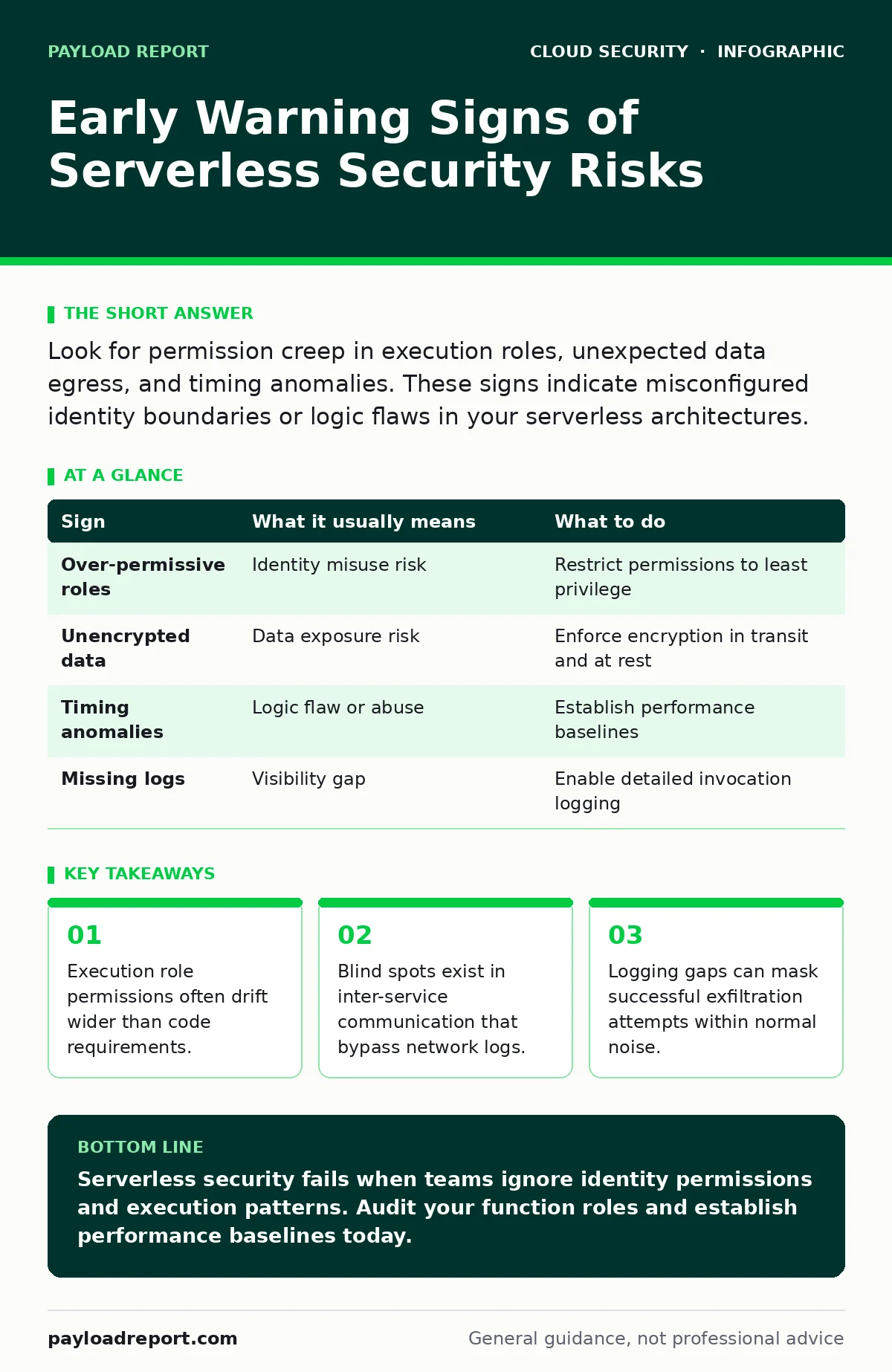
Look for permission creep in execution roles, unexpected data egress, and timing anomalies. These signs indicate misconfigured identity boundaries or logic flaws in your serverless architectures.
The Illusion of Managed Security
Serverless computing shifts infrastructure management to the cloud provider, but it does not remove security responsibility. You still control the code, the configuration, and the identity permissions. Many teams assume that because they do not manage servers, they do not manage security. This assumption creates blind spots where misconfigurations persist unnoticed for months.
The provider secures the underlying hardware and hypervisor. You secure the function logic and the access it holds. When you separate these responsibilities, you must also separate your monitoring strategies. Standard server monitoring tools often fail to capture the ephemeral nature of serverless executions.
Immediate Indicators of Misconfiguration
Some signs appear quickly during development or deployment. The most common is excessive permission grants. Developers often attach broad policies to function execution roles to avoid debugging access denied errors. This practice creates a path of least resistance for attackers who manage to execute code within your environment.
Another immediate sign is unencrypted data at rest. If your serverless function writes to a storage bucket or database, the connection must be encrypted. Failure to enforce encryption in transit or at rest exposes data to interception or theft. You will see this in configuration audits before you see it in attack logs.
Hidden Signals in Execution Patterns
More subtle signs relate to how functions behave under load. Serverless functions scale automatically, which can mask resource exhaustion attacks. An attacker might trigger thousands of invocations to drain your budget or disrupt service. This is known as a denial-of-wallet attack.
Timing anomalies are harder to spot. If a function usually takes ten milliseconds but suddenly takes five seconds, it may be processing unexpected data or communicating with a malicious endpoint. You need baseline performance metrics to detect these deviations. Without baselines, slow responses look like normal variance.
The Identity Privilege Trap
The most dangerous risk in serverless is identity misuse. Functions run with specific identities that have permissions to other cloud resources. If a function has write access to a database, an attacker who compromises that function also has write access to the database.
This chain of trust is often invisible to traditional security tools. Network firewalls see legitimate traffic between cloud services. They do not see if the identity using that traffic is authorised. You must map which functions access which resources. Any gap in this mapping is a potential breach path.
Monitoring the Ephemeral Lifecycle
Serverless functions start and stop rapidly. This lifecycle makes traditional endpoint detection difficult. You cannot install agents on instances that exist for seconds. Instead, you must rely on cloud-native logging and tracing.
Ensure your logging captures invocation context, including source IP and caller identity. If logs are incomplete, you cannot reconstruct an attack after it happens. Incomplete logs are a silent failure. They give you no warning until the damage is done.
See also: Cloud Access Security Brokers: 8 FAQs on Policy and Visibility · Exposed Docker APIs: Questions Asked, Answers Given
Response and Remediation Steps
When you identify a risk, act immediately. Restrict permissions to the minimum required for the function to operate. Use automated tools to scan for over-permissive policies. Review code for hardcoded secrets or credentials.
Isolate affected functions and rotate any credentials they used. Check for data exfiltration by reviewing access logs for storage and databases. Implement continuous monitoring to catch future deviations. Do not rely on periodic audits alone.
| Sign | What it usually means | What to do |
|---|---|---|
| Over-permissive roles | Identity misuse risk | Restrict permissions to least privilege |
| Unencrypted data | Data exposure risk | Enforce encryption in transit and at rest |
| Timing anomalies | Logic flaw or abuse | Establish performance baselines |
| Missing logs | Visibility gap | Enable detailed invocation logging |
Integrating with Broader Security
Serverless security does not exist in isolation. It must align with your broader cloud security strategy. If you use containers alongside serverless, ensure you are not repeating mistakes from insecure container images.
Consider how SaaS security posture management applies to the management consoles you use to deploy functions. Misconfigurations in these consoles can expose your entire deployment pipeline. Similarly, if you use Kubernetes security basics for other workloads, apply the same principle of least privilege to serverless identities.
Building a Resilient Posture
Security in serverless environments requires a shift in mindset. You are securing logic and identity, not hardware. Focus on reducing the attack surface by limiting what each function can do. Monitor for unusual behaviour and respond quickly to deviations.
Regularly review your cloud compliance status to ensure you meet regulatory requirements. Use secure access service edge (SASE) principles to control who can access your deployment environments. Remember that exposed Docker APIs are not a risk in pure serverless, but hybrid deployments may still be vulnerable.
Key takeaways
- Execution role permissions often drift wider than code requirements.
- Blind spots exist in inter-service communication that bypass network logs.
- Logging gaps can mask successful exfiltration attempts within normal noise.
Serverless security fails when teams ignore identity permissions and execution patterns. Audit your function roles and establish performance baselines today.
Frequently asked questions
Does serverless eliminate the need for patching?
No. While the provider patches the infrastructure, you must keep your code and dependencies free of vulnerabilities.
How do I detect logic flaws in serverless functions?
Use fuzzing and automated testing to validate input handling and error paths before deployment.
Are serverless functions immune to DDoS attacks?
No. They are vulnerable to volume-based attacks that trigger excessive invocations and cost.
Can I use traditional firewalls with serverless?
Yes, but they only protect network entry points. You still need identity-based controls for internal access.
How this guide was produced: written by the Payload Report editorial team with AI assistance, checked against the public references listed below, and reviewed when the facts change. See our editorial policy or report an error.