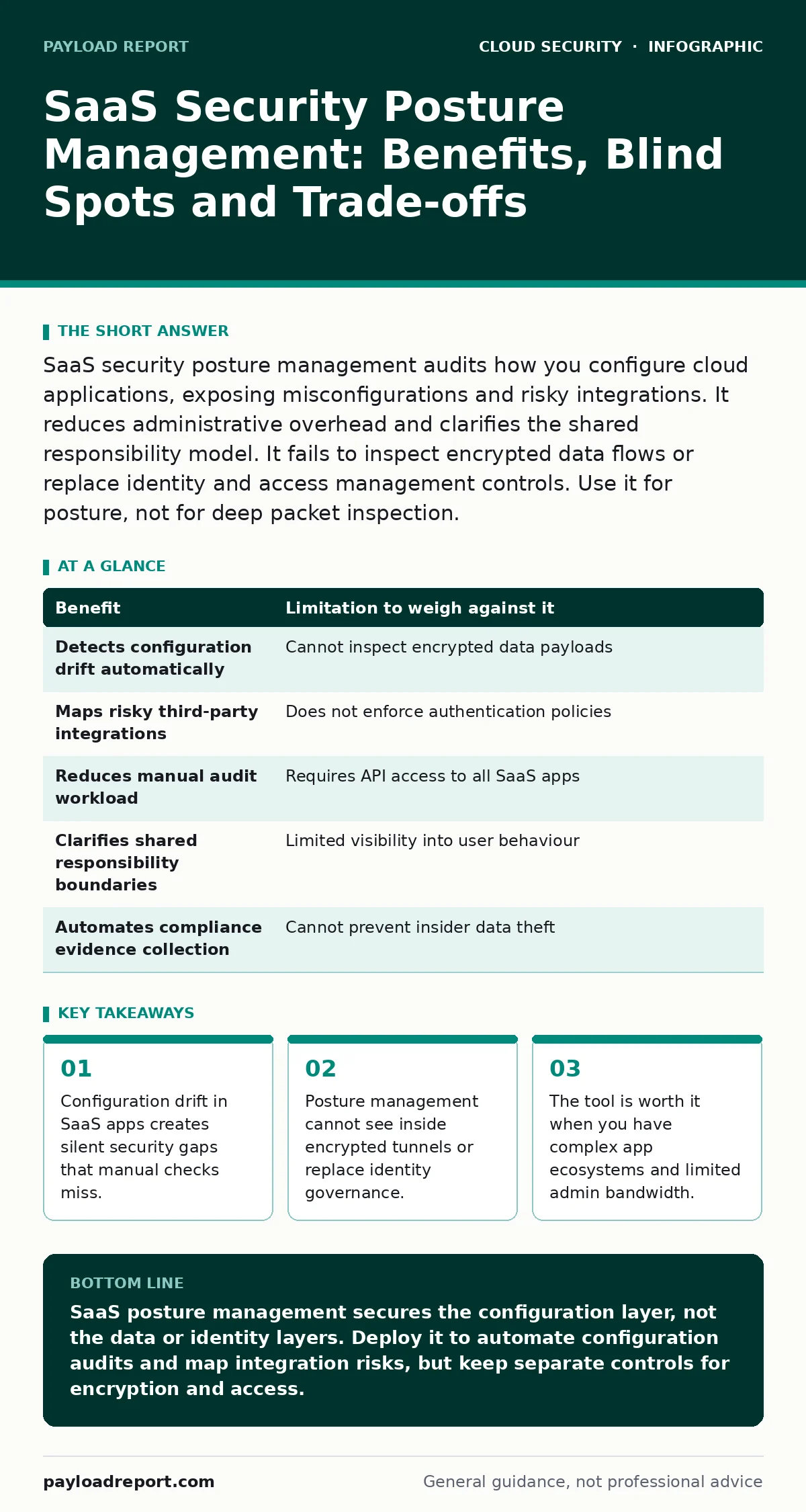
SaaS security posture management audits how you configure cloud applications, exposing misconfigurations and risky integrations. It reduces administrative overhead and clarifies the shared responsibility model. It fails to inspect encrypted data flows or replace identity and access management controls. Use it for posture, not for deep packet inspection.
The Shared Responsibility Gap
You rent software, but you still own the risk. In the traditional server model, you controlled the operating system, the network stack and the application code. With Software as a Service, the provider manages the infrastructure. You manage the configuration, the users and the data permissions. This division is called the shared responsibility model.
Most teams understand the concept but fail to execute it. You assume the vendor secures the platform, which is true. You also assume your internal settings are secure, which is rarely true for long. Misconfigurations in SaaS applications are the leading cause of data exposure in cloud environments. A single wrong setting in a collaboration tool can expose internal documents to the public internet.
SaaS security posture management addresses this specific gap. It does not protect the underlying infrastructure. It protects the way you use the application. It treats your SaaS tenant as a system that requires continuous auditing, just like a server or a container cluster.
Configuration Drift and Silent Risk
Software configurations do not stay static. Administrators change settings to enable new features. Users request access to new integrations. Over time, these small changes accumulate. This phenomenon is known as configuration drift.
Imagine a team enables file sharing with external partners to speed up a project. The project ends, but the permission remains open. Six months later, a new employee inherits those permissions. The original intent is lost, but the risk remains. Manual audits cannot catch this. They are point-in-time snapshots that become obsolete the moment they are completed.
Posture management tools monitor these settings continuously. They compare your current state against a baseline of secure configuration. When a setting deviates from the baseline, the tool flags it. This allows you to detect drift before it becomes an incident. It shifts security from a periodic checklist to a continuous state.
The Integrations Explosion
Modern workplaces rely on hundreds of applications. These applications connect to each other through Application Programming Interfaces. An API is a set of rules that allows different software programs to communicate. When you connect a CRM system to a marketing tool, you are creating an API integration.
Each integration requires permissions. A marketing tool might need read-only access to customer emails. A support ticketing system might need write access to user profiles. As you add more tools, the number of possible connections grows exponentially. This is called integration sprawl.
You cannot manage integration sprawl with a spreadsheet. You need a tool that maps the relationships between your applications. Posture management identifies risky integrations, such as a low-security app with high-level access to sensitive data. It also detects shadow IT, where employees connect personal tools to corporate data without approval. This visibility is the primary benefit of adopting a posture management strategy.
The Encryption Blind Spot
SaaS security posture management has a hard limit. It cannot see inside encrypted traffic. Most SaaS applications use Transport Layer Security to encrypt data in transit. This encryption protects data from eavesdropping, but it also hides the content from security tools.
A posture management tool can tell you that a file was uploaded. It can tell you who uploaded it and when. It cannot tell you what was in the file. It cannot inspect the payload for malware or sensitive data patterns. This is a fundamental architectural constraint, not a feature deficiency.
Do not expect posture management to replace Data Loss Prevention. DLP tools operate at the network or endpoint level, where they can decrypt and inspect traffic. Posture management operates at the configuration level. It manages the rules, not the content. Confusing these two functions leads to false confidence. You may have perfect configuration but still leak data through encrypted channels.
Identity and Access Management Gaps
Posture management tools often include basic identity checks. They can list users, roles and permissions. However, they are not identity providers. They do not enforce authentication or manage password policies.
Identity and access management is a separate discipline. It deals with who can log in and what they can do. Posture management deals with how the application is configured to allow those actions. If a user has too many permissions, posture management can flag the role as risky. It cannot revoke the permission or enforce multi-factor authentication.
You need both. Identity governance ensures the right people have access. Posture management ensures the access paths are configured securely. Using posture management as a substitute for identity governance is a common mistake. It leaves the authentication layer exposed to credential-based attacks.
See also: Cloud Access Security Brokers: 8 FAQs on Policy and Visibility · Serverless Incident Response: Containment, Recovery and Prevention Steps
Benefits and Limitations Weighed
The value of posture management depends on your specific risk profile. It is not a universal solution. The table below contrasts the concrete benefits with the limitations you must weigh against them.
| Benefit | Limitation to weigh against it |
|---|---|
| Detects configuration drift automatically | Cannot inspect encrypted data payloads |
| Maps risky third-party integrations | Does not enforce authentication policies |
| Reduces manual audit workload | Requires API access to all SaaS apps |
| Clarifies shared responsibility boundaries | Limited visibility into user behaviour |
| Automates compliance evidence collection | Cannot prevent insider data theft |
This balance is clear. The tool excels at structural security. It fails at content and behaviour. You must build your defence around this reality.
When It Is Worth It
Posture management is worth the investment when your SaaS ecosystem is complex. If you use more than ten core applications, manual tracking becomes impossible. The cost of a misconfiguration exceeds the cost of the tool.
It is also worth it when you lack dedicated cloud security staff. The tool automates the monitoring that a human would otherwise perform. It provides a single pane of glass for your SaaS configuration state. This reduces the cognitive load on your IT team.
Consider it if you face strict regulatory requirements. Compliance frameworks often demand evidence of secure configuration. Posture management generates this evidence automatically. It turns a months-long audit preparation into a continuous process.
When It Is Not
Do not invest in posture management if you have a simple stack. If you use only two or three applications, you can manage their settings manually. The tool adds complexity without adding value.
It is not worth it if you expect it to replace a cloud access security broker. CASB tools focus on data movement and user activity. Posture management focuses on application settings. They serve different purposes. Using one to replace the other leaves critical blind spots.
Avoid it if you cannot provide API access. The tool needs read-only access to your SaaS applications to function. If your vendors do not support API integration, the tool cannot see your configuration. It becomes a blind monitor.
Key takeaways
- Configuration drift in SaaS apps creates silent security gaps that manual checks miss.
- Posture management cannot see inside encrypted tunnels or replace identity governance.
- The tool is worth it when you have complex app ecosystems and limited admin bandwidth.
- It is not worth it if you expect it to replace CASB or inspect private user data.
SaaS posture management secures the configuration layer, not the data or identity layers. Deploy it to automate configuration audits and map integration risks, but keep separate controls for encryption and access.
Frequently asked questions
Does SaaS posture management replace CASB?
No. CASB focuses on data movement and user activity. Posture management focuses on application configuration and settings. They are complementary technologies that address different risk vectors.
Can posture management stop data leaks?
It can stop leaks caused by misconfigured permissions. It cannot stop leaks caused by users downloading sensitive files and sending them externally. It manages the gates, not the traffic.
Do I need API access for every app?
Yes. The tool needs to read configuration data from each application. Without API access, it cannot detect drift or risky settings. Ensure your vendors support standard API integrations.
How often should I review posture findings?
Review critical findings immediately. Schedule weekly reviews for medium-risk items. Monthly reviews are sufficient for low-risk configuration drift. Automate remediation where possible.
How this guide was produced: written by the Payload Report editorial team with AI assistance, checked against the public references listed below, and reviewed when the facts change. See our editorial policy or report an error.