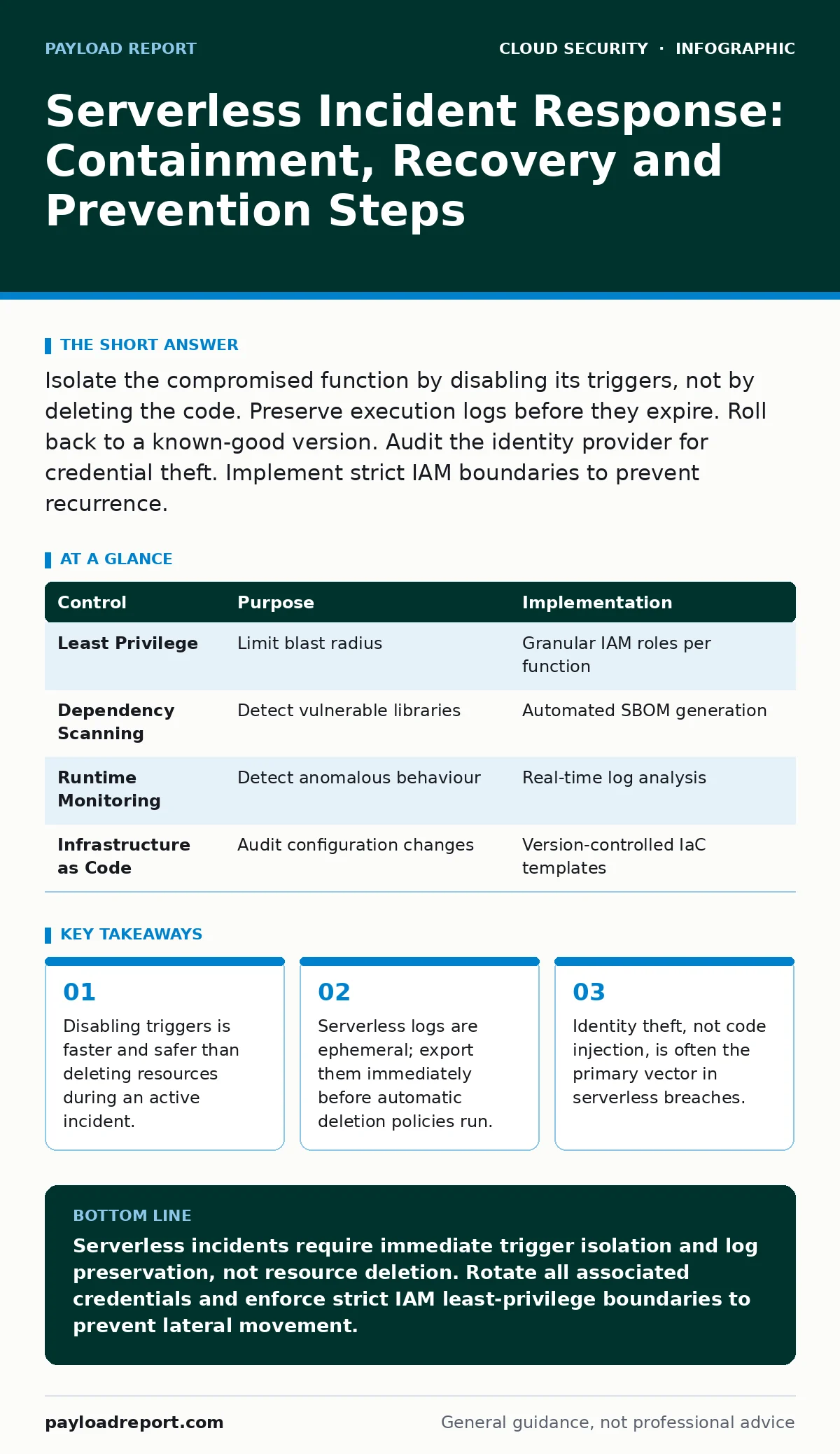
Isolate the compromised function by disabling its triggers, not by deleting the code. Preserve execution logs before they expire. Roll back to a known-good version. Audit the identity provider for credential theft. Implement strict IAM boundaries to prevent recurrence.
First hour
An incident in a serverless environment unfolds differently than on a traditional server. You do not have a persistent machine to isolate. The compute instance dies after execution. This ephemerality is your biggest challenge and your greatest advantage. The attacker has no persistent foothold on a host, but they have a window to exfiltrate data or pivot. Your first hour is defined by speed and preservation.
Your priority is to stop the bleeding without destroying the forensic trail. You must identify the specific function version or alias under attack. Serverless platforms often maintain version history. Pinning your traffic to a previous, clean version is often possible through traffic shifting configurations. This allows you to take the compromised code offline while keeping the service available for legitimate users who are routed to the safe version.
- Identify the affected function and its unique identifier.
- Disable incoming triggers (API gateway routes, queue subscribers) for that function.
- Export CloudWatch or equivalent logs to a secure, external storage bucket.
- Freeze the IAM roles associated with the function to prevent privilege escalation.
- Notify the incident response lead and relevant engineering owners.
Disabling triggers is the correct containment strategy. Deleting the function is a panic response that erases the configuration state. If you delete the function, you lose the metadata about how it was invoked. You also risk breaking downstream services that depend on its existence. By disabling triggers, you create a dead end for the attacker. They can no longer invoke the code, but the code remains accessible for analysis.
First day
Once the immediate threat is contained, you shift to investigation. The assumption is that the attacker has accessed the environment variables or the IAM role attached to the function. These are the secrets. In serverless architecture, the function code is secondary to the permissions it holds. A compromised function with broad permissions is a gateway to your entire cloud account.
You must review the execution logs. Look for unusual invocation patterns. Serverless functions are triggered by events. A sudden spike in invocations from an unknown IP range is a clear indicator of compromise. However, sophisticated attackers mimic normal traffic. You must look for anomalies in the payload. Did the function receive data it does not usually process? Did it return unexpected headers?
The identity layer is frequently overlooked. Many serverless applications rely on a central identity provider for authentication. If the attacker stole a valid session token, they can impersonate users without ever touching the function code. You must invalidate sessions for affected users. This is not just about the function; it is about the trust boundary. If the identity provider is compromised, the function security is irrelevant.
You should also review the deployment pipeline. How did the malicious code get there? Was it a direct push to the production branch? Was it a pull request approved by a developer? The answer determines whether you have a security issue or a process issue. If the pipeline was compromised, you must rotate all deployment credentials. If the code was approved, you must review the code review process.
First week
Recovery involves more than restoring service. It involves restoring trust. You must verify that the environment is clean. This means auditing all IAM roles. Serverless functions often have overly permissive roles by default. You must apply the principle of least privilege. Each function should only have the permissions it needs to perform its specific task. No more, no less.
You must also review the dependencies. Serverless functions often rely on third-party libraries. A compromised library can introduce backdoors. You must audit the software bill of materials. Identify all third-party components and check for known vulnerabilities. This is not a one-time task. It must be integrated into your deployment pipeline.
Implementing strict IAM boundaries is the most effective way to prevent recurrence. If an attacker compromises a function, they should not be able to pivot to other services. This requires granular permissions. You must also implement runtime protection. This involves monitoring function behavior for anomalies. If a function suddenly starts accessing a different service, alert immediately.
Who to tell
Communication is a critical part of incident response. You must inform internal stakeholders. This includes engineering, legal, and compliance teams. The engineering team needs to understand the technical impact. The legal team needs to assess regulatory obligations. The compliance team needs to document the incident for audits.
You must also consider external notifications. Depending on the nature of the data involved, you may be required to notify customers or regulators. This decision should be made in consultation with legal counsel. Delaying notification can exacerbate the impact. Prompt, transparent communication builds trust.
How to stop a repeat
Prevention requires a shift in mindset. Security is not an afterthought. It is built into the development process. You must implement security testing in your CI/CD pipeline. This includes static analysis of code and dynamic analysis of dependencies. You must also enforce infrastructure as code. This ensures that configurations are versioned and auditable.
You should also review your access controls. Implement multi-factor authentication for all administrative access. Use short-lived credentials wherever possible. This reduces the window of opportunity for attackers. You must also monitor for misconfigurations. A misconfigured function can expose sensitive data or allow unauthorized access.
| Control | Purpose | Implementation |
|---|---|---|
| Least Privilege | Limit blast radius | Granular IAM roles per function |
| Dependency Scanning | Detect vulnerable libraries | Automated SBOM generation |
| Runtime Monitoring | Detect anomalous behaviour | Real-time log analysis |
| Infrastructure as Code | Audit configuration changes | Version-controlled IaC templates |
See also: Rainbow Table Attack Response: Contain, Recover and Prevent Credential Theft · Purple Teaming FAQs: How to Run Effective Security Tests
Related considerations
Serverless security does not exist in a vacuum. It interacts with other cloud security domains. For example, if your serverless functions interact with containerised services, you must understand the boundaries between them. Misconfigurations in one area can expose vulnerabilities in another.
You should also consider the broader architecture. If you are using a hybrid approach, the attack surface expands. You must ensure that security controls are consistent across all environments. This includes on-premises, virtual machines, and serverless functions.
For teams managing complex container orchestration, the principles of isolation and least privilege are similar. You may find value in reviewing Kubernetes security basics to understand how permission models differ. Similarly, if your serverless functions are exposed via an API gateway, the principles of secure access service edge (SASE) can inform your network security strategy.
Compliance requirements vary by industry. You must ensure that your serverless architecture meets these requirements. This often involves detailed logging and monitoring. You should review cloud compliance frameworks to understand the specific obligations for your sector.
Final steps
The incident is not over until you have learned from it. Conduct a post-mortem. Identify what went wrong and what went right. Use this information to improve your processes. Update your runbooks. Train your team. Security is a continuous process. It requires constant vigilance and adaptation.
You must also update your monitoring rules. The indicators of compromise you identified during the incident should be added to your detection logic. This ensures that you can detect similar attacks in the future. You must also review your response plan. Did it work? What could be improved? Use this feedback to refine your procedures.
Key takeaways
- Disabling triggers is faster and safer than deleting resources during an active incident.
- Serverless logs are ephemeral; export them immediately before automatic deletion policies run.
- Identity theft, not code injection, is often the primary vector in serverless breaches.
Serverless incidents require immediate trigger isolation and log preservation, not resource deletion. Rotate all associated credentials and enforce strict IAM least-privilege boundaries to prevent lateral movement.
Frequently asked questions
How do I know if my serverless function is compromised?
Look for unusual invocation spikes, unexpected data payloads, or anomalous outbound network connections in your execution logs.
Should I delete the compromised function immediately?
No. Disabling triggers preserves forensic evidence and prevents accidental re-deployment while containing the threat.
What is the most common entry point for serverless attacks?
Identity theft and session hijacking are more common than direct code injection, so monitor your identity provider closely.
How do I prevent privilege escalation in serverless?
Assign granular IAM roles to each function, ensuring they only have the minimum permissions required for their specific task.
How this guide was produced: written by the Payload Report editorial team with AI assistance, checked against the public references listed below, and reviewed when the facts change. See our editorial policy or report an error.