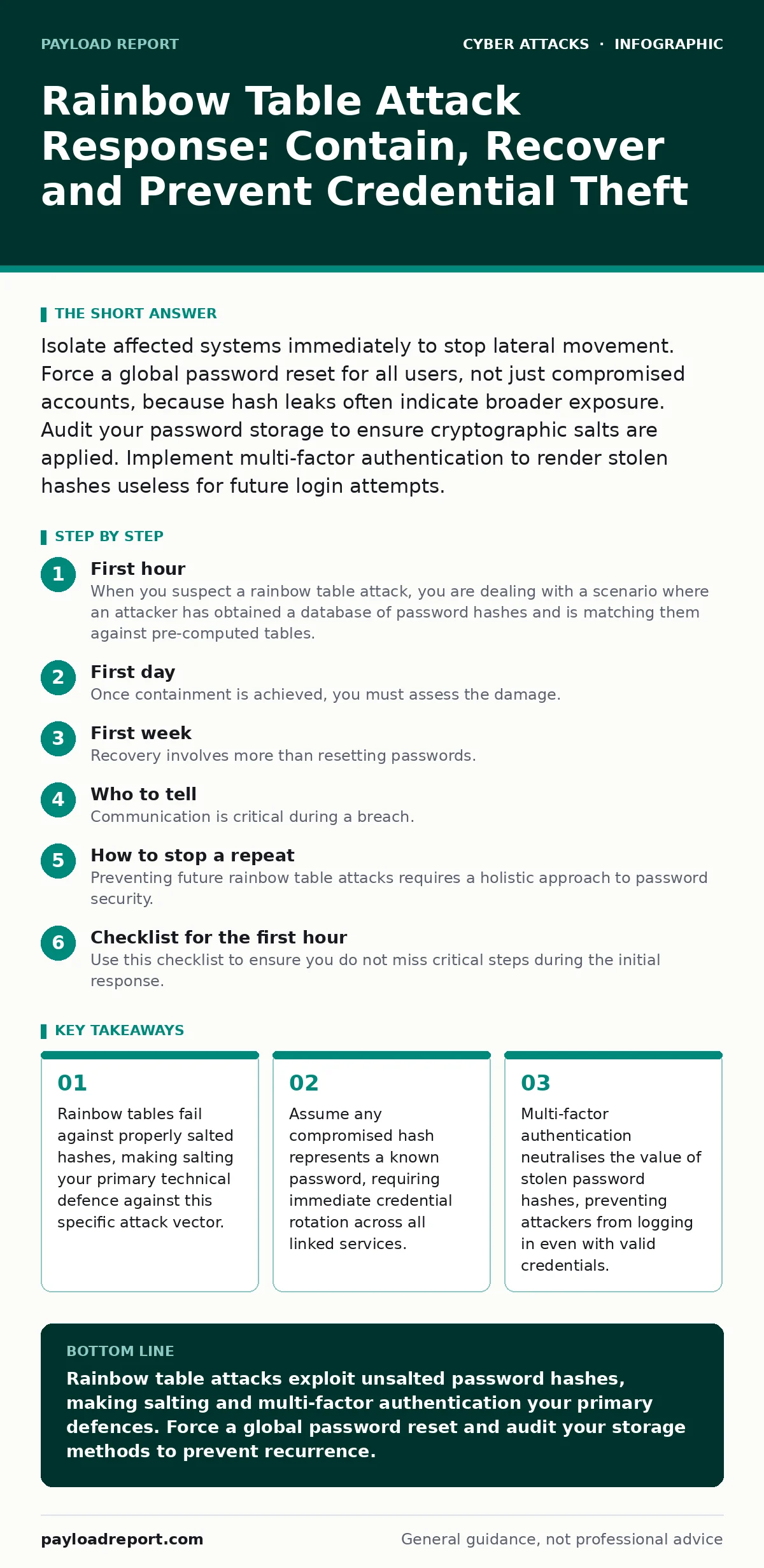
Isolate affected systems immediately to stop lateral movement. Force a global password reset for all users, not just compromised accounts, because hash leaks often indicate broader exposure. Audit your password storage to ensure cryptographic salts are applied. Implement multi-factor authentication to render stolen hashes useless for future login attempts.
First hour
When you suspect a rainbow table attack, you are dealing with a scenario where an attacker has obtained a database of password hashes and is matching them against pre-computed tables. This is not a brute force attack that tries every combination in real time. It is a lookup operation. The attacker already knows the password if it exists in their table. Your priority is to stop them from using that knowledge to access your systems.
- Isolate affected servers from the network to prevent lateral movement.
- Disable compromised user accounts in your identity provider.
- Preserve memory dumps and log files from the affected systems.
- Notify your incident response team and legal counsel.
- Identify the scope of the hash leak.
You must determine which systems hold the compromised hashes. Often, these hashes are stored in application databases, not just your central identity provider. If an application stores passwords locally, it is a separate breach. You need to find every instance where those hashes exist. Check your database backups as well. An attacker may have exfiltrated old backups that contain historical hashes.
First day
Once containment is achieved, you must assess the damage. Rainbow table attacks rely on the absence of salts. A salt is a random value added to each password before hashing. This ensures that even if two users have the same password, their hashes are different. If your system does not use salts, every common password is vulnerable to a single lookup. You must verify whether your password storage mechanism uses per-user salts.
If salts are missing, the entire user base is at risk. You cannot assume only the matched accounts are compromised. The attacker likely has the full hash dump. They may only have tested common passwords so far. You must treat every password in that database as compromised. This requires a forced password reset for all users. Do not allow users to reuse their previous password. Enforce a strict policy that rejects the last ten passwords.
You should also review your access logs. Look for successful logins from unusual locations or devices shortly after the breach. This indicates the attacker is actively using the stolen credentials. Block those IP addresses and devices. If you use DNS filtering, review the traffic logs for connections to known malicious domains. Attackers often use compromised accounts to download further tools or exfiltrate data.
First week
Recovery involves more than resetting passwords. You must fix the underlying vulnerability. If your application stores unsalted hashes, you must migrate to a modern hashing algorithm like Argon2 or bcrypt. These algorithms are computationally expensive, making rainbow table generation impractical. They also include salting by default. Do not use MD5 or SHA1 for password storage. These are too fast and allow attackers to generate massive tables easily.
Implement multi-factor authentication across all user accounts. This is your strongest defence against credential theft. Even if an attacker has a valid password hash, they cannot log in without the second factor. Use hardware security keys or authenticator apps. Avoid SMS-based verification if possible, as it is vulnerable to SIM swapping. Login alerts can also help you detect unauthorized access attempts in real time. Configure your system to notify users when a login occurs from a new device.
Review your third-party integrations. Attackers often use compromised credentials to access connected services. Check for any API keys or tokens that may have been exposed. Rotate these credentials immediately. If you use email spoofing protections like SPF, ensure they are correctly configured to prevent attackers from impersonating your domain in follow-up attacks.
Who to tell
Communication is critical during a breach. You must inform your users, regulators, and potentially law enforcement. Be transparent about what happened and what you are doing to fix it. Avoid technical jargon in user communications. Explain that their password was exposed and that they should change it on other sites where they use the same password. This is a common practice among attackers who try the same credentials on multiple platforms.
If you suspect vendor email compromise, notify your suppliers and partners. Attackers may use your compromised credentials to send fraudulent invoices or requests to your business contacts. Provide them with the correct contact details and warn them about potential scams. This helps prevent secondary breaches in your supply chain.
Regulators may require formal notification depending on your jurisdiction and the type of data compromised. Legal counsel should guide this process. Ensure you document all steps taken during the response. This documentation may be required for audits or legal proceedings.
How to stop a repeat
Preventing future rainbow table attacks requires a holistic approach to password security. Ensure all new applications use modern, salted hashing algorithms. Conduct regular code reviews to check for hardcoded passwords or weak storage methods. Train developers on secure coding practices related to authentication.
Implement regular penetration testing to identify weaknesses in your authentication systems. Test for common vulnerabilities like unsalted hashes or weak encryption. Use automated tools to scan for misconfigurations. Regular audits help you stay ahead of evolving attack techniques.
Monitor your network for signs of data exfiltration. Large outbound data transfers may indicate an attacker is stealing database dumps. Set up alerts for unusual database access patterns. Early detection allows you to respond before the attacker can use the stolen data.
See also: Purple Teaming FAQs: How to Run Effective Security Tests · How to Write Customer Breach Notification Letters That Limit Liability
Checklist for the first hour
Use this checklist to ensure you do not miss critical steps during the initial response.
- Isolate affected systems from the network.
- Disable compromised accounts.
- Preserve logs and memory dumps.
- Identify all systems holding password hashes.
- Notify incident response team.
- Begin forensic analysis of access logs.
Long term defence
Rainbow table attacks are a symptom of weak password storage. By enforcing salting and using slow hashing algorithms, you make these attacks computationally infeasible. Combine this with multi-factor authentication to add a layer of defence that does not rely solely on passwords. Regularly review and update your security policies to adapt to new threats. Stay informed about emerging techniques in credential theft.
Key takeaways
- Rainbow tables fail against properly salted hashes, making salting your primary technical defence against this specific attack vector.
- Assume any compromised hash represents a known password, requiring immediate credential rotation across all linked services.
- Multi-factor authentication neutralises the value of stolen password hashes, preventing attackers from logging in even with valid credentials.
Rainbow table attacks exploit unsalted password hashes, making salting and multi-factor authentication your primary defences. Force a global password reset and audit your storage methods to prevent recurrence.
Frequently asked questions
Can rainbow tables crack multi-factor authentication?
No, rainbow tables only recover password hashes. They cannot bypass the second factor required for multi-factor authentication.
How long does it take to generate a rainbow table?
Generation time varies based on password complexity and hardware. Pre-computed tables for common passwords are already available to attackers.
Should I change my passwords if I use a password manager?
Yes, if the breach involves your password manager, change all passwords immediately. If the breach is elsewhere, change the password for that specific site.
Are salted hashes completely secure?
Salting prevents rainbow table attacks but does not stop brute force attacks. Use slow hashing algorithms to mitigate brute force risks.
How this guide was produced: written by the Payload Report editorial team with AI assistance, checked against the public references listed below, and reviewed when the facts change. See our editorial policy or report an error.