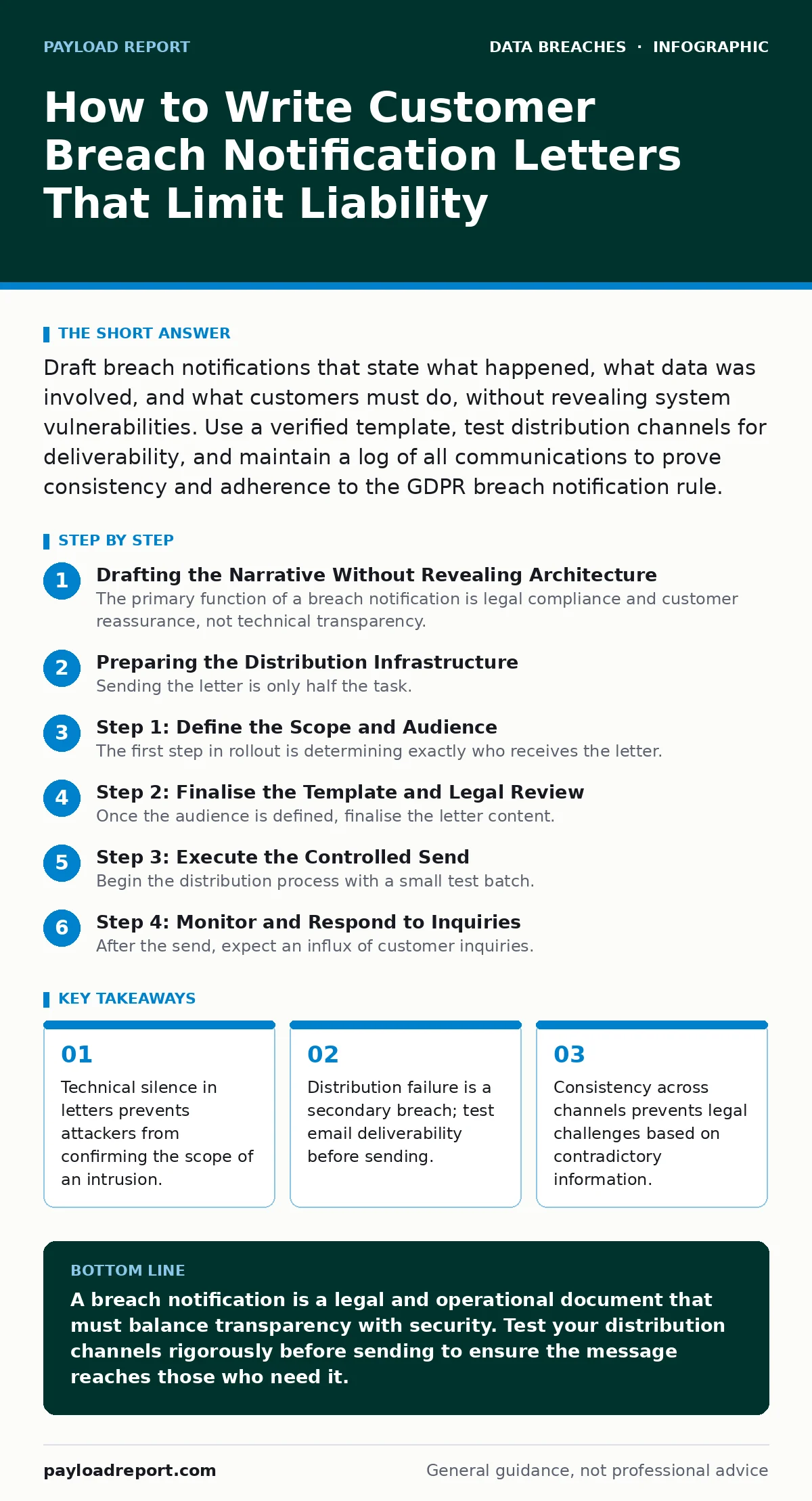
Draft breach notifications that state what happened, what data was involved, and what customers must do, without revealing system vulnerabilities. Use a verified template, test distribution channels for deliverability, and maintain a log of all communications to prove consistency and adherence to the GDPR breach notification rule.
Drafting the Narrative Without Revealing Architecture
The primary function of a breach notification is legal compliance and customer reassurance, not technical transparency. You must describe the incident in terms of impact, not mechanism. If you explain how the attacker bypassed your firewall, you hand them a map of your defences. This is a common error that turns a containment effort into a prolonged exposure.
Define the data types involved using standard categories. State whether names, addresses, or payment details were accessed. Avoid naming specific database schemas or internal server names. This precision satisfies the GDPR breach notification rule without aiding further exploitation. If the breach involved misdirected emails, specify the date range and recipient criteria rather than the email gateway configuration.
Imagine a scenario where you mention a specific software version in the letter. Attackers monitoring these disclosures will immediately search for known vulnerabilities in that version. They will then target other organisations using the same configuration. Your notification becomes a weaponised intelligence source. Keep the description functional: "unauthorised access to customer records" is sufficient. "Exploitation of a zero-day in the web application firewall" is dangerous.
Preparing the Distribution Infrastructure
Sending the letter is only half the task. Ensuring it arrives is the operational challenge. Many organisations draft excellent letters but fail to consider deliverability. If your notification lands in spam folders, you have failed to notify. This can be interpreted as negligence or intentional concealment by regulators.
Set up a dedicated sending domain or subdomain for these communications. Do not use your primary marketing or transactional email infrastructure. This isolates any reputation damage. If the breach was caused by a compromised account, using that account to send notifications is counterproductive. It signals that the attacker still has access.
Configure your email headers to include authentication records. Domain-based Message Authentication, Reporting and Conformance (DMARC) policies must be active for the sending domain. This prevents spoofing and ensures recipients can verify the message origin. Without this, your notification may be rejected by strict mail filters. You must also prepare a physical mailing list for customers who opted out of electronic communications.
Step 1: Define the Scope and Audience
The first step in rollout is determining exactly who receives the letter. You must cross-reference the affected data sets with your customer database. Include only those whose data was actually accessed or exfiltrated. Sending letters to unaffected customers causes unnecessary alarm and dilutes the urgency for those at risk.
Create three distinct lists: primary affected, secondary affected, and internal stakeholders. Primary affected customers received the most sensitive data types. Secondary affected customers had lower-risk data exposed. Internal stakeholders include legal, PR, and executive teams who need to approve the final text.
Verification: Compare the count of recipients against the forensic report of affected records. The numbers must match within a reasonable margin of error. If the lists diverge, pause the rollout. Investigate the discrepancy before proceeding.
Step 2: Finalise the Template and Legal Review
Once the audience is defined, finalise the letter content. The template must include the nature of the incident, the data involved, the potential harm, and the steps the organisation is taking. It must also provide clear instructions for the customer.
Submit the draft to legal counsel for review. They will ensure the language meets local regulatory requirements. This is not just a compliance check; it is a liability shield. Ensure the tone is factual and calm. Avoid apologetic language that admits fault beyond what is legally established. Avoid defensive language that blames the customer.
Verification: Conduct a "read-back" test. Have someone unfamiliar with the incident read the letter. Ask them to summarise what happened and what they need to do. If their summary misses key actions, rewrite the instructions. Clarity is more valuable than brevity.
Step 3: Execute the Controlled Send
Begin the distribution process with a small test batch. Send the notification to a small group of internal staff and trusted external partners. Check for rendering issues in different email clients. Verify that links to support pages work and lead to the correct information.
Monitor the delivery logs closely. Watch for bounce rates and spam complaints. If the bounce rate exceeds normal thresholds, halt the send. Investigate the cause. It may be a formatting issue or a reputation problem with the sending domain. Do not ignore these signals. A failed delivery is a failure of duty.
See also: Rainbow Table Attack Response: Contain, Recover and Prevent Credential Theft · Purple Teaming FAQs: How to Run Effective Security Tests
Step 4: Monitor and Respond to Inquiries
After the send, expect an influx of customer inquiries. Prepare a support script for your help desk. Agents must give consistent answers that align with the letter. Contradictory information from support staff can undermine the notification and create legal exposure.
Track common questions. If many customers are confused about a specific point, update the FAQ on your support page. Do not resend the letter unless new material information emerges. Use the existing channels to provide updates. This maintains a clear audit trail of communications.
Verification Checklist for Rollout
Use this checklist to ensure the rollout is complete and correct.
- Recipient list matches forensic data scope.
- Legal review approval is documented.
- Test batch sent and rendered correctly.
- Delivery logs show acceptable success rates.
- Support team briefed on consistent messaging.
- Archive of all sent notifications secured.
Maintaining the Notification Record
The notification is not a one-time event. You must maintain a record of the communication for future reference. This includes the final text, the list of recipients, and the timestamp of the send. Store this securely. It serves as evidence of compliance in case of regulatory audit or litigation.
Review the process after the incident is closed. Identify where delays occurred. Did legal review take too long? Was the data matching process inefficient? Document these lessons. Update your incident response plan to include these improvements. This reduces the time to notify in future incidents.
Consider the long-term impact on customer trust. Transparency builds resilience. Hiding details destroys it. Your notification strategy should reflect this balance. It should be clear, accurate, and timely, without compromising security.
Integrating with Broader Security Measures
Breach notifications are part of a larger security ecosystem. They work best when combined with proactive measures. For instance, if you offer full disk encryption, you can state that stolen devices do not expose readable data. This limits the perceived harm. If you have implemented database activity monitoring, you can explain how you detected the intrusion quickly.
However, do not overpromise. If encryption was not enabled, do not claim it was. Accuracy is paramount. Link the notification to broader advice, such as fraud alerts for financial data or credit freezes for identity information. This provides customers with actionable next steps.
Key takeaways
- Technical silence in letters prevents attackers from confirming the scope of an intrusion.
- Distribution failure is a secondary breach; test email deliverability before sending.
- Consistency across channels prevents legal challenges based on contradictory information.
A breach notification is a legal and operational document that must balance transparency with security. Test your distribution channels rigorously before sending to ensure the message reaches those who need it.
Frequently asked questions
How soon must I send a breach notification?
Timelines vary by jurisdiction and regulation. Some require notification within seventy-two hours of discovery, while others allow more time. Check your local laws immediately upon confirming a breach.
Can I send the notification via SMS?
SMS is acceptable if it reaches the customer effectively. Ensure the message is concise and includes a link to more detailed information. Verify that SMS delivery is reliable for your audience.
What if I don't know the exact number of affected customers?
Notify based on the best available evidence. State that the number is approximate and subject to change as the investigation continues. Update customers if the scope changes significantly.
Do I need to notify customers for minor breaches?
It depends on the potential harm. If the data is low-risk and no harm is likely, some regulations allow you to withhold notification. Document your reasoning for this decision.
How this guide was produced: written by the Payload Report editorial team with AI assistance, checked against the public references listed below, and reviewed when the facts change. See our editorial policy or report an error.