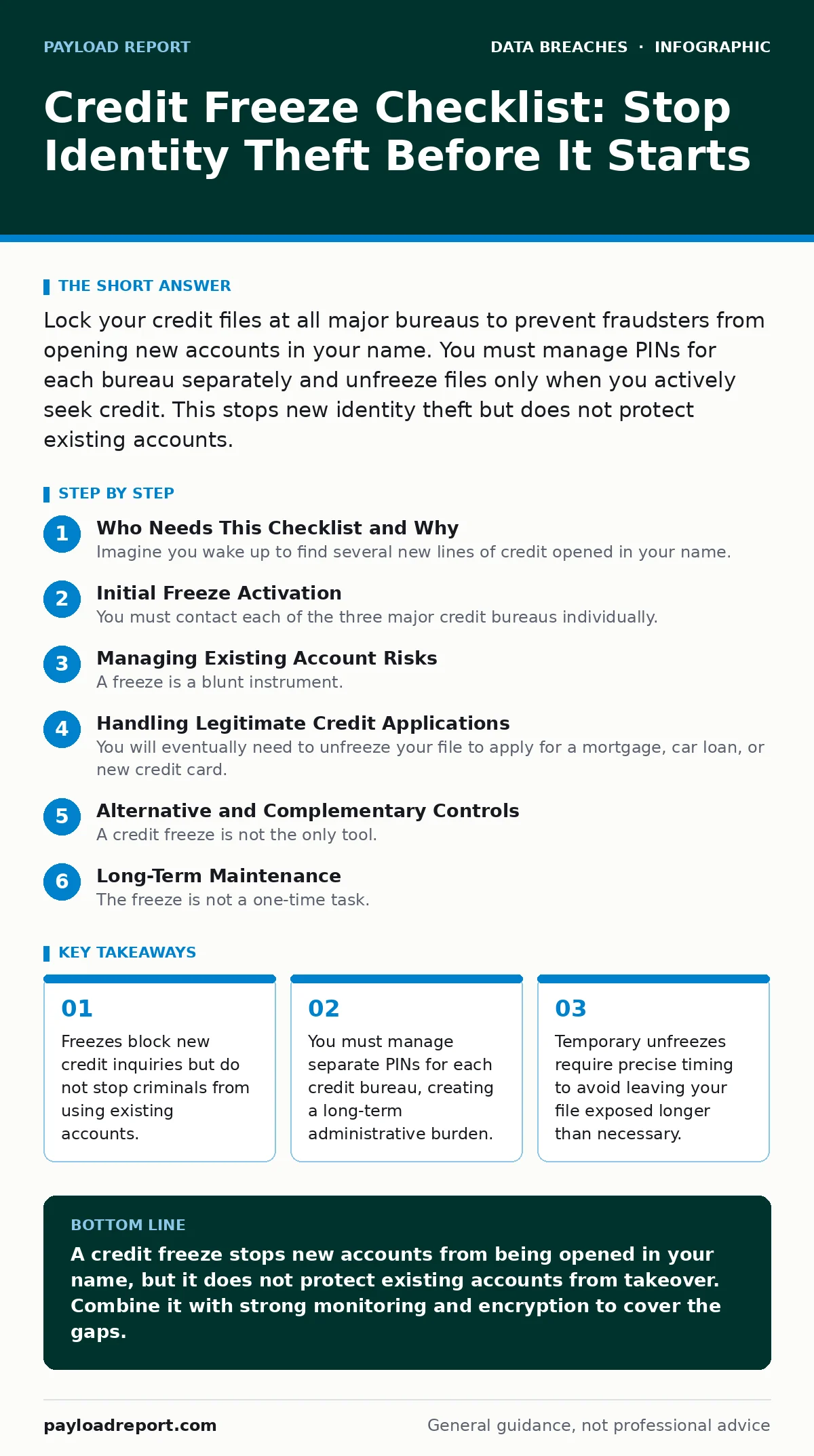
Lock your credit files at all major bureaus to prevent fraudsters from opening new accounts in your name. You must manage PINs for each bureau separately and unfreeze files only when you actively seek credit. This stops new identity theft but does not protect existing accounts.
Who Needs This Checklist and Why
Imagine you wake up to find several new lines of credit opened in your name. The damage is done before you even call the bank. A credit freeze, also known as a security freeze, prevents this specific outcome by locking your credit file. Lenders cannot access your report to approve new loans, credit cards, or mortgages.
This mechanism stops identity thieves from creating new accounts. It does not stop them from using accounts you already own. If a thief has your login details for your existing bank account, a freeze does nothing. You need this checklist to ensure the freeze is applied correctly and to manage the ongoing maintenance it requires.
Use this list to verify every step. Do not assume one bureau notifies the others. Each bureau operates independently. Missing one leaves a gap in your defence.
Initial Freeze Activation
You must contact each of the three major credit bureaus individually. There is no single switch that locks all three. You will receive a unique PIN or password from each. These credentials are the keys to your financial identity. Lose them, and the process to recover them is slow and cumbersome.
- Freeze file at Equifax: Prevents new credit checks at the largest bureau.
- Freeze file at Experian: Blocks applications processed through this major network.
- Freeze file at TransUnion: Stops lenders using this bureau from seeing your history.
- Record all PINs securely: Ensures you can unfreeze files when needed without delay.
- Verify freeze status online: Confirms the lock is active before you assume safety.
Managing Existing Account Risks
A freeze is a blunt instrument. It blocks new credit but ignores the accounts you already hold. Criminals often target existing accounts because they require no new approval. They simply need your credentials. This is where unauthorized access becomes the primary threat model.
If you rely solely on a freeze, you create a false sense of security. You might neglect to monitor your existing statements. You might ignore login alerts. The freeze does not alert you to fraud on open accounts. You must combine the freeze with other controls to cover this blind spot.
- Enable transaction alerts: Get instant notification of unusual activity on existing accounts.
- Review credit report quarterly: Check for accounts you did not open or recognise.
- Update passwords for financial apps: Reduce the risk of credential stuffing attacks.
- Verify two-factor authentication: Ensure login security is not reliant on SMS alone.
- Monitor for misdirected emails: Prevent phishing attempts that steal login credentials.
Handling Legitimate Credit Applications
You will eventually need to unfreeze your file to apply for a mortgage, car loan, or new credit card. This is the friction point. You must plan ahead. Unfreezing takes time, and doing it manually for each bureau is tedious.
Do not leave your file unfrozen after the application. Many people forget to re-freeze. This leaves your file open to abuse for months or years. Set a reminder to re-lock the file immediately after the lender confirms they have pulled your report.
- Identify required bureaus: Check with your lender which bureaus they use.
- Schedule unfreeze in advance: Allow time for the change to propagate.
- Use temporary unfreeze if available: Some bureaus offer time-limited unlocks.
- Re-freeze immediately after application: Prevents lingering exposure to new fraud.
- Confirm lender received report: Ensures the unfreeze served its purpose.
Alternative and Complementary Controls
A credit freeze is not the only tool. Fraud alerts are a lighter option. They require lenders to verify your identity before issuing credit. This is less restrictive than a freeze but also less secure. A fraud alert lasts for a short period and must be renewed.
For high-value data, consider encryption at rest for any digital records you keep of your financial documents. If your device is stolen, the thief cannot read your saved statements or tax returns. This adds a layer of protection beyond the credit bureaus.
- Compare freeze vs fraud alert: Choose based on your risk tolerance.
- Encrypt sensitive financial files: Protects data if your device is lost or stolen.
- Understand GDPR breach notification rule: Know your rights if a vendor leaks your data.
- Review customer breach notification letters: Act quickly if a vendor suffers an incident.
- Implement full disk encryption: Secures all data on your laptop or phone.
See also: GDPR Breach Notification Rules Explained for Beginners
Long-Term Maintenance
The freeze is not a one-time task. It is a long-term commitment. You must remember your PINs. You must remember to re-freeze after every application. You must monitor your existing accounts. The administrative cost is real.
If you lose your PIN, you must prove your identity to the bureau. This process can take weeks. During that time, your file may be vulnerable. Keep your recovery information safe. Treat it with the same care as your master password.
- Backup PINs in multiple secure locations: Prevents lockout if one storage method fails.
- Update contact info with bureaus: Ensures you receive important notices.
- Re-freeze after every major application: Closes the window of exposure.
- Check for identity theft insurance: Provides financial recourse if fraud occurs.
- Review freeze status annually: Confirms the lock is still active and valid.
When Freezes Fail
Imagine you apply for a loan and the lender says your file is frozen. You unfreeze it, but the lender still cannot access it. This can happen if the bureau uses a different identifier. Or if the freeze was not applied correctly.
In these cases, you must call the bureau directly. Online systems can fail. Human intervention may be required. Do not assume the digital confirmation is absolute. Verify with the lender that they can see your report.
- Call bureau if online unfreeze fails: Resolves technical glitches in the system.
- Verify lender’s bureau preference: Ensures you unfreeze the correct file.
- Document all interactions: Provides a paper trail if disputes arise.
- Check for database activity monitoring: Ensures your data is not being accessed illicitly.
- Understand the limits of protection: Accepts that no single control stops all threats.
Key takeaways
- Freezes block new credit inquiries but do not stop criminals from using existing accounts.
- You must manage separate PINs for each credit bureau, creating a long-term administrative burden.
- Temporary unfreezes require precise timing to avoid leaving your file exposed longer than necessary.
A credit freeze stops new accounts from being opened in your name, but it does not protect existing accounts from takeover. Combine it with strong monitoring and encryption to cover the gaps.
Frequently asked questions
Does a credit freeze affect my credit score?
No. A freeze does not impact your score because lenders cannot access your report to calculate it. Your history remains unchanged.
Can I unfreeze my credit online?
Yes. All major bureaus allow online unfreezing if you have your PIN. This is faster than calling or mailing a request.
Is a freeze free?
Yes. Federal law requires bureaus to provide freezes and unfreezes for free. Do not pay for this service through third parties.
Do I need to freeze my file if I am retired?
Yes. Retirees are common targets for identity theft. A freeze prevents fraudsters from opening new accounts using your identity.
How this guide was produced: written by the Payload Report editorial team with AI assistance, checked against the public references listed below, and reviewed when the facts change. See our editorial policy or report an error.