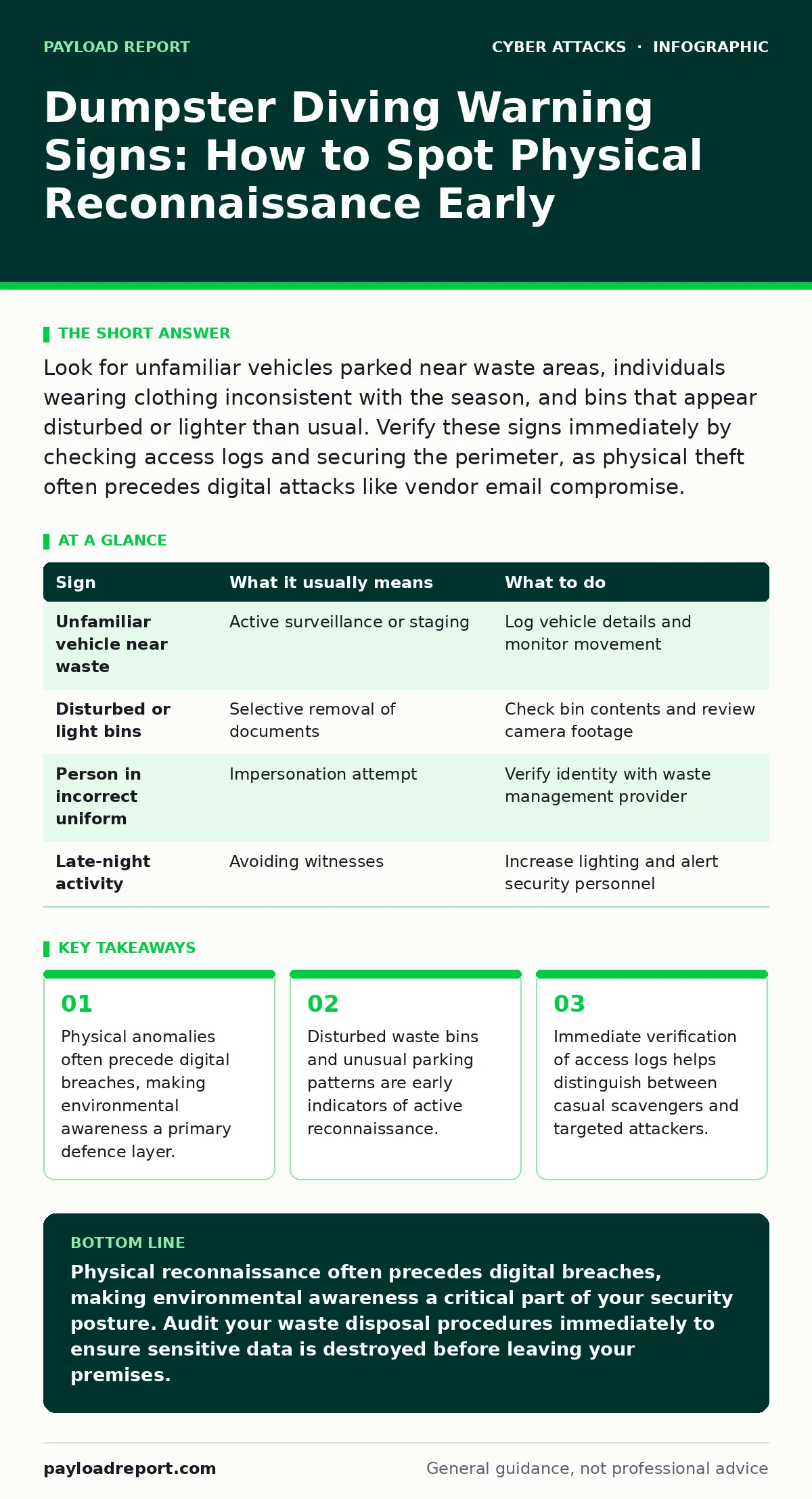
Look for unfamiliar vehicles parked near waste areas, individuals wearing clothing inconsistent with the season, and bins that appear disturbed or lighter than usual. Verify these signs immediately by checking access logs and securing the perimeter, as physical theft often precedes digital attacks like vendor email compromise.
The Illusion of Digital Security
Many organisations focus entirely on network perimeters while ignoring the physical boundary. An attacker does not need to bypass a firewall if they can simply walk to the loading bay. This physical approach, often called dumpster diving, involves searching through discarded materials for sensitive information. It relies on the assumption that what is thrown away is no longer protected.
The most dangerous aspect of this tactic is its invisibility to standard monitoring tools. A firewall log shows no entry, and an intrusion detection system remains silent. The breach happens in the open, under the light of a security camera that no one is watching. You must treat the waste area as a high-security zone, not an afterthought.
Obvious Indicators of Presence
Some signs of physical reconnaissance are difficult to miss if you know what to look for. Unfamiliar vehicles parked near waste collection points for extended periods are a primary red flag. These vehicles often lack local registration or have obscured number plates. The driver may remain inside the vehicle, waiting for staff to leave the area.
Another obvious sign is the presence of individuals wearing clothing that does not match the weather or the surrounding workforce. An attacker might wear a high-vis vest to blend in with maintenance staff, but the fit or brand often looks incorrect. They may also carry bags that appear disproportionately large for casual scavenging. These visual cues suggest preparation rather than opportunism.
Subtle Signs That Escape Notice
More sophisticated attackers avoid obvious visual anomalies. They may pose as delivery personnel or waste management staff, using legitimate-looking uniforms. The sign here is not their appearance, but their movement. Watch for individuals who move with purpose towards specific bins rather than wandering randomly. They know exactly where the accounting or HR departments dispose of their waste.
A harder sign to detect is the state of the bins themselves. If a bin that usually holds heavy, compacted waste appears lighter or has been partially emptied, it indicates prior access. The attacker may have removed only the most valuable documents, leaving the rest to maintain the illusion of normalcy. This selective removal is a strong indicator of targeted reconnaissance rather than casual scavenging.
| Sign | What it usually means | What to do |
|---|---|---|
| Unfamiliar vehicle near waste | Active surveillance or staging | Log vehicle details and monitor movement |
| Disturbed or light bins | Selective removal of documents | Check bin contents and review camera footage |
| Person in incorrect uniform | Impersonation attempt | Verify identity with waste management provider |
| Late-night activity | Avoiding witnesses | Increase lighting and alert security personnel |
The Connection to Digital Attacks
Physical theft rarely exists in isolation. Documents recovered from bins often contain credentials, internal directory structures, or project codenames. Attackers use this information to craft highly targeted phishing kits or to bypass multi-factor authentication. Without this physical data, a generic spear-phishing attempt is easily spotted. With it, the message appears to come from a known colleague or vendor.
This physical data can also help an attacker understand your email infrastructure. Knowing the correct naming conventions for internal accounts allows them to refine their email spoofing attempts. They can mimic the tone and structure of legitimate internal communications. This makes the subsequent digital attack far more convincing and harder to detect by automated filters.
Immediate Response Protocols
When you notice a sign of dumpster diving, do not confront the individual directly. Physical confrontation can escalate quickly and puts your staff at risk. Instead, document the incident immediately. Take photographs of the vehicle, the individual, and the state of the waste bins if safe to do so. Note the time and any distinguishing features.
Alert your security team and review access logs for the waste area. Cross-reference this physical activity with any recent login alerts or unusual network traffic. If you suspect data theft, initiate your incident response plan. Assume that any sensitive information discarded in the last few weeks is compromised. You may need to rotate credentials or update your DNS filtering rules to block known malicious domains.
See also: Prevent Vendor Email Compromise: Stop Payment Fraud at the Source
Preventing Future Access
The most effective defence is to ensure that sensitive information never reaches the bin. Shred all documents containing personal or financial data before disposal. Use cross-cut shredders that produce particles small enough to prevent reconstruction. This eliminates the value of the waste to an attacker.
Secure the waste area with fencing and lighting. Install cameras that cover the bins and the access routes. Limit access to authorised staff only. Regular audits of waste disposal procedures can identify gaps in your physical security. By treating waste as a potential data leak, you close a critical entry point that many attackers rely on.
Beyond the Bin
Physical reconnaissance extends beyond waste bins. Attackers may also search for sticky notes with passwords left on monitors or sticky notes with login details on desks. These low-hanging fruits are often ignored in favour of complex digital attacks. However, they provide the initial foothold needed for deeper infiltration.
Ensure that your staff understands the value of physical security. Training should cover not just phishing, but also the risks of leaving sensitive information in plain sight. Combine this awareness with technical controls like SPF records to verify email authenticity. A layered approach that includes both physical and digital safeguards provides the best protection against determined adversaries.
Key takeaways
- Physical anomalies often precede digital breaches, making environmental awareness a primary defence layer.
- Disturbed waste bins and unusual parking patterns are early indicators of active reconnaissance.
- Immediate verification of access logs helps distinguish between casual scavengers and targeted attackers.
Physical reconnaissance often precedes digital breaches, making environmental awareness a critical part of your security posture. Audit your waste disposal procedures immediately to ensure sensitive data is destroyed before leaving your premises.
Frequently asked questions
How can I tell if a bin has been tampered with?
Check for signs of forced entry, such as bent locks or torn lids. Also, look for bins that appear lighter than usual or have been partially emptied, which suggests selective removal of documents.
How does physical theft relate to email security?
Physical theft provides attackers with internal naming conventions and employee details, which they use to craft convincing phishing emails. This makes email spoofing more effective and harder to detect by automated filters.
How this guide was produced: written by the Payload Report editorial team with AI assistance, checked against the public references listed below, and reviewed when the facts change. See our editorial policy or report an error.