Third party risk assessment is important because it shifts security responsibility from internal controls to external dependencies. Without it, you inherit vulnerabilities you cannot patch. These assessments reveal hidden attack surfaces, ensure contractual compliance, and prevent single points of failure in your data supply chain before they become breaches.
Why is third party risk assessment important
Third party risk assessment is important because your organisation’s security boundary no longer ends at your firewall. It extends to every vendor, partner and service provider that touches your data. When you grant access to a third party, you effectively merge your attack surface with theirs. If their defences are weaker than yours, attackers will bypass your strong controls by entering through their weaker ones. This structural reality means that ignoring vendor risk is not a passive oversight; it is an active expansion of your vulnerability footprint.
The primary reason for these assessments is visibility. You cannot protect what you do not know exists. Many organisations maintain detailed maps of their own infrastructure but operate with blind spots regarding their suppliers. A software update, a database query or a support ticket can traverse multiple external networks before reaching your systems. Without a structured assessment process, you have no way of knowing whether those intermediate networks are secure. You are trusting strangers with your keys, hoping they lock their doors.
The hidden cost of trust without verification
Imagine a team that relies entirely on vendor self-certifications. They receive a PDF stating the supplier is compliant and file it away. Suppose that supplier suffers a phishing attack three months later. Their internal systems are compromised, and attackers move laterally to the shared database they access for the first team. The first team has no visibility into this shift. They continue operating, unaware that their data is now exposed.
Now imagine a second team that performs continuous technical assessments. They monitor the supplier’s external security posture using passive telemetry. When the supplier’s security headers change or their certificate transparency logs show unusual activity, the second team receives an alert. They investigate and find the compromise early. They revoke access before data exfiltration occurs. The difference between these teams is not effort; it is the mechanism of trust. The first team trusts a document. The second team trusts evidence.
What goes wrong when you skip the process
When organisations skip regular assessments, they create a false sense of security. They believe that because they chose a reputable vendor, the risk is managed. This is a dangerous assumption. Reputable vendors can still fail. Their security teams may leave. Their budgets may be cut. Their cloud configurations may drift. None of these changes are visible to you unless you are looking.
The most common failure mode is credential sharing. Many integrations require shared API keys or database credentials. If the vendor loses control of these credentials, you lose control of your data. You cannot change a key that belongs to another organisation without breaking the service. This dependency creates a hostage situation. The vendor’s security weaknesses become your immediate liabilities. You are forced to wait for their remediation timeline, which may not align with your risk tolerance.
Another hidden cost is the accumulation of technical debt. As you add more vendors, the complexity of your security architecture grows exponentially. Each new connection adds a potential entry point. Without a rigorous assessment process, you cannot prioritise which risks to mitigate first. You end up spreading your security resources thinly, trying to monitor everything but protecting nothing effectively. This leads to alert fatigue and missed signals.
Reasons for assessment in order of weight
The reasons for conducting third-party risk assessments vary in impact. You should prioritise them based on the potential damage to your organisation. The heaviest weight goes to direct data exposure. If a vendor holds your customer data, a breach at their end is a breach at your end. This triggers legal obligations and reputational damage. You must verify their encryption standards, access controls and incident response capabilities.
The second heaviest weight is operational continuity. If a vendor provides a critical service, their downtime is your downtime. Assessments should include their disaster recovery plans and business continuity strategies. You need to know how long they can operate without their primary infrastructure. This is not just about security; it is about resilience. A vendor who cannot recover from an outage is a single point of failure.
The third reason is regulatory compliance. Many frameworks require you to demonstrate due diligence in managing third-party risks. If you suffer a breach and cannot prove you assessed the vendor, you may face additional penalties. This is not just about GDPR breach notification rule compliance; it is about proving you took reasonable steps to prevent the incident. Documentation is your defence.
What to do with that knowledge
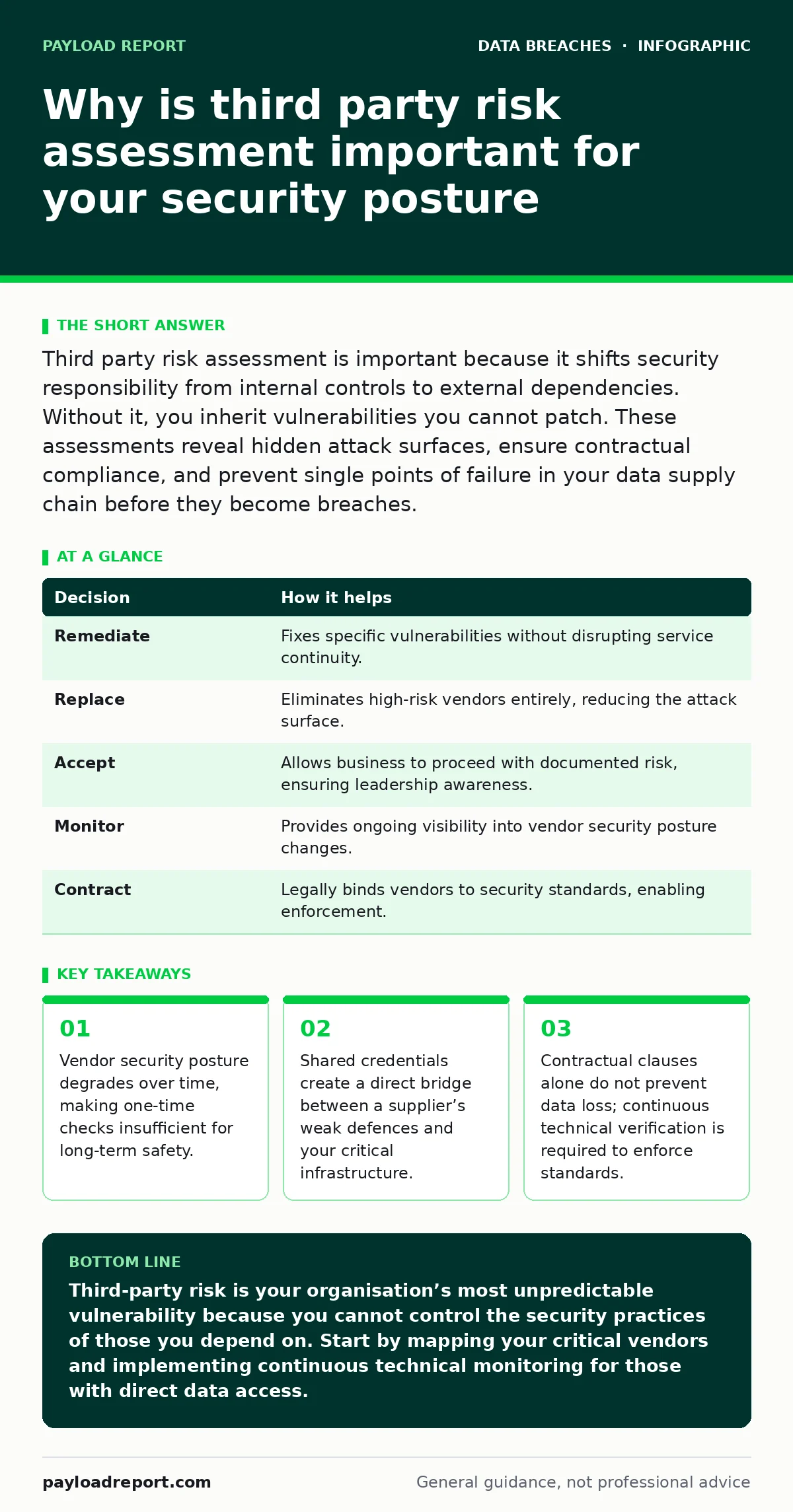
Once you have assessed a vendor, you must act on the findings. Do not just file the report. Use the data to make decisions. If a vendor fails to meet your minimum security standards, you must decide whether to remediate, replace or accept the risk. Remediation involves working with the vendor to fix specific issues. This requires clear contracts and regular check-ins. Replacement is the most secure option but may not be feasible. Acceptance requires formal sign-off from leadership.
You should also integrate these assessments into your procurement process. Do not allow new vendors to go live without a baseline assessment. This prevents the accumulation of unvetted risk. Make security a gatekeeper, not an afterthought. This shifts the culture from reactive to proactive. It forces business units to consider security before signing contracts.
Finally, use the data to improve your own security. If multiple vendors struggle with a specific control, such as multi-factor authentication, you may need to adjust your own requirements. You can mandate that all vendors implement specific controls before gaining access. This raises the overall security bar for your ecosystem. It is a collective defence strategy.
| Decision | How it helps |
|---|---|
| Remediate | Fixes specific vulnerabilities without disrupting service continuity. |
| Replace | Eliminates high-risk vendors entirely, reducing the attack surface. |
| Accept | Allows business to proceed with documented risk, ensuring leadership awareness. |
| Monitor | Provides ongoing visibility into vendor security posture changes. |
| Contract | Legally binds vendors to security standards, enabling enforcement. |
See also: Encryption at Rest Checklist for Data Protection
The edge case where usual advice fails
Standard advice often suggests using questionnaires to assess vendors. This approach fails when vendors provide generic answers. They may tick "yes" for every control, regardless of their actual implementation. This creates a paper trail of compliance that masks reality. You are not assessing their security; you are assessing their willingness to fill out forms.
The hidden cost here is the time spent reviewing false positives. Your security team wastes hours verifying claims that are likely untrue. This delays onboarding and creates friction with business units. It also gives a false sense of security. You believe the vendor is secure because they said so. The non-obvious consequence is that sophisticated attackers exploit this gap. They target the weak points that the questionnaire missed.
To avoid this, combine questionnaires with technical verification. Use passive scanning to check external configurations. Verify certificate transparency logs. Check for known vulnerabilities in their public-facing assets. This provides objective data that cannot be faked. It complements the subjective data from questionnaires. You get a more complete picture of the vendor’s true security posture. This hybrid approach is more work, but it is far more effective.
Continuous monitoring as a safety net
Assessments are not a one-time event. They are a continuous process. Vendor security postures change daily. New vulnerabilities are discovered. Staff turnover occurs. Configurations drift. A vendor who is secure today may be insecure tomorrow. You need a mechanism to detect these changes in real-time.
Continuous monitoring tools can track external indicators of compromise. They can alert you to changes in DNS records, SSL certificates or web server headers. These are low-cost signals that can indicate a breach. For example, if a vendor’s website suddenly loads from a different IP address, it may indicate hijacking. If their SSL certificate is revoked, it may indicate a compromise. These signals are often missed by manual assessments.
This approach does not replace deep assessments. It supplements them. It provides early warning signs that allow you to investigate before a breach occurs. It is the difference between reacting to a disaster and preventing one. You cannot monitor every vendor with the same intensity, but you can prioritise based on risk. High-risk vendors get deep assessments and continuous monitoring. Low-risk vendors get periodic checks.
Key takeaways
- Vendor security posture degrades over time, making one-time checks insufficient for long-term safety.
- Shared credentials create a direct bridge between a supplier’s weak defences and your critical infrastructure.
- Contractual clauses alone do not prevent data loss; continuous technical verification is required to enforce standards.
Third-party risk is your organisation’s most unpredictable vulnerability because you cannot control the security practices of those you depend on. Start by mapping your critical vendors and implementing continuous technical monitoring for those with direct data access.
Frequently asked questions
How often should I reassess a third-party vendor?
Reassess high-risk vendors annually or whenever a significant change occurs in their service or security posture. Low-risk vendors can be reassessed every two years.
Can I outsource my third-party risk assessments?
You can use external tools for technical monitoring, but the final risk decision must remain with your organisation. Outsourcing the assessment does not outsource the liability.
What if a vendor refuses to provide security details?
Treat this as a high-risk indicator. You cannot manage risk you cannot see. Consider replacing the vendor or restricting their access to non-sensitive data only.
How do I handle misdirected emails from vendors?
Implement strict data handling policies and training for vendor staff. Use encryption for sensitive data in transit. Monitor for unusual data access patterns that may indicate leakage.
How this guide was produced: written by the Payload Report editorial team with AI assistance, checked against the public references listed below, and reviewed when the facts change. See our editorial policy or report an error.