
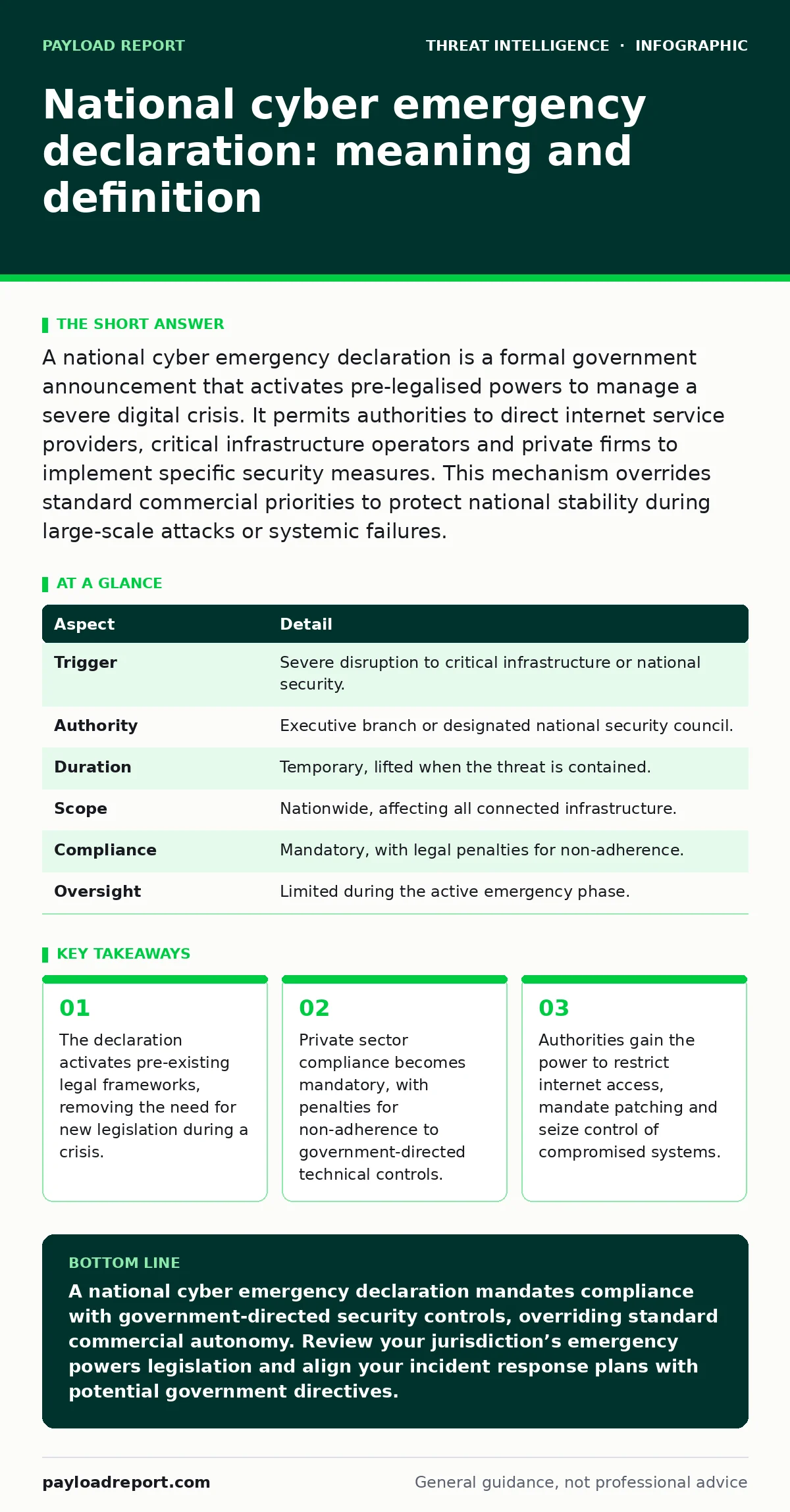
A national cyber emergency declaration is a formal government announcement that activates pre-legalised powers to manage a severe digital crisis. It permits authorities to direct internet service providers, critical infrastructure operators and private firms to implement specific security measures. This mechanism overrides standard commercial priorities to protect national stability during large-scale attacks or systemic failures.
Everyday analogy for emergency powers
Imagine a major highway collapse during a flood. Traffic police do not ask drivers for permission to reroute vehicles. They deploy barriers, close lanes and direct emergency services through restricted zones. The normal rules of the road are suspended to prevent further disaster. A national cyber emergency declaration operates on this same principle.
It treats the digital infrastructure as a public utility under threat. The government assumes the role of the traffic controller. Individual property rights and commercial autonomy yield to collective safety requirements. This shift is not permanent. It remains active only until the immediate threat is contained and normal operations can resume without risking further systemic damage.
The origin of the term in practice
The concept stems from civil defence legislation rather than pure cybersecurity law. Most nations already possess emergency powers to respond to natural disasters, pandemics or terrorist attacks. Cyber incidents were added to these frameworks as digital dependencies grew. The term "national cyber emergency" formalises this inclusion. It signals that a digital event has reached the threshold of a national security incident.
This threshold is rarely defined by the number of affected users alone. It focuses on the impact on critical national functions. Power grids, financial clearing systems and healthcare data networks trigger these declarations more often than retail breaches. The legal basis allows executives to act swiftly without waiting for parliamentary debate or judicial approval. This speed is the defining characteristic of the mechanism.
How the declaration works day to day
Operational teams experience this declaration as a sudden change in regulatory status. Routine security monitoring shifts to compliance monitoring. Government agencies issue specific technical directives. These directives may include mandatory patching timelines, forced password resets or the blocking of specific IP ranges. Internet service providers must implement these blocks at the network edge. Cloud providers may be required to isolate affected tenants.
The declaration creates a legal shield for these actions. Companies that refuse to comply face fines or criminal charges. This removes the usual commercial hesitation. Profit margins and service level agreements become secondary to national stability. Security operations teams must align their incident response plans with these external mandates. Internal decision-making authority is partially ceded to state actors.
| Aspect | Detail |
|---|---|
| Trigger | Severe disruption to critical infrastructure or national security. |
| Authority | Executive branch or designated national security council. |
| Duration | Temporary, lifted when the threat is contained. |
| Scope | Nationwide, affecting all connected infrastructure. |
| Compliance | Mandatory, with legal penalties for non-adherence. |
| Oversight | Limited during the active emergency phase. |
Common misconceptions about scope
Many organisations assume a cyber emergency declaration only applies to government networks. This is incorrect. The power extends to private sector entities that operate critical infrastructure. This includes energy, transport, healthcare and financial services. Another common error is believing the declaration creates new laws. It activates existing emergency powers. The legal framework must already be in place.
If the law does not exist, the declaration is unconstitutional or ineffective. Teams often confuse this with a general advisory warning. An advisory suggests best practices. An emergency declaration mandates specific actions. The difference is legal enforceability. Failing to distinguish between the two leads to compliance gaps. Security leaders must review their legal obligations before a crisis occurs.
Integration with threat intelligence platforms
Threat intelligence platforms play a dual role during these events. They ingest government advisories as high-priority feeds. They also distribute the technical indicators of compromise mandated by the declaration. This ensures that private sector defences align with national strategies. The platforms automate the blocking of malicious domains and IP addresses. This reduces the manual workload on security teams.
However, the volume of data increases significantly. False positives may rise as broad blocks are implemented. Analysts must validate alerts to avoid disrupting legitimate business operations. The integration allows for rapid dissemination of patches and mitigation strategies. It creates a unified defence posture across the nation. Without this integration, the declaration’s effectiveness is limited to those who monitor government channels directly.
The role of information sharing groups
Information Sharing and Analysis Centres (ISACs) become critical conduits during emergencies. They translate high-level government directives into sector-specific guidance. For example, a financial ISAC will interpret general banking security mandates for its members. This translation is vital for operational clarity. Private firms often lack the resources to interpret broad legal language.
ISACs provide the technical context needed for implementation. They also aggregate threat data from members to inform government decisions. This two-way flow of information improves the accuracy of national responses. It ensures that the government’s actions are based on real-time ground truth. The collaboration reduces duplication of effort. It allows for a coordinated defence that spans multiple industries and jurisdictions.
What people usually get wrong
The most persistent error is assuming the declaration ends the incident. It marks the beginning of the containment phase. The threat actor is still active. The declaration simply changes the rules of engagement. Another mistake is neglecting the legal implications of data handling. During an emergency, data sharing requirements may change. Privacy laws may be suspended or modified.
Teams must understand these temporary shifts to avoid legal exposure. Finally, many organisations fail to test their emergency response plans. They assume that standard incident response procedures will suffice. They do not account for the loss of external dependencies. A declaration may cut off access to cloud providers or third-party support. Plans must include offline contingencies.
Hidden costs and trade-offs
The immediate benefit of a declaration is coordinated defence. The hidden cost is the erosion of operational agility. Mandatory controls may conflict with business continuity requirements. Forcing a system offline to contain a threat may cause greater economic damage than the threat itself. Security teams must weigh these trade-offs carefully. The declaration also creates a single point of failure in decision-making.
If the government’s assessment is wrong, the entire nation follows a flawed strategy. This centralisation reduces the ability of local teams to adapt to unique local conditions. The pressure to comply can also lead to rushed implementations. This increases the risk of introducing new vulnerabilities. The focus on immediate containment may delay long-term remediation efforts.
Preparing for the possibility
Preparation involves more than just technical readiness. It requires legal and operational alignment. Review the emergency powers legislation in your jurisdiction. Understand the thresholds that trigger a declaration. Identify which of your assets fall under critical infrastructure definitions. Establish communication channels with relevant ISACs and government agencies.
Test your ability to implement mandatory controls rapidly. Ensure that your incident response plans include scenarios for government intervention. Train staff on the legal implications of non-compliance. Document your compliance processes to demonstrate good faith. This preparation reduces panic and confusion when a declaration occurs. It allows teams to focus on containment rather than interpretation.
Conclusion on emergency powers
A national cyber emergency declaration is a tool of last resort. It reflects the severity of the threat and the limitations of voluntary cooperation. It shifts the balance of power from private owners to public authorities. Understanding its mechanics allows security teams to navigate the legal and technical challenges. It ensures that defensive actions align with national priorities. The declaration is not a silver bullet. It is a framework for coordinated action. Success depends on the quality of the underlying threat intelligence and the speed of implementation. Teams must remain agile and compliant. The goal is to restore normal operations as quickly as possible.
Key takeaways
- The declaration activates pre-existing legal frameworks, removing the need for new legislation during a crisis.
- Private sector compliance becomes mandatory, with penalties for non-adherence to government-directed technical controls.
- Authorities gain the power to restrict internet access, mandate patching and seize control of compromised systems.
- The definition varies by jurisdiction, but the core function is always the temporary suspension of normal operational autonomy.
A national cyber emergency declaration mandates compliance with government-directed security controls, overriding standard commercial autonomy. Review your jurisdiction’s emergency powers legislation and align your incident response plans with potential government directives.
Frequently asked questions
Does a cyber emergency declaration apply to small businesses?
It primarily targets critical infrastructure operators. However, small businesses connected to these networks may face indirect restrictions. Internet service providers may implement blocks that affect all customers. Compliance with upstream mandates is often required.
How long does a cyber emergency declaration last?
Duration varies by jurisdiction and threat severity. It remains active until the government determines the threat is contained. This can range from days to weeks. Extensions are possible if the threat persists.
Can a company refuse a government directive under this declaration?
Refusal is generally illegal and carries penalties. The declaration provides legal authority for mandatory compliance. Exceptions are rare and usually require judicial intervention. Non-compliance can result in fines or criminal charges.
How does this differ from a standard security advisory?
An advisory suggests best practices and is voluntary. A declaration mandates specific actions and is legally enforceable. The difference lies in the legal obligation. Failure to follow an advisory has no legal penalty. Failure to follow a declaration does.
How this guide was produced: written by the Payload Report editorial team with AI assistance, checked against the public references listed below, and reviewed when the facts change. See our editorial policy or report an error.