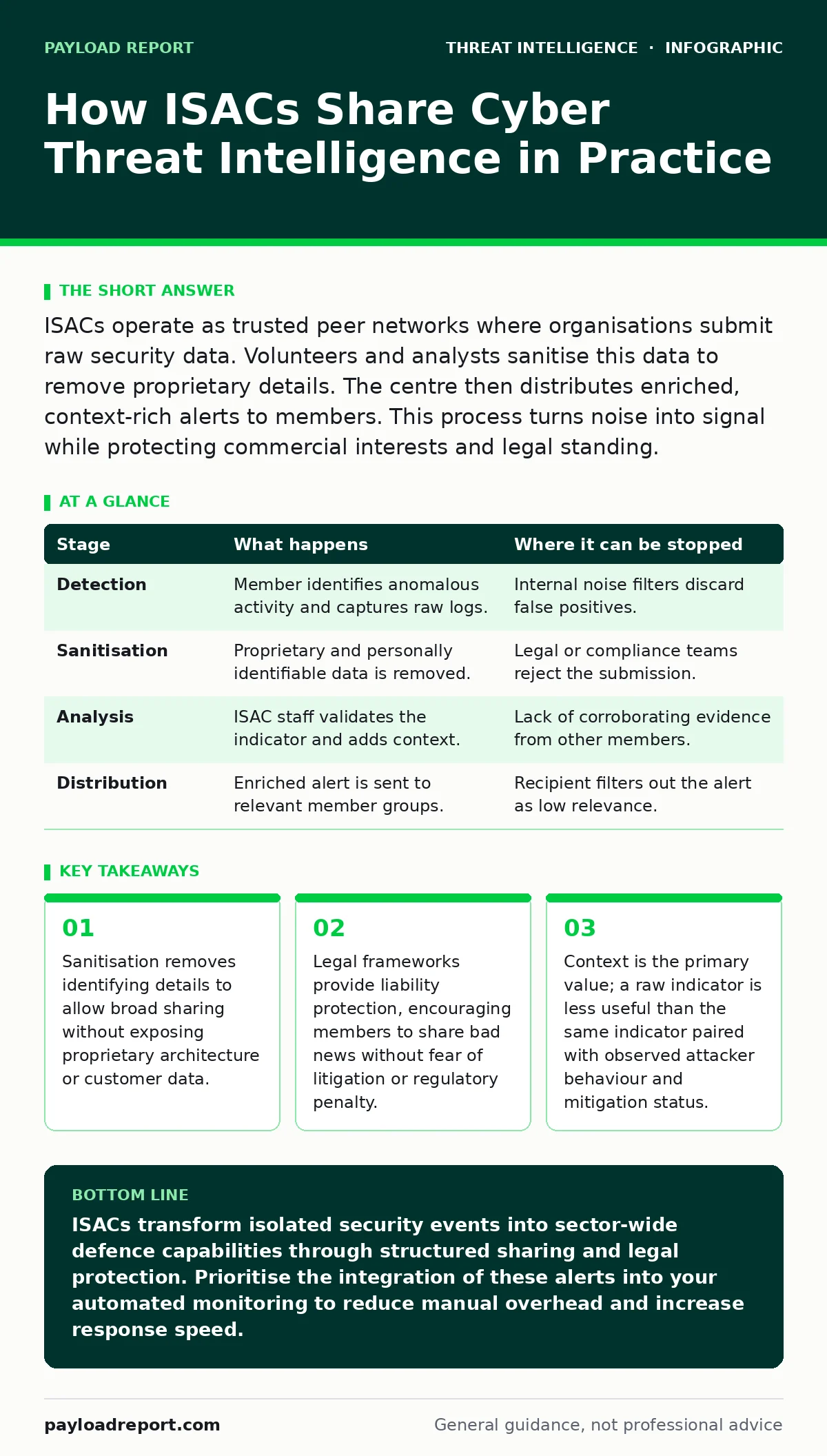
ISACs operate as trusted peer networks where organisations submit raw security data. Volunteers and analysts sanitise this data to remove proprietary details. The centre then distributes enriched, context-rich alerts to members. This process turns noise into signal while protecting commercial interests and legal standing.
The Foundation of Trust and Law
An Information Sharing and Analysis Centre, or ISAC, functions as a structured community for peers within a specific sector. These groups exist because individual organisations often lack the broader context needed to distinguish a local anomaly from a sector-wide attack. The mechanism relies on two pillars: operational trust and legal protection. Without legal safeguards, organisations hesitate to share data about their own vulnerabilities or failures. The liability framework ensures that sharing good faith intelligence does not expose the provider to lawsuits from recipients who may act on that information.
This structure differs from open-source intelligence communities. In an ISAC, membership is restricted to entities within the defined sector. This restriction creates a bounded environment where the risk of exposing critical infrastructure details to adversaries is lower. You are sharing with competitors who face the same regulatory pressures and attack vectors. This shared burden aligns incentives. Everyone benefits from a faster collective response, even if no single organisation can solve the problem alone.
Stage 1: Detection and Initial Triage
The process begins when a member organisation detects suspicious activity. This might be a failed login attempt, a malformed packet, or an unusual process execution. The security team captures the raw data associated with the event. This data often contains noise, false positives, or irrelevant internal identifiers. The first step is internal triage to determine if the activity represents a genuine threat.
If the activity is deemed significant, the organisation prepares a report. This report must balance detail with discretion. You need enough technical specificity for the ISAC to validate the claim, but not so much that you reveal your internal network topology. This stage is where many potential contributions stall. Analysts often struggle to decide what constitutes sensitive proprietary information. The rule of thumb is that if the data helps an attacker compromise your specific instance, it is too detailed. If it helps them understand the general technique, it is shareable.
| Stage | What happens | Where it can be stopped |
|---|---|---|
| Detection | Member identifies anomalous activity and captures raw logs. | Internal noise filters discard false positives. |
| Sanitisation | Proprietary and personally identifiable data is removed. | Legal or compliance teams reject the submission. |
| Analysis | ISAC staff validates the indicator and adds context. | Lack of corroborating evidence from other members. |
| Distribution | Enriched alert is sent to relevant member groups. | Recipient filters out the alert as low relevance. |
Stage 2: Sanitisation and Anonymisation
Sanitisation is the most critical operational step in the ISAC workflow. It involves stripping the data of any element that could identify the submitting organisation or its customers. This includes removing internal IP addresses, specific server names, and customer identifiers. The goal is to create a generic representation of the attack. For example, instead of reporting a breach of a specific database server, you report the exploitation of a known vulnerability in that type of database.
This step requires careful handling of indicators of compromise. An IP address might be useful, but if it is a dynamic residential address, it has little long-term value. If it is a command and control server, it is highly valuable. The ISAC staff or volunteer analysts help members navigate this distinction. They look for patterns that transcend the specific instance. This is where the community expertise shines. A member might not know that a certain file hash is associated with a broader campaign, but the ISAC analyst might recognise the pattern from other submissions.
Stage 3: Analysis and Contextualisation
Once the data is sanitised, the ISAC performs analysis. This is not just about verifying the technical accuracy of the indicator. It is about adding context. Why is this attack happening now? What is the likely objective? Which other sectors are affected? The ISAC aggregates data from multiple members to spot trends. A single report of a specific malware variant might be an isolated incident.
This aggregation allows the ISAC to produce high-fidelity alerts. They can distinguish between a scanning botnet, which is noisy but low risk, and a targeted intrusion attempt, which is silent but high risk. The added context includes mitigation advice. This advice is often tailored to the sector. For instance, advice for a power utility will differ from advice for a retail bank, even if the underlying vulnerability is the same. The ISAC understands the operational technology constraints of its members. This depth of knowledge is what separates an ISAC alert from a generic security advisory.
Stage 4: Distribution and Feedback
The final stage is distribution. The ISAC sends the alert to its members. This is rarely a broadcast to everyone. Alerts are often targeted. If the threat is specific to a certain type of hardware or software, only members using that technology receive the high-priority alert. This reduces alert fatigue. Members are more likely to act on an alert that is clearly relevant to their environment.
Feedback loops are essential for the system to improve. Members report back on whether the indicator was valid in their environment. Did they see the same activity? Was the mitigation effective? This feedback helps the ISAC refine its future alerts. It also helps identify if the initial report was a false positive. If multiple members report no activity, the ISAC can downgrade the alert or retract it. This continuous cycle of sharing, acting, and reporting back builds the collective defence.
See also: Advanced Persistent Threats: Definition, Mechanics and Detection · Process Injection: How Code Runs Without A Process
Limits and Hidden Costs
ISACs are not a substitute for your own security monitoring. They provide context, not detection. You still need to monitor your own networks. The ISAC tells you what to look for, but it cannot look for it for you. Relying solely on external alerts leaves gaps in your coverage. Attackers often customise their tools for specific targets. A generic alert might miss a bespoke attack designed for your organisation.
There is also a hidden cost in participation. Staff time is required to sanitise data and review alerts. This is often an unfunded burden on existing security teams. If your team is already overwhelmed, adding ISAC duties can lead to burnout or poor quality submissions. You must weigh the benefit of shared intelligence against the operational cost of contributing. Not every incident needs to be shared. Focus on high-value, sector-relevant threats.
Integration with Other Defences
To maximise the value of ISAC intelligence, you must integrate it into your existing workflows. This often involves using threat intelligence platforms to automate the ingestion of alerts. These platforms can parse the structured data from the ISAC and push relevant indicators to your firewalls or endpoint detection systems. Without automation, the volume of information can overwhelm analysts.
Imagine you receive an alert about a new phishing campaign. Manually updating your email filters is slow and error-prone. An automated pipeline ensures that the indicators are applied consistently across your entire estate. This integration turns passive information into active defence. It also allows you to contribute back more efficiently. Your automated systems can detect the same indicators and feed them back to the ISAC, creating a faster feedback loop.
The Role of Human Analysis
Despite advances in automation, human analysis remains central to the ISAC model. Machines can match indicators, but they struggle with intent and nuance. Human analysts interpret the strategic implications of an attack. They understand the business impact of a disruption to a payment system versus a disruption to a marketing website. This strategic insight is difficult to automate.
The human element also fosters trust. Members know who is analysing the data. They can ask questions and seek clarification. This direct line of communication is invaluable during a crisis. When a major attack is underway, the ability to speak directly to the analysts who are tracking it can save hours of confusion. The ISAC provides a channel for this dialogue, bridging the gap between raw data and decision-making.
Key takeaways
- Sanitisation removes identifying details to allow broad sharing without exposing proprietary architecture or customer data.
- Legal frameworks provide liability protection, encouraging members to share bad news without fear of litigation or regulatory penalty.
- Context is the primary value; a raw indicator is less useful than the same indicator paired with observed attacker behaviour and mitigation status.
ISACs transform isolated security events into sector-wide defence capabilities through structured sharing and legal protection. Prioritise the integration of these alerts into your automated monitoring to reduce manual overhead and increase response speed.
Frequently asked questions
How do I know if my organisation should join an ISAC?
Consider joining if you operate in a sector with shared infrastructure or regulatory requirements. The value lies in the collective insight, which is most useful for industries facing common attack vectors.
Is the data shared in ISACs confidential?
Yes, strict confidentiality agreements govern all shared data. Members are prohibited from sharing the information outside the group. This legal framework protects your proprietary data while allowing for broad intelligence sharing.
Can ISACs share information with government agencies?
Many ISACs have relationships with government cybersecurity agencies. However, they typically share only anonymised, aggregated data. Individual member reports are not passed on without explicit consent, preserving member privacy.
What if I suspect a breach but am not sure?
You can still share the uncertainty. Submitting incomplete or uncertain data is valuable. The ISAC analysts can help determine if your suspicion aligns with other reports. This collaborative triage helps identify emerging threats faster.
How this guide was produced: written by the Payload Report editorial team with AI assistance, checked against the public references listed below, and reviewed when the facts change. See our editorial policy or report an error.