
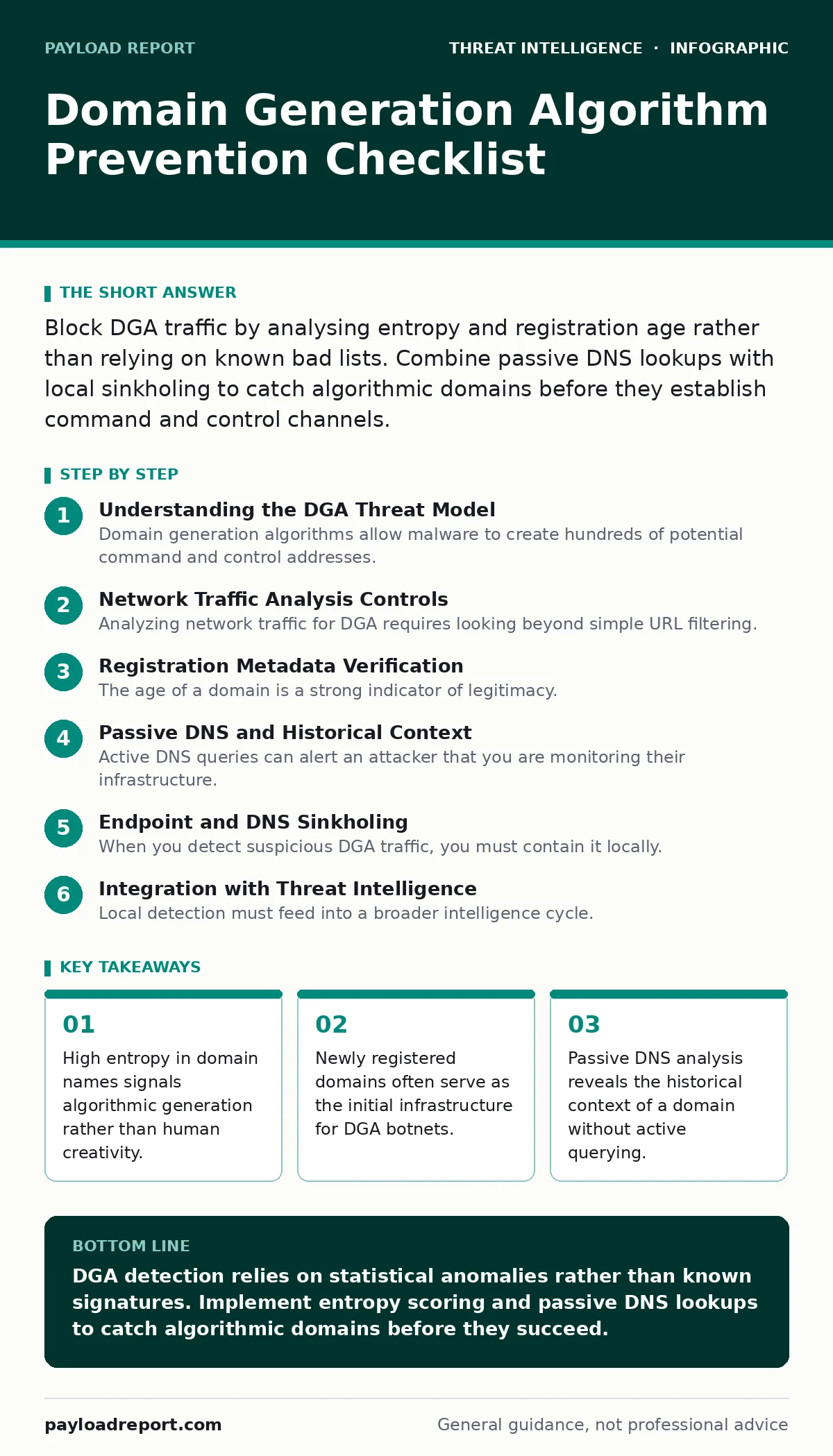
Block DGA traffic by analysing entropy and registration age rather than relying on known bad lists. Combine passive DNS lookups with local sinkholing to catch algorithmic domains before they establish command and control channels.
Understanding the DGA Threat Model
Domain generation algorithms allow malware to create hundreds of potential command and control addresses. The malware runs the same algorithm as the attacker, ensuring both sides land on the same active domain. This mechanism bypasses static blocklists because the domains change daily or hourly. You cannot predict the next domain, but you can identify the statistical anomalies that DGA creates.
Traditional security tools look for known malicious indicators. DGA traffic lacks these indicators until the domain is already active and communicating. By the time a reputation service flags the domain, the attacker has already issued commands or exfiltrated data. You must shift from reactive blocking to proactive detection based on naming patterns and registration metadata.
Network Traffic Analysis Controls
Analyzing network traffic for DGA requires looking beyond simple URL filtering. You need mechanisms that evaluate the randomness and structure of requested hostnames. The following items help you build a detection layer that identifies algorithmic noise amidst legitimate traffic.
- Deploy entropy scoring on DNS queries: High mathematical randomness indicates a generated string rather than a memorable brand name.
- Monitor query volume per source host: A single machine requesting dozens of unique domains in minutes suggests automated scanning.
- Flag requests to non-existent domains: NX responses for high-entropy names reveal a botnet trying to find its active controller.
- Inspect TLS SNI fields: The Server Name Indication often reveals the intended domain before the certificate handshake completes.
These controls add processing overhead to your DNS resolvers. High entropy scoring requires calculating character distribution for every query, which can impact performance on large networks. You must balance detection depth with latency requirements.
Registration Metadata Verification
The age of a domain is a strong indicator of legitimacy. Most DGA domains are registered shortly before they are needed. Legitimate businesses rarely register domains and use them for critical infrastructure within hours. Checking registration metadata adds a layer of context that pure network analysis misses.
- Reject connections to domains younger than 48 hours: Fresh registrations lack the trust history of established brands.
- Verify registrar reputation: Some registrars are known for lax identity verification, making them popular for disposable infrastructure.
- Cross-reference WHOIS data consistency: Mismatches between contact details and domain purpose often signal temporary abuse.
- Check for privacy protection services: While privacy is legal, its combination with new registration and high entropy raises suspicion.
You should integrate these checks into your proxy or gateway. Blocking all new domains is impractical, as legitimate startups exist. You must tune your thresholds to avoid disrupting business operations while catching the obvious outliers. This approach complements guides on threat intelligence platforms by adding local context to global data.
Passive DNS and Historical Context
Active DNS queries can alert an attacker that you are monitoring their infrastructure. Passive DNS relies on cached records from previous observations. This method allows you to see the history of a domain without sending a direct request to the attacker’s nameserver. It provides a safer way to assess risk.
- Query passive DNS databases: Historical records show if a domain has been associated with malware in the past.
- Analyze IP address reuse patterns: DGA domains often resolve to the same IP clusters repeatedly over time.
- Track certificate transparency logs: New certificates for random domains appear in public logs before the domain is even used.
- Monitor for rapid IP rotation: A domain resolving to different IPs every few minutes suggests dynamic infrastructure.
Passive data is not real-time. A newly generated domain will have no history. You must combine passive lookups with real-time entropy checks to cover the full lifecycle of a DGA attack. This strategy aligns with principles found in defense evasion guides, where attackers try to hide in plain sight.
Endpoint and DNS Sinkholing
When you detect suspicious DGA traffic, you must contain it locally. Redirecting the traffic to a controlled internal server, known as sinkholing, prevents the malware from reaching its controller. This breaks the command and control loop and allows you to study the behaviour safely.
- Configure local DNS sinkholes: Redirect suspected DGA domains to an internal IP that logs all requests.
- Isolate affected endpoints automatically: Quarantine machines that exhibit high-volume DGA-like query patterns.
- Log all sinkholed traffic: Detailed logs help you reverse-engineer the algorithm used by the malware.
- Update blocklists dynamically: Use sinkhole data to generate new blocklists for your perimeter devices.
Sinkholing does not remove the malware from the endpoint. It only cuts off communication. You still need to investigate the host for other indicators of compromise. This process is similar to handling process injection attempts, where the goal is to stop execution rather than just block network access.
See also: Windows Event Log Monitoring: Implementation Steps and Verification · Defense Evasion Explained: How Attackers Hide in Plain Sight
Integration with Threat Intelligence
Local detection must feed into a broader intelligence cycle. Sharing indicators with trusted partners helps the community stay ahead of evolving algorithms. However, you must ensure that the data you share is accurate and actionable. Sharing low-quality data creates noise and reduces the value of the ecosystem.
- Contribute clean indicators to ISACs: Information Sharing and Analysis Centers aggregate data from multiple sectors.
- Validate findings before sharing: Confirm that the domain is truly malicious to avoid polluting shared datasets.
- Automate indicator ingestion: Feed verified DGA indicators directly into your firewalls and proxies.
- Participate in purple teaming exercises: Test your DGA detection rules against simulated attacks internally.
This collaborative approach ensures that your defences benefit from the collective experience of other organisations. It also helps you identify gaps in your own monitoring. For deeper insights on external threats, consider reading about initial access brokers who often sell access to compromised systems.
Key takeaways
- High entropy in domain names signals algorithmic generation rather than human creativity.
- Newly registered domains often serve as the initial infrastructure for DGA botnets.
- Passive DNS analysis reveals the historical context of a domain without active querying.
DGA detection relies on statistical anomalies rather than known signatures. Implement entropy scoring and passive DNS lookups to catch algorithmic domains before they succeed.
Frequently asked questions
What is the difference between DGA and fast-flux DNS?
DGA generates new domain names algorithmically, while fast-flux DNS rapidly changes the IP addresses of a static domain name.
Can entropy scoring cause false positives?
Yes, legitimate services like CDNs or randomised ad networks may produce high-entropy strings, requiring careful tuning.
How do I tune my entropy thresholds?
Analyse your baseline traffic to determine the average entropy of legitimate domains, then set thresholds slightly above that norm.
Is sinkholing legal?
Sinkholing your own network traffic is generally legal, but intercepting third-party traffic may violate privacy laws.
How this guide was produced: written by the Payload Report editorial team with AI assistance, checked against the public references listed below, and reviewed when the facts change. See our editorial policy or report an error.