
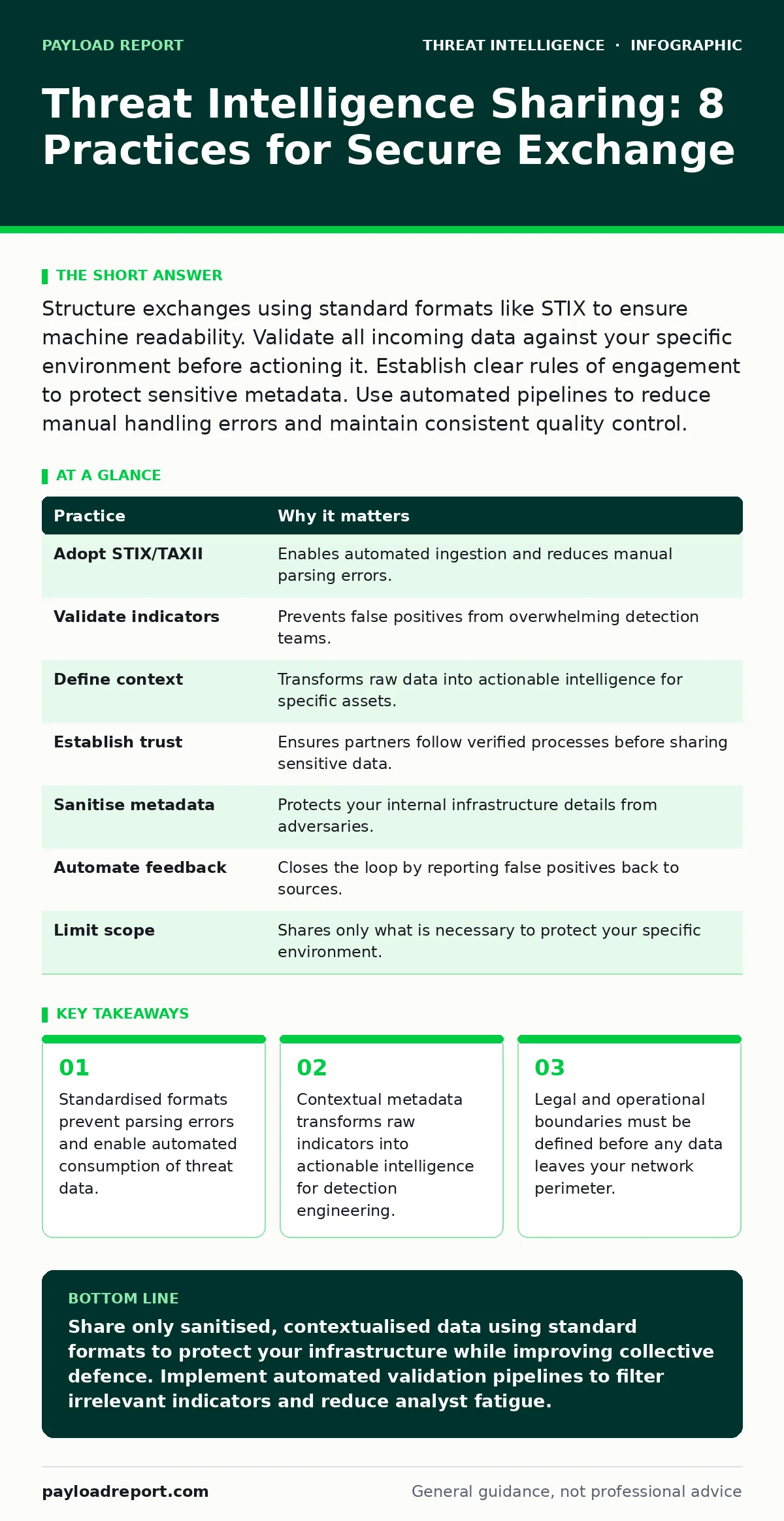
Structure exchanges using standard formats like STIX to ensure machine readability. Validate all incoming data against your specific environment before actioning it. Establish clear rules of engagement to protect sensitive metadata. Use automated pipelines to reduce manual handling errors and maintain consistent quality control.
Standardise Data Formats for Machine Readability
Threat intelligence sharing fails when data arrives in unstructured formats that require manual parsing. Human analysts waste hours converting CSV files or email attachments into a format your security tools can ingest. Standardised protocols allow automated systems to consume, correlate and act upon data without human intervention. This reduces latency between detection and response.
You must adopt widely accepted standards to ensure interoperability between different vendors and internal systems. The Structured Threat Information eXpression (STIX) standard provides a common language for describing cyber threats. Using STIX ensures that an indicator of compromise (IOC) retains its meaning when shared across different platforms.
1. Adopt STIX and TAXII Standards
STIX defines the structure of threat data, while the Trusted Automated eXchange of Intelligence Information (TAXII) protocol handles the transport. Together they create a reliable pipeline for automated sharing. You should configure your security information and event management (SIEM) system to accept STIX 2.1 objects directly. This eliminates the need for custom scripts that break when data structures change. Verify that your sharing partners also support these standards. If a partner only provides PDF reports, you cannot automate their contribution. Request STIX bundles or API access instead. This ensures your defence automation remains scalable and consistent.
| Practice | Why it matters |
|---|---|
| Adopt STIX/TAXII | Enables automated ingestion and reduces manual parsing errors. |
| Validate indicators | Prevents false positives from overwhelming detection teams. |
| Define context | Transforms raw data into actionable intelligence for specific assets. |
| Establish trust | Ensures partners follow verified processes before sharing sensitive data. |
| Sanitise metadata | Protects your internal infrastructure details from adversaries. |
| Automate feedback | Closes the loop by reporting false positives back to sources. |
| Limit scope | Shares only what is necessary to protect your specific environment. |
| Monitor quality | Ensures shared data remains relevant and accurate over time. |
Validate Indicators Against Your Environment
Not every threat indicator is relevant to your organisation. A file hash associated with a malware campaign targeting banking systems is useless if you do not operate in finance. Ingesting irrelevant data increases noise in your detection systems. This noise leads to alert fatigue, where analysts ignore genuine threats because they are buried in false positives.
You must filter incoming intelligence against your asset inventory and network topology. Only indicators that match your operating systems, applications and network segments should be deployed into your detection rules. This targeted approach improves the signal-to-noise ratio. It ensures your team focuses on threats that can actually impact your infrastructure.
Enrich Data with Operational Context
A raw IP address or domain name is rarely actionable on its own. Context tells your analysts why an indicator is dangerous and how it behaves. Without context, you cannot distinguish between a compromised server and a legitimate cloud service. You should include details such as the malware family, the attack vector and the affected software versions.
This metadata helps your detection engineers write precise rules. It also aids incident responders in understanding the scope of an attack. For example, knowing that a domain uses domain generation algorithms (DGAs) helps you block entire families of malicious sites. Context turns static data into dynamic intelligence. It allows your team to anticipate adversary behaviour rather than just reacting to it.
Sanitise Metadata to Protect Your Privacy
Sharing threat intelligence often requires revealing details about your own systems. If you share logs that contain internal IP addresses or hostnames, you give adversaries a map of your network. This is known as operational security leakage. You must strip all personally identifiable information and internal infrastructure details before sharing.
Use anonymisation techniques to remove identifying markers. Replace internal IP ranges with generic placeholders. Ensure that timestamps do not reveal your patching schedule or backup routines. This protection is vital for maintaining your security posture. It prevents adversaries from using your shared data to plan further attacks against your organisation.
Establish Clear Rules of Engagement
Before sharing any data, you must define what can be shared and how. Ambiguity leads to accidental disclosure of sensitive information. Create a written policy that outlines the types of data you will share. Specify the formats, the frequency and the recipients. Define what happens if a partner shares inaccurate or malicious data. Include legal agreements that protect both parties from liability. These rules ensure that all participants understand their responsibilities. They also provide a framework for resolving disputes. Clear guidelines build trust among partners. They make the sharing process predictable and secure.
See also: Threat Intelligence for Small Teams: Practical Data Sources
Automate Feedback Loops for Continuous Improvement
Threat intelligence is not a one-way street. Your organisation contributes to the community by validating or correcting shared data. If you receive an indicator that is false, you should report it back to the source. This feedback helps improve the quality of the intelligence ecosystem. Automate this process where possible. Configure your systems to send false positive reports directly to your partners via API. This reduces the burden on your analysts. It also ensures that errors are corrected quickly. Continuous feedback strengthens the reliability of the intelligence you receive. It creates a cycle of improvement that benefits all participants.
Limit Scope to Minimise Exposure
Sharing too much data increases your risk. You should only share information that is necessary for the protection of your partners. Avoid sharing detailed vulnerability assessments or internal architecture diagrams. Focus on indicators of compromise and tactics, techniques and procedures (TTPs). This limited scope reduces the chance of accidental disclosure. It also makes it easier to manage the sharing process. By keeping the scope narrow, you maintain control over your sensitive information. This approach balances the benefits of collaboration with the need for confidentiality.
Monitor Quality and Relevance Over Time
Intelligence sources degrade over time. A partner that was once reliable may become inaccurate or slow to update. You must regularly review the performance of your intelligence feeds. Measure the accuracy, timeliness and relevance of the data you receive. Discontinue feeds that consistently provide low-quality data. This maintenance ensures that your detection systems remain effective. It prevents outdated or incorrect information from cluttering your alerts. Regular review is a critical part of managing your threat intelligence programme. It ensures that you are always working with the best available data.
Key takeaways
- Standardised formats prevent parsing errors and enable automated consumption of threat data.
- Contextual metadata transforms raw indicators into actionable intelligence for detection engineering.
- Legal and operational boundaries must be defined before any data leaves your network perimeter.
Share only sanitised, contextualised data using standard formats to protect your infrastructure while improving collective defence. Implement automated validation pipelines to filter irrelevant indicators and reduce analyst fatigue.
Frequently asked questions
How do I share threat intelligence without exposing my internal network details?
Strip all internal IP addresses, hostnames and timestamps from your data before sharing. Use anonymisation tools to replace identifying information with generic placeholders.
What is the best format for sharing threat intelligence with other organisations?
STIX 2.1 is the widely accepted standard for structuring threat data. Combine it with the TAXII protocol for secure and automated transport of the information.
Should I trust all indicators from a reputable threat intelligence feed?
No. Always validate indicators against your specific environment. Reputable feeds can still contain false positives or irrelevant data for your specific assets.
How often should I review my threat intelligence sharing partnerships?
Review the quality and relevance of your partnerships regularly. Discontinue sources that consistently provide inaccurate or outdated data to maintain high detection standards.
How this guide was produced: written by the Payload Report editorial team with AI assistance, checked against the public references listed below, and reviewed when the facts change. See our editorial policy or report an error.