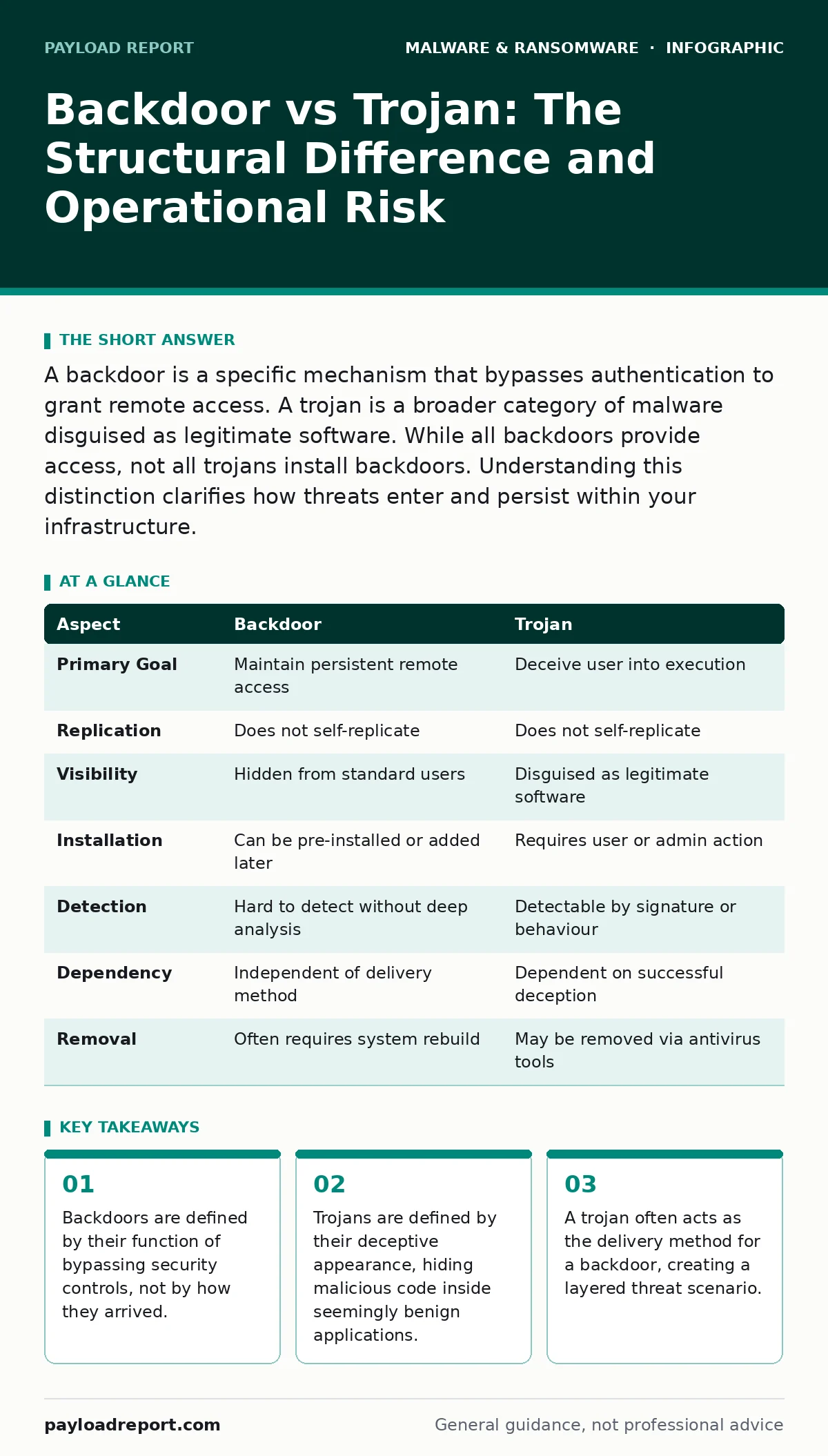
A backdoor is a specific mechanism that bypasses authentication to grant remote access. A trojan is a broader category of malware disguised as legitimate software. While all backdoors provide access, not all trojans install backdoors. Understanding this distinction clarifies how threats enter and persist within your infrastructure.
The Core Distinction Between Access and Delivery
The fundamental difference lies in purpose versus presentation. A backdoor is a mechanism designed to bypass standard authentication or encryption. It creates a secret path into a system that remains open even after the initial compromise. A trojan, named after the ancient wooden horse, is a piece of malware that disguises itself as legitimate software. You download it because it appears useful or harmless. The trojan is the vehicle; the backdoor is often the cargo. One describes how you get in, the other describes what you did to trick the gatekeeper.
What Constitutes a Backdoor
A backdoor exists to maintain access. It operates independently of the legitimate user interface. Attackers use backdoors to return to a compromised system without triggering standard login alerts. These mechanisms can be embedded in operating system code, third-party applications, or network services. They often use non-standard ports or encrypted channels to evade detection. The goal is persistence. If you remove the initial infection, the backdoor may remain. This allows an attacker to re-enter the network silently. Backdoors do not care how they were installed. They only care that they remain open and functional for remote control.
What Constitutes a Trojan
A trojan relies entirely on deception. It does not self-replicate like a computer virus. Instead, it waits for you to execute it. It might look like a PDF reader, a game update, or a productivity tool. Once executed, it performs its hidden function. This function could be data theft, system destruction, or installing additional malware. The defining characteristic is the mismatch between appearance and behaviour. You expect a calculator; you get a data exfiltration tool. Trojans are versatile. They can carry various payloads depending on the attacker’s objective. The deception is the primary feature, not the technical capability.
Point-by-Point Comparison
| Aspect | Backdoor | Trojan |
|---|---|---|
| Primary Goal | Maintain persistent remote access | Deceive user into execution |
| Replication | Does not self-replicate | Does not self-replicate |
| Visibility | Hidden from standard users | Disguised as legitimate software |
| Installation | Can be pre-installed or added later | Requires user or admin action |
| Detection | Hard to detect without deep analysis | Detectable by signature or behaviour |
| Dependency | Independent of delivery method | Dependent on successful deception |
| Removal | Often requires system rebuild | May be removed via antivirus tools |
Where the Concepts Overlap
The line blurs when a trojan installs a backdoor. This is the most common scenario in advanced attacks. The trojan serves as the delivery mechanism. It tricks the user into running the installer. Once inside, the trojan drops a backdoor component. This component establishes the persistent connection. The trojan might then delete itself to avoid detection. The backdoor remains. This creates a two-stage threat. You might remove the trojan but miss the backdoor. This overlap complicates incident response. You must treat the initial deception and the resulting access as separate but linked events.
See also: Threat Intelligence for Small Teams: Practical Data Sources
Choosing Your Defensive Focus
Choose the first when you suspect an attacker already has access. If you see unusual outbound traffic or unauthorised privilege escalation, assume a backdoor exists. Focus on closing the entry point. Audit all remote access protocols. Disable unused services. Verify that no hidden accounts exist. Look for processes that run with high privileges but have no legitimate purpose. The goal is to sever the attacker’s connection and prevent return.
Choose the second when you are preventing initial compromise. Focus on user education and application whitelisting. Ensure that users do not execute untrusted binaries. Use endpoint detection and response (EDR) to monitor for suspicious behaviour. Validate the integrity of downloaded files. Prevent the execution of scripts from untrusted sources. The goal is to stop the deception from succeeding. If the trojan never runs, the backdoor never installs.
Operational Implications for Security Teams
Understanding this distinction changes how you hunt for threats. Hunting for trojans focuses on behaviour at execution time. You look for unexpected processes launching from temporary directories. Hunting for backdoors focuses on network and system state. You look for open ports that should be closed. You look for connections to known command-and-control servers. A comprehensive strategy requires both approaches. You need to stop the entry and remove the persistence.
Imagine a scenario where a user clicks a malicious link. This link downloads a trojan. The trojan installs a remote access trojan. This specific type of trojan includes a backdoor component. The attacker now has two ways in. The initial trojan process and the persistent backdoor. Removing one does not solve the problem. You must identify both. This is why generic antivirus solutions often fail. They might catch the trojan signature but miss the custom backdoor behaviour.
Integration with Broader Security Practices
This distinction matters for golden images. If your baseline system image contains a backdoor, every new deployment is compromised. You must verify the integrity of your base images. Regularly scan for known backdoor signatures. Compare hash values against trusted sources. This prevents the spread of pre-installed backdoors across your infrastructure.
It also impacts how you handle Mac malware. Apple users often assume their systems are safe. However, trojans targeting macOS are increasing. These trojans often install backdoors to bypass Gatekeeper protections. You must apply the same rigorous scrutiny to macOS endpoints as you do to Windows systems. Do not rely on platform isolation. The principles of deception and persistence apply everywhere.
Key takeaways
- Backdoors are defined by their function of bypassing security controls, not by how they arrived.
- Trojans are defined by their deceptive appearance, hiding malicious code inside seemingly benign applications.
- A trojan often acts as the delivery method for a backdoor, creating a layered threat scenario.
Frequently asked questions
Can a backdoor exist without a trojan?
Yes, a backdoor can be pre-installed by a developer, added by a privileged insider, or installed via a direct exploit without any deceptive software.
Is every remote access tool a backdoor?
No, legitimate remote access tools are not backdoors unless they are used to bypass authentication or remain active without authorisation.
How do I detect a hidden backdoor?
Monitor for unusual network connections, unexpected services running with high privileges, and changes to system files that do not match known updates.
Can a trojan replicate like a virus?
No, trojans do not self-replicate. They rely on user action or other malware to spread, unlike computer viruses which copy themselves to other files.
How this guide was produced: written by the Payload Report editorial team with AI assistance, checked against the public references listed below, and reviewed when the facts change. See our editorial policy or report an error.