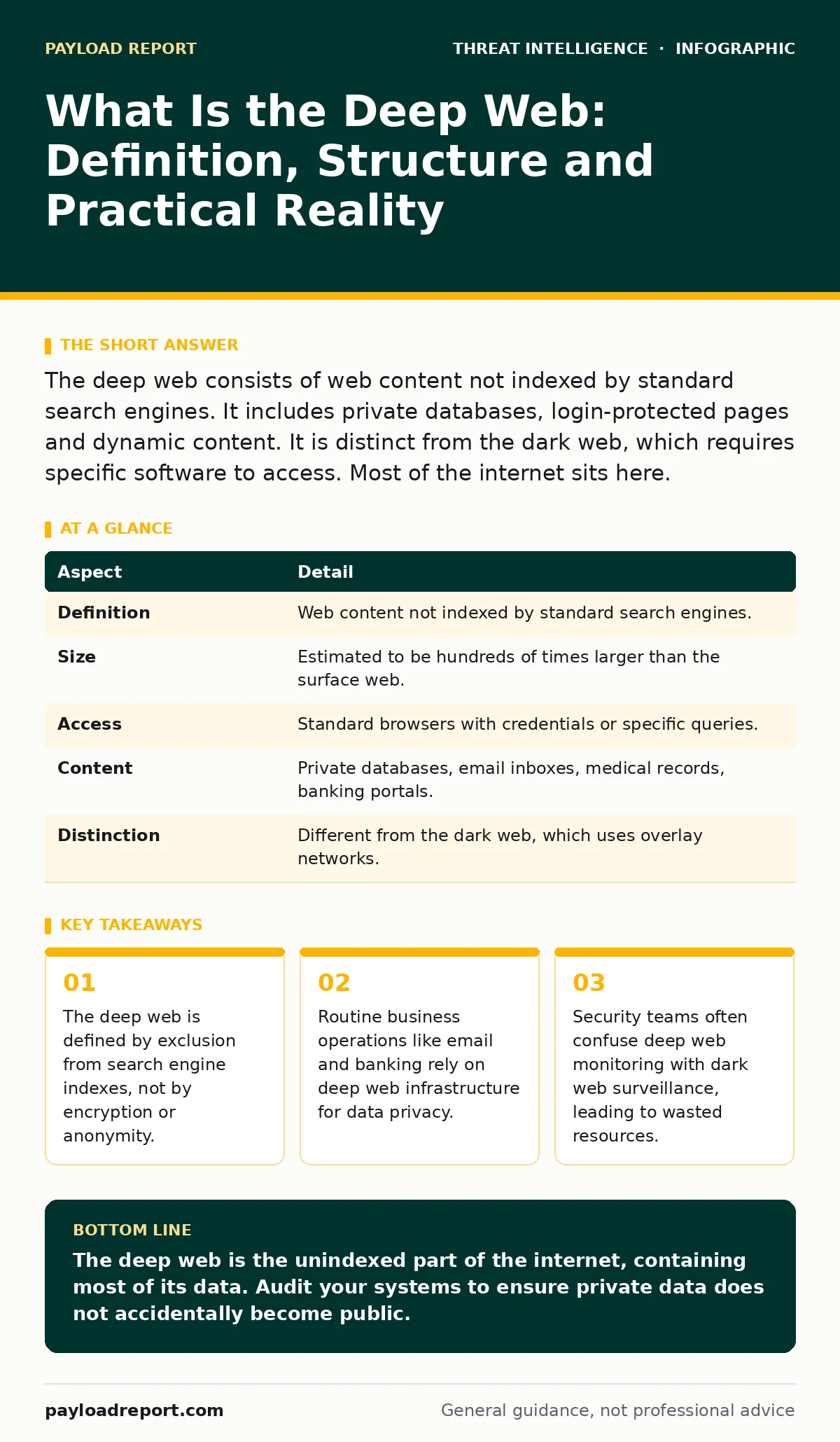
The deep web consists of web content not indexed by standard search engines. It includes private databases, login-protected pages and dynamic content. It is distinct from the dark web, which requires specific software to access. Most of the internet sits here.
The Library Analogy
Imagine a vast library open to the public. The index card catalogue at the entrance represents the surface web. It lists every book the librarians have chosen to make visible to casual visitors. You can walk in, look at the catalogue, and find those books easily.
Now imagine the rest of the library. There are private reading rooms, restricted archives and personal notes stored in drawers. These materials exist in the same building. They are part of the library. But they do not appear in the public catalogue. You cannot find them by browsing the index. This hidden majority is the deep web.
The term describes content that exists on the internet but remains invisible to standard search engine crawlers. It is not a separate network. It is simply the part of the internet that search engines choose not to, or cannot, index.
At a Glance
| Aspect | Detail |
|---|---|
| Definition | Web content not indexed by standard search engines. |
| Size | Estimated to be hundreds of times larger than the surface web. |
| Access | Standard browsers with credentials or specific queries. |
| Content | Private databases, email inboxes, medical records, banking portals. |
| Distinction | Different from the dark web, which uses overlay networks. |
Where the Term Comes From
The phrase emerged in the late 1990s to distinguish between searchable content and the rest of the internet. Early search engines relied on web crawlers. These automated programs follow links from page to page to build an index.
Crawlers have limits. They cannot log in to websites. They cannot interpret complex database queries. They avoid pages that require JavaScript execution or user interaction. Any content behind these barriers falls into the deep web category.
The term gained traction when researchers realised that the indexed web was a tiny fraction of the total data available. It was not a conspiracy. It was a technical limitation of how information retrieval works.
Daily Use and Infrastructure
You interact with the deep web every day. When you check your email, you are accessing a server that stores your messages. That server is part of the deep web. The messages are not public. They are not indexed. They are private data stored on a web-accessible server.
Online banking works the same way. Your account balance is stored in a database. When you log in, the server retrieves that specific data. The search engines do not know your balance. They do not index your transaction history. This is by design.
Corporate intranets are another example. Employee directories, project management tools and internal wikis are often hosted on web servers. They are accessible via a browser. But they sit behind authentication walls. They are deep web resources.
The Dark Web Confusion
Security professionals often conflate the deep web with the dark web. This is a critical error. The dark web is a small subset of the deep web. It refers to sites hosted on overlay networks. These networks require specific software, such as Tor or I2P, to access.
The dark web is designed for anonymity. It hides the identity of both the user and the server. The deep web is designed for privacy and function. It hides data from public search indexes but does not necessarily hide the identity of the user or the server.
Most data leaks occur on the deep web, not the dark web. Hackers breach a corporate database. They dump the data on a private server. They might share the link on a dark web forum. But the data itself resides on the deep web. Monitoring the dark web for stolen credentials is only part of the picture. You must also monitor for exposed deep web assets.
See also: How to Write Customer Breach Notification Letters That Limit Liability · Windows Event Log Monitoring: Implementation Steps and Verification
What People Get Wrong
Many assume that deep web content is inherently illegal or malicious. This is incorrect. The vast majority of deep web content is mundane. It is personal data, business records and private communications.
Another common mistake is assuming that deep web monitoring is easy. Because the content is not indexed, finding it requires specific intelligence. You need to know where to look. You need to understand the architecture of the target systems.
Security teams often focus on perimeter defence. They build firewalls and install intrusion detection systems. They forget that their own data is sitting in the deep web, waiting to be found. If a database is misconfigured, it becomes searchable. It moves from the deep web to the surface web. This is a common cause of data exposure.
The Hidden Cost of Visibility
There is a trade-off between visibility and security. To use the internet effectively, you must publish some data. Search engines help users find your services. They drive traffic to your website. But they also reveal your infrastructure.
Every page you index is a potential attack surface. Attackers use search engines to find vulnerabilities. They look for outdated software, default passwords and exposed files. The more you reveal, the easier it is for them to find weaknesses.
This is why the deep web exists. It allows you to keep data private while still using web technologies. But it requires discipline. You must ensure that private data stays private. You must test your configurations regularly. You must assume that attackers are looking for your data.
Practical Steps for Security Teams
Start by mapping your deep web assets. Identify all databases, APIs and web applications that store sensitive data. Ensure they are not publicly accessible. Use tools that scan for exposed endpoints.
Monitor for accidental exposure. Set up alerts for when your internal data appears on search engines. This can happen due to misconfiguration or developer error. Quick detection limits the damage.
Educate your development team. They need to understand the difference between the surface web and the deep web. They must design applications with privacy in mind. Data should be private by default.
Key takeaways
- The deep web is defined by exclusion from search engine indexes, not by encryption or anonymity.
- Routine business operations like email and banking rely on deep web infrastructure for data privacy.
- Security teams often confuse deep web monitoring with dark web surveillance, leading to wasted resources.
The deep web is the unindexed part of the internet, containing most of its data. Audit your systems to ensure private data does not accidentally become public.
Frequently asked questions
Is the deep web illegal?
No. The deep web includes private email, banking and medical records. It is legal and necessary for privacy.
How do I access the deep web?
You access it daily through login-protected websites. It requires credentials or specific knowledge, not special software.
What is the difference between deep web and dark web?
The dark web requires special software like Tor. The deep web is just unindexed content accessible via standard browsers.
Can search engines index the deep web?
Only if you make it public. Search engines cannot index content behind login walls or complex databases.
How this guide was produced: written by the Payload Report editorial team with AI assistance, checked against the public references listed below, and reviewed when the facts change. See our editorial policy or report an error.