
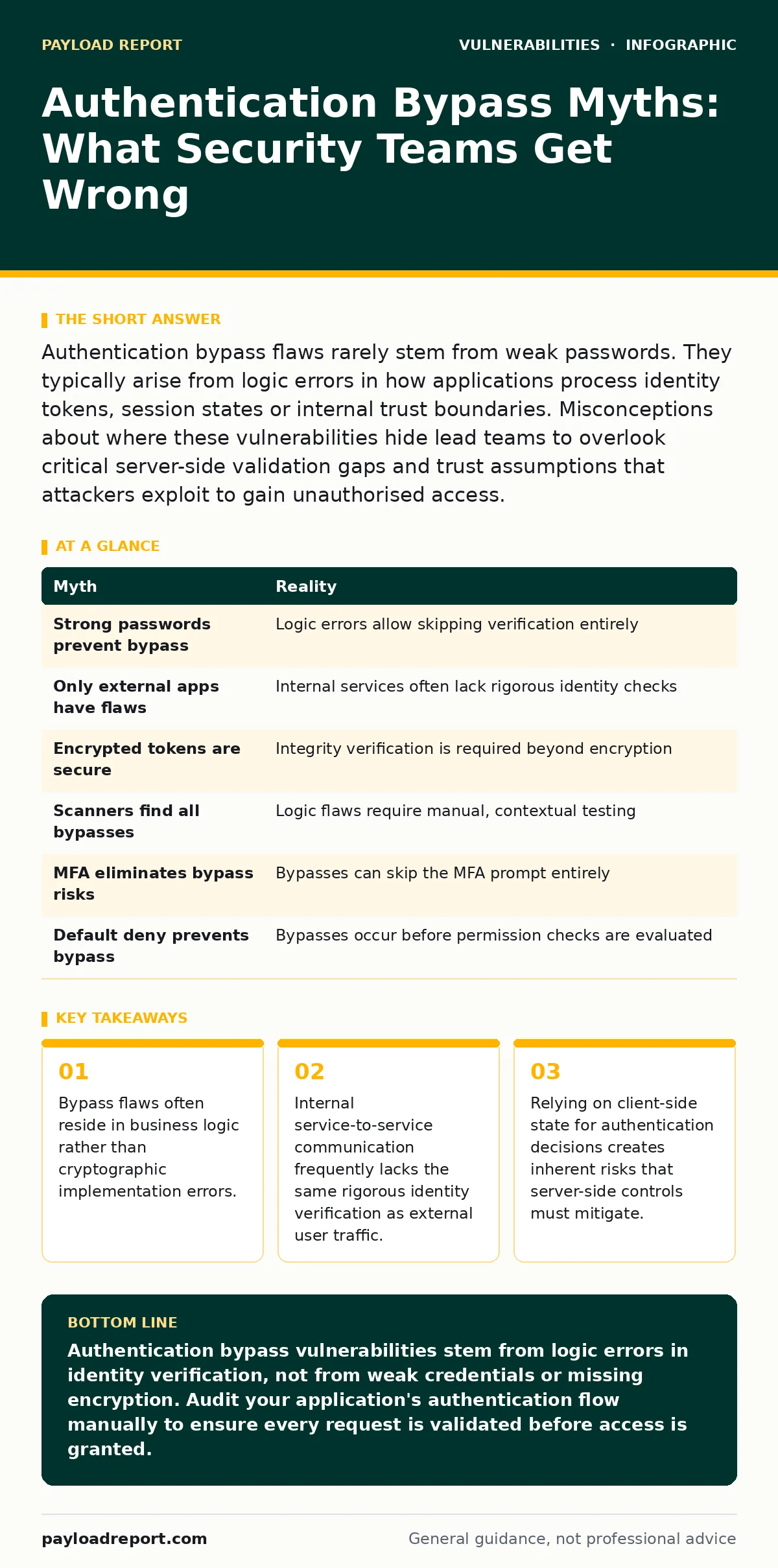
Authentication bypass flaws rarely stem from weak passwords. They typically arise from logic errors in how applications process identity tokens, session states or internal trust boundaries. Misconceptions about where these vulnerabilities hide lead teams to overlook critical server-side validation gaps and trust assumptions that attackers exploit to gain unauthorised access.
Myth: Strong Passwords Prevent Authentication Bypass
Reality: Password complexity policies do not protect against authentication bypass vulnerabilities. These flaws allow attackers to circumvent the authentication mechanism entirely, rendering password strength irrelevant. The vulnerability exists in the code that processes the login request, not in the secret itself.
If an application fails to verify credentials against the database before granting access, a complex password provides zero additional security. Attackers exploit logic errors that skip the verification step. This often happens when error handling paths return success states by default. You must assume that credential storage and hashing mechanisms are separate from the authentication flow logic. The bypass occurs because the application trusts an unverified state.
Myth: Only External-Facing Applications Have Bypass Flaws
Reality: Internal services and administrative interfaces frequently contain authentication bypass vulnerabilities. Developers often assume that internal networks are trusted zones, so they omit rigorous identity checks for backend APIs. This assumption fails when attackers gain initial footholds through other means. Once inside the network, they target these internal services.
The lack of mutual authentication between microservices allows one compromised component to impersonate another. This lateral movement is often faster than attacking external endpoints. Internal bypasses are harder to detect because traffic appears legitimate to perimeter tools. You must apply the same strict identity verification standards to internal service-to-service calls as you do to public-facing user interfaces. Trust boundaries must be enforced at every layer.
Myth: Session Tokens Are Secure If They Are Encrypted
Reality: Encryption protects data in transit but does not validate the authenticity of the session state. An authentication bypass can occur if the application accepts a manipulated session token without verifying its integrity or origin. Attackers may craft tokens that bypass validation checks by exploiting how the server parses claims. If the application trusts the token structure without cryptographic verification, encryption is irrelevant.
The flaw lies in the verification logic, not the transport security. You must ensure that every session token is signed and verified server-side before granting access. Stateless authentication mechanisms like JSON Web Tokens require strict signature validation. Without this check, an attacker can modify claims to elevate privileges or bypass authentication entirely.
Myth: Automated Scanning Tools Find All Bypass Vulnerabilities
Reality: Static and dynamic application security testing tools struggle to detect logic-based authentication bypasses. These tools excel at finding known patterns like SQL injection or cross-site scripting. They often miss nuanced logic errors where the application behaves unexpectedly under specific conditions. An authentication bypass might only trigger when a user has a specific role, a certain session state or a particular request header.
Automated scanners lack the contextual understanding to simulate these complex scenarios. You must complement automated scanning with manual penetration testing. Human analysts can identify business logic flaws that require understanding the application's intended workflow. Relying solely on automated reports leaves critical logic gaps exposed.
Myth: Multi-Factor Authentication Eliminates Bypass Risks
Reality: Multi-factor authentication adds a layer of verification but does not fix underlying logic flaws in the authentication process. If an application has a bypass vulnerability, an attacker can skip the multi-factor step entirely. The flaw allows access before the second factor is requested or validated. Multi-factor authentication protects against credential theft, not against code that fails to enforce authentication checks.
You must ensure that the application logic enforces authentication at every protected endpoint. If a bypass allows an attacker to access the application state without triggering the multi-factor prompt, the additional factor is never utilised. The security control is bypassed, not defeated. Logic validation must precede any secondary authentication steps.
Myth: Default Deny Policies Prevent Authentication Bypass
Reality: Default deny policies block unauthorised access to resources but do not prevent the authentication mechanism itself from being bypassed. An authentication bypass allows an attacker to gain a valid identity or session without providing credentials. Once they have this valid state, default deny policies permit their access because they appear authorised.
The flaw is in how the application establishes trust, not in how it enforces permissions afterwards. You must distinguish between authentication and authorisation. Authentication verifies who you are. Authorisation determines what you can do. A bypass flaw compromises the first step. If the application grants a valid session token without proper verification, subsequent permission checks will pass. Secure the identity establishment process first.
| Myth | Reality |
|---|---|
| Strong passwords prevent bypass | Logic errors allow skipping verification entirely |
| Only external apps have flaws | Internal services often lack rigorous identity checks |
| Encrypted tokens are secure | Integrity verification is required beyond encryption |
| Scanners find all bypasses | Logic flaws require manual, contextual testing |
| MFA eliminates bypass risks | Bypasses can skip the MFA prompt entirely |
| Default deny prevents bypass | Bypasses occur before permission checks are evaluated |
Key takeaways
- Bypass flaws often reside in business logic rather than cryptographic implementation errors.
- Internal service-to-service communication frequently lacks the same rigorous identity verification as external user traffic.
- Relying on client-side state for authentication decisions creates inherent risks that server-side controls must mitigate.
- Automated scanning tools struggle to detect logic-based bypasses that require specific contextual states to trigger.
Authentication bypass vulnerabilities stem from logic errors in identity verification, not from weak credentials or missing encryption. Audit your application's authentication flow manually to ensure every request is validated before access is granted.
Frequently asked questions
How do I test for authentication bypass vulnerabilities?
Manually manipulate authentication tokens, session states and request headers to see if the application grants access without proper verification. Test error handling paths and internal API endpoints for missing identity checks.
Should I disable internal trust assumptions?
Yes. Assume every internal service is potentially untrusted. Enforce mutual authentication and strict identity verification for all service-to-service communications to prevent lateral movement and internal bypasses.
How this guide was produced: written by the Payload Report editorial team with AI assistance, checked against the public references listed below, and reviewed when the facts change. See our editorial policy or report an error.