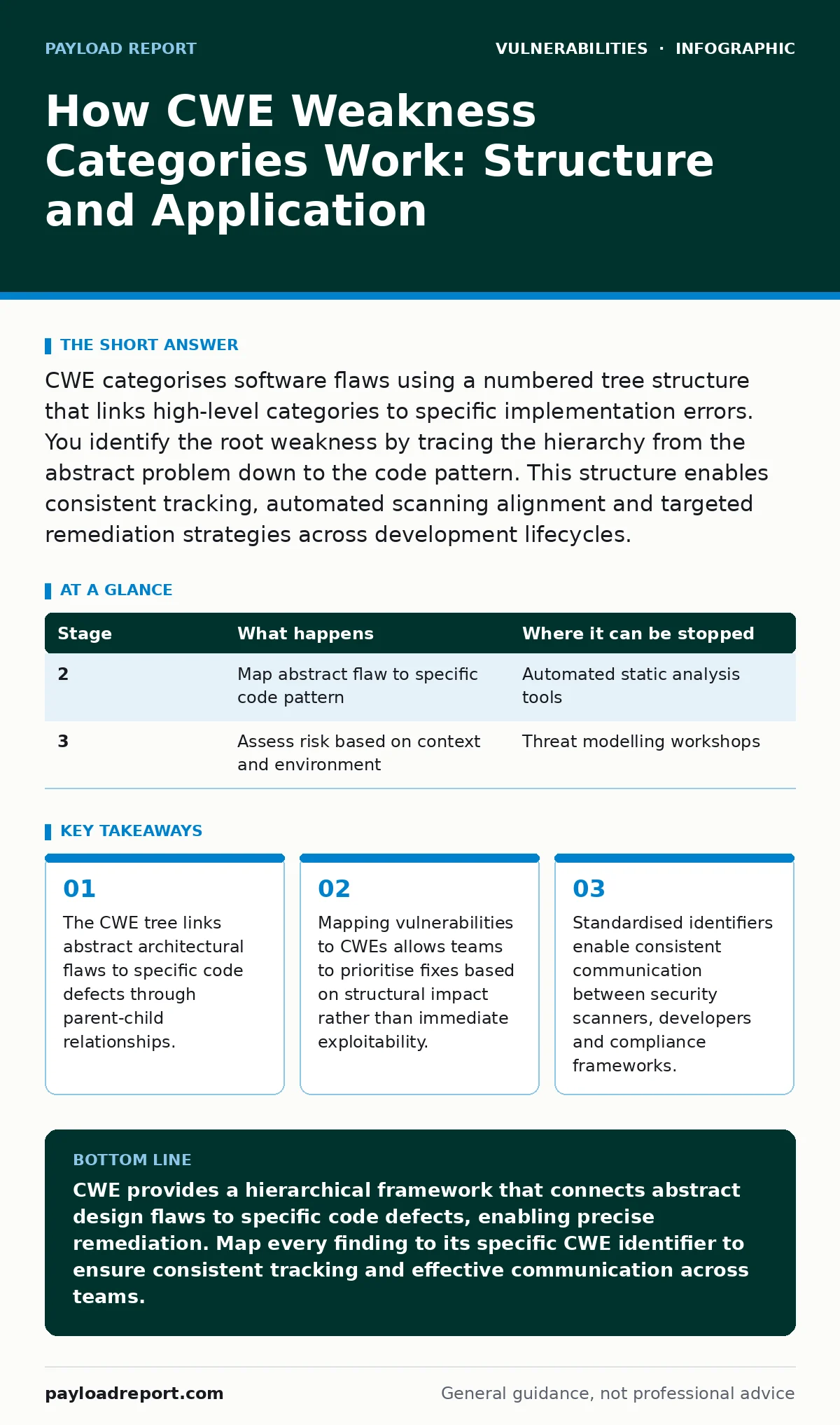
CWE categorises software flaws using a numbered tree structure that links high-level categories to specific implementation errors. You identify the root weakness by tracing the hierarchy from the abstract problem down to the code pattern. This structure enables consistent tracking, automated scanning alignment and targeted remediation strategies across development lifecycles.
Understanding the CWE Hierarchy Structure
The Common Weakness Enumeration (CWE) is a community-developed list of software weakness types. It serves as a standard dictionary for describing flaws in software and hardware. The structure is not a flat list. It is a tree-like hierarchy that connects general concepts to specific implementation errors. This hierarchy allows security professionals to discuss weaknesses at different levels of abstraction.
High-level categories describe broad architectural or design flaws. Lower-level entries describe specific coding mistakes. Each entry has a unique identifier, such as CWE-79. This identifier remains constant even if the description changes. The hierarchy prevents ambiguity. Two teams can discuss "injection" and know exactly which variant they mean.
Stage 1: Identification of the Abstract Flaw
Security assessments begin by identifying the high-level weakness. This stage focuses on the architectural or design intent. You look for gaps in how the system handles data, controls access or manages resources. This is often where vulnerability scanning tools report initial findings. The tool flags a symptom, such as unvalidated input.
You map this symptom to a high-level CWE category. This category describes the nature of the flaw without specifying the code. For instance, you might identify a failure in input validation. This approach helps you understand the scope of the problem. It reveals whether the issue is isolated or systemic.
Stage 2: Mapping to Specific Implementation Errors
Once the abstract flaw is identified, you drill down into the specific implementation. This stage connects the high-level category to concrete coding patterns. You examine the source code or binary to find the exact mistake. This might be an unchecked array index or a missing escape sequence.
You assign the specific CWE identifier to the finding. This identifier links the code defect to the broader category. This step is critical for remediation. Fixing the specific code error resolves the immediate vulnerability. It also informs whether other parts of the code suffer from the same pattern.
Stage 3: Contextualisation and Risk Assessment
Identifying the CWE is not the end of the process. You must contextualise the weakness within the application environment. Not all instances of a weakness carry the same risk. A buffer overflow in a local utility differs from one in a network-facing service.
You assess the likelihood of exploitation and the potential impact. This involves considering the attack surface and the sensitivity of the data. This stage often overlaps with vulnerability scanning results. You correlate the scanner output with your manual analysis. This ensures you prioritise fixes that matter most to business security.
| Stage | What happens | Where it can be stopped |
|---|---|---|
| 2 | Map abstract flaw to specific code pattern | Automated static analysis tools |
| 3 | Assess risk based on context and environment | Threat modelling workshops |
Stage 4: Remediation and Verification
The final stage involves fixing the code and verifying the repair. You apply patches or rewrite functions to eliminate the weakness. You then re-scan the application to confirm the fix. This verification step ensures the remediation did not introduce new errors.
You update your internal records with the resolved CWE identifier. This creates a historical record of your security posture. It helps you track recurring issues. Over time, this data reveals trends in development practices. It highlights areas where training or process improvements are needed.
See also: Bug Bounty Best Practices: Build a Program That Catches Real Threats
Applying CWE in Security Operations
Integrating CWE into your operations requires discipline. You must standardise how your team records and discusses weaknesses. This reduces confusion during incident response. It also improves the accuracy of your software bill of materials (SBOM). When you know the exact weaknesses in your components, you can assess supply chain risk more accurately.
CWE also enhances bug bounty programs. Clear definitions help external researchers understand what you consider in scope. It prevents duplicate reports and focuses efforts on high-value targets. By using standard identifiers, you align your internal findings with external disclosures. This creates a unified view of your security landscape.
Common Pitfalls in CWE Usage
Many teams struggle with the granularity of CWE. They either choose too broad a category or too specific one. Using high-level categories obscures the technical details needed for remediation. Using overly specific categories makes it hard to aggregate data for management reporting.
Another pitfall is ignoring the hierarchical relationships. Failing to see the parent-child links leads to fragmented fixes. You might patch a specific code error while leaving the architectural flaw intact. This results in recurring vulnerabilities. You must address both the symptom and the root cause.
Integrating CWE with Other Standards
CWE does not exist in isolation. It intersects with other security frameworks and standards. You often see CWE references in vulnerability scanning reports. These reports help you prioritise which findings to address first. They translate technical flaws into business risk.
Understanding CWE also helps when dealing with authentication bypass vulnerabilities. Many such flaws stem from poor session management or input validation. By identifying the underlying CWE, you can implement more robust controls. This approach is more effective than applying generic patches. It addresses the root cause of the security failure.
Strategic Value of Standardised Weaknesses
Adopting CWE provides a common language for security. It bridges the gap between developers and security teams. Developers understand the specific code changes required. Security teams understand the risk implications. This shared understanding accelerates the remediation process.
It also supports compliance efforts. Many regulations require evidence of vulnerability management. Using standard identifiers simplifies reporting. It demonstrates that you have a structured approach to security. This reduces the burden of audits and improves your overall security posture.
Key takeaways
- The CWE tree links abstract architectural flaws to specific code defects through parent-child relationships.
- Mapping vulnerabilities to CWEs allows teams to prioritise fixes based on structural impact rather than immediate exploitability.
- Standardised identifiers enable consistent communication between security scanners, developers and compliance frameworks.
CWE provides a hierarchical framework that connects abstract design flaws to specific code defects, enabling precise remediation. Map every finding to its specific CWE identifier to ensure consistent tracking and effective communication across teams.
Frequently asked questions
How do I choose the right CWE identifier for a new vulnerability?
Start by identifying the high-level category that describes the nature of the flaw. Then drill down the hierarchy to find the most specific code pattern that matches your implementation error.
Can CWE identifiers change over time?
The numerical identifiers remain permanent, but the descriptions and hierarchy can be updated by the community. Always check the current version of the CWE list for the most accurate context.
Is CWE only applicable to software development?
While primarily used for software, CWE concepts apply to hardware and configuration weaknesses too. Any system with a defined weakness can be mapped to the CWE hierarchy for consistent tracking.
How does CWE relate to CVE?
CVE identifies specific instances of vulnerabilities in products. CWE describes the underlying weakness types. A single CWE can have many CVEs, and a single CVE can involve multiple CWEs.
How this guide was produced: written by the Payload Report editorial team with AI assistance, checked against the public references listed below, and reviewed when the facts change. See our editorial policy or report an error.