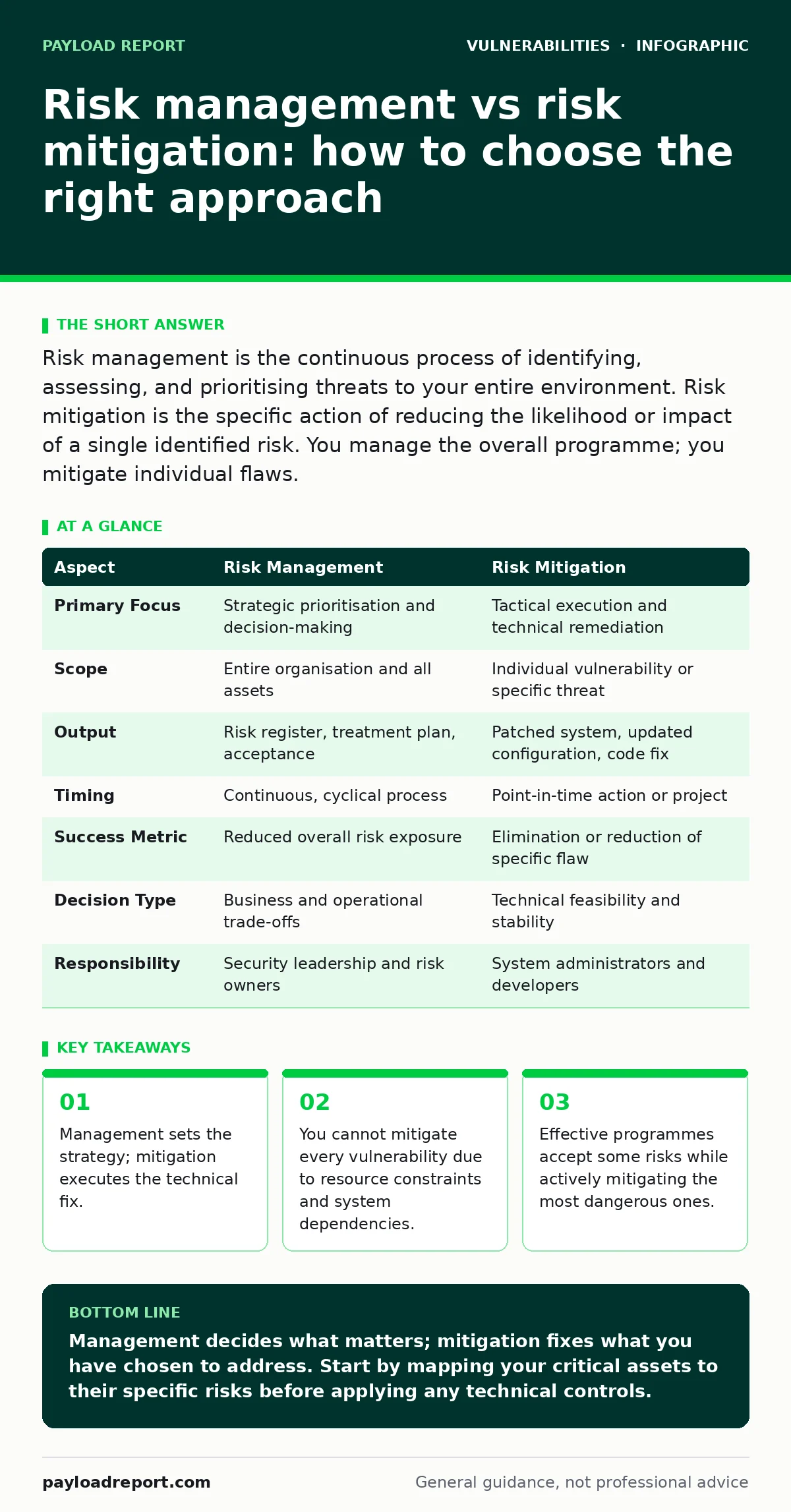
Risk management is the continuous process of identifying, assessing, and prioritising threats to your entire environment. Risk mitigation is the specific action of reducing the likelihood or impact of a single identified risk. You manage the overall programme; you mitigate individual flaws.
The core difference between risk management and risk mitigation
Risk management and risk mitigation are distinct phases within your security programme. Risk management is the overarching strategy that determines which threats matter to your organisation. It involves scanning your environment, understanding the context of each weakness, and deciding whether to fix, accept, or transfer the burden. Risk mitigation is the tactical response. It is the specific action you take to reduce the probability or impact of a risk you have already decided to address. You manage the portfolio of risks; you mitigate the individual items within that portfolio.
What is risk management?
Risk management is the continuous cycle of discovery and prioritisation. You begin by identifying assets and the threats that target them. This often involves vulnerability scanning to find known weaknesses in your infrastructure. Once identified, you assess the severity of each finding not just by its technical score, but by its potential business impact.
A critical flaw in a decommissioned server carries less risk than a moderate flaw in a customer-facing database. You then make a decision: mitigate, accept, transfer, or avoid. This decision-making process is the heart of management. It ensures you focus your limited engineering hours on the issues that could actually harm your operations.
What is risk mitigation?
Risk mitigation is the execution phase. It is the concrete work of reducing risk to an acceptable level. This usually means applying a patch, configuring a firewall rule, or changing code. Mitigation can also involve implementing compensating controls when a direct fix is impossible.
For example, if you cannot patch an IoT device vulnerabilities due to vendor lock-in, you might isolate the device on a separate network segment. This isolation mitigates the risk of lateral movement. Mitigation is binary and technical. It either works or it does not. It does not involve strategic trade-offs; it involves engineering solutions to specific problems identified during the management phase.
Risk management vs risk mitigation comparison
| Aspect | Risk Management | Risk Mitigation |
|---|---|---|
| Primary Focus | Strategic prioritisation and decision-making | Tactical execution and technical remediation |
| Scope | Entire organisation and all assets | Individual vulnerability or specific threat |
| Output | Risk register, treatment plan, acceptance | Patched system, updated configuration, code fix |
| Timing | Continuous, cyclical process | Point-in-time action or project |
| Success Metric | Reduced overall risk exposure | Elimination or reduction of specific flaw |
| Decision Type | Business and operational trade-offs | Technical feasibility and stability |
| Responsibility | Security leadership and risk owners | System administrators and developers |
When to choose risk management
You choose risk management when you lack clarity on where to start. If your team is overwhelmed by hundreds of alerts, you do not need more fixes; you need prioritisation. Use this approach when integrating new technologies that introduce unknown attack surfaces. It is the correct path when business leaders question the value of security spending. You must articulate how certain risks align with business objectives. This is also where you address n-day vulnerabilities that have been known for some time but remain unpatched due to operational constraints. Management allows you to formally accept these risks with documentation, rather than ignoring them.
See also: What Is Managed Detection and Response (MDR): How It Works · Log Tampering: How Attackers Erase Their Footprints
When to choose risk mitigation
You choose risk mitigation when a specific threat poses an immediate danger to critical assets. If a server-side template injection flaw is found in your primary web application, you mitigate it immediately. You also choose mitigation when compliance requirements mandate a specific control, such as encryption for data at rest.
Mitigation is the right choice when a vulnerability has active exploit code in the wild. In these cases, the risk assessment is already done: the impact is high, and the likelihood is certain. You bypass lengthy deliberation and move straight to remediation. This is also where you address authentication bypass vulnerabilities that could grant unauthorised access to sensitive systems.
Where they overlap
The boundary between management and mitigation blurs during incident response. When a breach occurs, management decisions happen in real-time. You must quickly assess the scope and decide which mitigation steps are safe to execute. For example, patching a router vulnerabilities might require a reboot that disrupts services.
Management weighs the risk of the vulnerability against the risk of downtime. Mitigation executes the patch during a maintenance window. This overlap highlights why security teams must understand both disciplines. A mitigator who does not understand management may break a critical system. A manager who does not understand mitigation may set unrealistic deadlines. Both perspectives are necessary for effective defence.
Integrating with your supply chain
Modern security extends beyond your own code. You must manage risks introduced by third-party components. A software bill of materials (SBOM) provides the inventory needed for effective risk management. Without it, you cannot know which libraries contain known flaws. Once identified, you mitigate by updating dependencies or replacing components. This process is complex because upstream changes can break your applications. Management helps you decide which updates are safe to deploy. Mitigation ensures the actual update is applied correctly. Ignoring supply chain risks leaves you vulnerable to attacks that bypass your own defences.
Addressing human factors
Technical controls fail when users bypass them. Weak password policies are a classic example. Management identifies that users choose predictable credentials. Mitigation might involve enforcing multi-factor authentication or password managers. However, if the user experience is poor, users will find ways around the controls. Management must balance security requirements with usability. Mitigation must be designed with the end-user in mind. Ignoring the human element leads to shadow IT and policy violations. You must manage the risk of user behaviour as rigorously as you manage software flaws.
Key takeaways
- Management sets the strategy; mitigation executes the technical fix.
- You cannot mitigate every vulnerability due to resource constraints and system dependencies.
- Effective programmes accept some risks while actively mitigating the most dangerous ones.
Management decides what matters; mitigation fixes what you have chosen to address. Start by mapping your critical assets to their specific risks before applying any technical controls.
Frequently asked questions
Can I skip risk management and just mitigate everything?
No, you lack the resources to fix every flaw. Attempting to mitigate all vulnerabilities leads to alert fatigue and missed critical threats. You must prioritise based on business impact.
Who is responsible for risk management vs mitigation?
Risk management is typically owned by security leadership and business unit heads. Mitigation is executed by system administrators, developers, and network engineers. Both roles must collaborate closely.
What is the role of vulnerability scanning in this process?
Scanning is a discovery tool for risk management. It provides the data needed to assess and prioritise risks. It does not mitigate anything on its own. You must act on the findings.
How this guide was produced: written by the Payload Report editorial team with AI assistance, checked against the public references listed below, and reviewed when the facts change. See our editorial policy or report an error.