
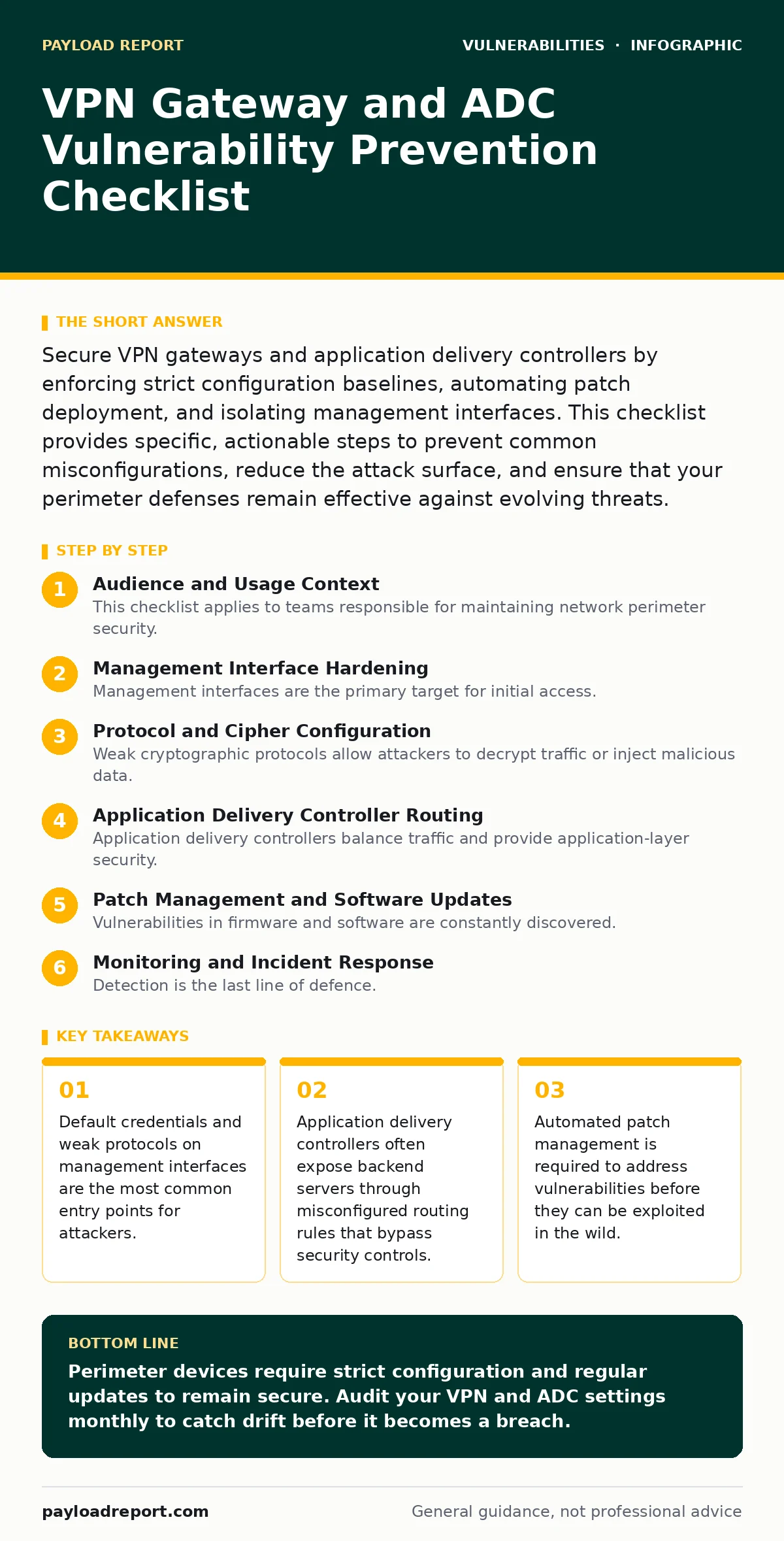
Secure VPN gateways and application delivery controllers by enforcing strict configuration baselines, automating patch deployment, and isolating management interfaces. This checklist provides specific, actionable steps to prevent common misconfigurations, reduce the attack surface, and ensure that your perimeter defenses remain effective against evolving threats.
Audience and Usage Context
This checklist applies to teams responsible for maintaining network perimeter security. It targets the specific risks associated with virtual private network gateways and application delivery controllers. These devices sit at the edge of your infrastructure, handling encryption, decryption, and traffic routing. A failure here allows attackers to bypass external defences and move directly into your internal network. Use this list during routine audits or after significant configuration changes.
Management Interface Hardening
Management interfaces are the primary target for initial access. If an attacker controls the device, they control the traffic passing through it. Default settings often leave these interfaces accessible from the public internet. You must restrict access to trusted IP ranges only.
- Disable default administrative accounts: Default accounts are known to attackers and often cannot be deleted, only disabled.
- Enforce multi-factor authentication for admin access: Passwords alone are insufficient against credential stuffing and brute-force attacks.
- Restrict management IP sources via firewall rules: Limiting access to known administrative subnets reduces the attack surface significantly.
- Change default service ports: Moving services from well-known ports reduces noise from automated scanners targeting default configurations.
Protocol and Cipher Configuration
Weak cryptographic protocols allow attackers to decrypt traffic or inject malicious data. Many devices ship with legacy protocols enabled for compatibility. You must disable these legacy options to ensure strong encryption. Modern standards provide better security without significant performance penalties.
- Disable SSLv3 and TLS 1.0: These protocols have known vulnerabilities that allow attackers to intercept and read encrypted data.
- Remove weak cipher suites: Weak ciphers can be broken with modern computing power, exposing sensitive information in transit.
- Enforce perfect forward secrecy: This ensures that a compromised long-term key does not reveal past session data.
- Validate certificate chains strictly: Improper validation allows attackers to present fraudulent certificates and intercept traffic.
Application Delivery Controller Routing
Application delivery controllers balance traffic and provide application-layer security. Misconfigured routing rules can expose backend servers directly to the internet. This bypasses security controls designed to protect those servers. You must verify that all traffic passes through the intended security stack.
- Audit virtual server configurations: Ensure that each virtual server points to the correct backend pool and security policies.
- Disable unused services and ports: Unused services increase the attack surface and may contain unpatched vulnerabilities.
- Implement strict host header validation: This prevents attackers from bypassing security rules by manipulating HTTP headers.
- Test for server-side request forgery: Misconfigured proxy settings can allow attackers to make internal requests on behalf of the server.
See our guide on attack surface for methods to map and reduce exposed endpoints.
Patch Management and Software Updates
Vulnerabilities in firmware and software are constantly discovered. Delaying updates leaves devices exposed to known exploits. Automated patch management ensures that critical fixes are applied promptly. You must have a process for testing and deploying updates without disrupting service.
- Subscribe to vendor security advisories: Early knowledge of vulnerabilities allows for proactive mitigation and prioritisation.
- Test patches in a staging environment: Applying patches directly to production can cause unexpected downtime or configuration errors.
- Automate patch deployment where possible: Manual processes are prone to human error and delay critical security fixes.
- Maintain a software bill of materials (SBOM): Knowing the components in your devices helps you assess the impact of new vulnerabilities.
Refer to the patch management guide for strategies on maintaining up-to-date systems.
Monitoring and Incident Response
Detection is the last line of defence. You must monitor for unusual activity that indicates a compromise. Logs provide the evidence needed to understand an attack and respond effectively. Ensure that logs are sent to a secure, external system to prevent tampering.
- Enable detailed logging for all sessions: Logs are required for forensic analysis and understanding the scope of a breach.
- Monitor for failed authentication attempts: A spike in failed logins often indicates a brute-force or credential stuffing attack.
- Alert on configuration changes: Unauthorised changes to device settings can indicate an attacker has gained control.
- Regularly review access logs: Periodic reviews help identify anomalies that automated alerts might miss.
Common Misconfigurations to Avoid
Many vulnerabilities arise from simple configuration errors. These errors are often overlooked during initial setup. Understanding these common pitfalls helps you avoid them. Regular audits catch these issues before they are exploited.
- Avoid using shared administrative credentials: Shared accounts make it impossible to trace actions to specific individuals.
- Do not expose management interfaces to the internet: Public access to management ports invites scanning and exploitation.
- Disable debug modes in production: Debug modes often leak sensitive information and can be used to bypass security controls.
- Verify firewall rules regularly: Over time, firewall rules can become permissive, allowing unintended traffic to pass.
See the guide on authentication bypass vulnerabilities to understand how misconfigurations can circumvent access controls.
Key takeaways
- Default credentials and weak protocols on management interfaces are the most common entry points for attackers.
- Application delivery controllers often expose backend servers through misconfigured routing rules that bypass security controls.
- Automated patch management is required to address vulnerabilities before they can be exploited in the wild.
Perimeter devices require strict configuration and regular updates to remain secure. Audit your VPN and ADC settings monthly to catch drift before it becomes a breach.
Frequently asked questions
How often should I review VPN gateway configurations?
Review configurations after every change and conduct a full audit at least quarterly to catch configuration drift.
Can I use default settings for a temporary VPN setup?
No, default settings are insecure and should never be used, even for temporary or test environments.
What is the biggest risk with application delivery controllers?
The biggest risk is misconfigured routing that exposes backend servers directly to the internet.
How do I know if my ADC is compromised?
Look for unusual traffic patterns, unexpected configuration changes, or failed authentication spikes in logs.
How this guide was produced: written by the Payload Report editorial team with AI assistance, checked against the public references listed below, and reviewed when the facts change. See our editorial policy or report an error.