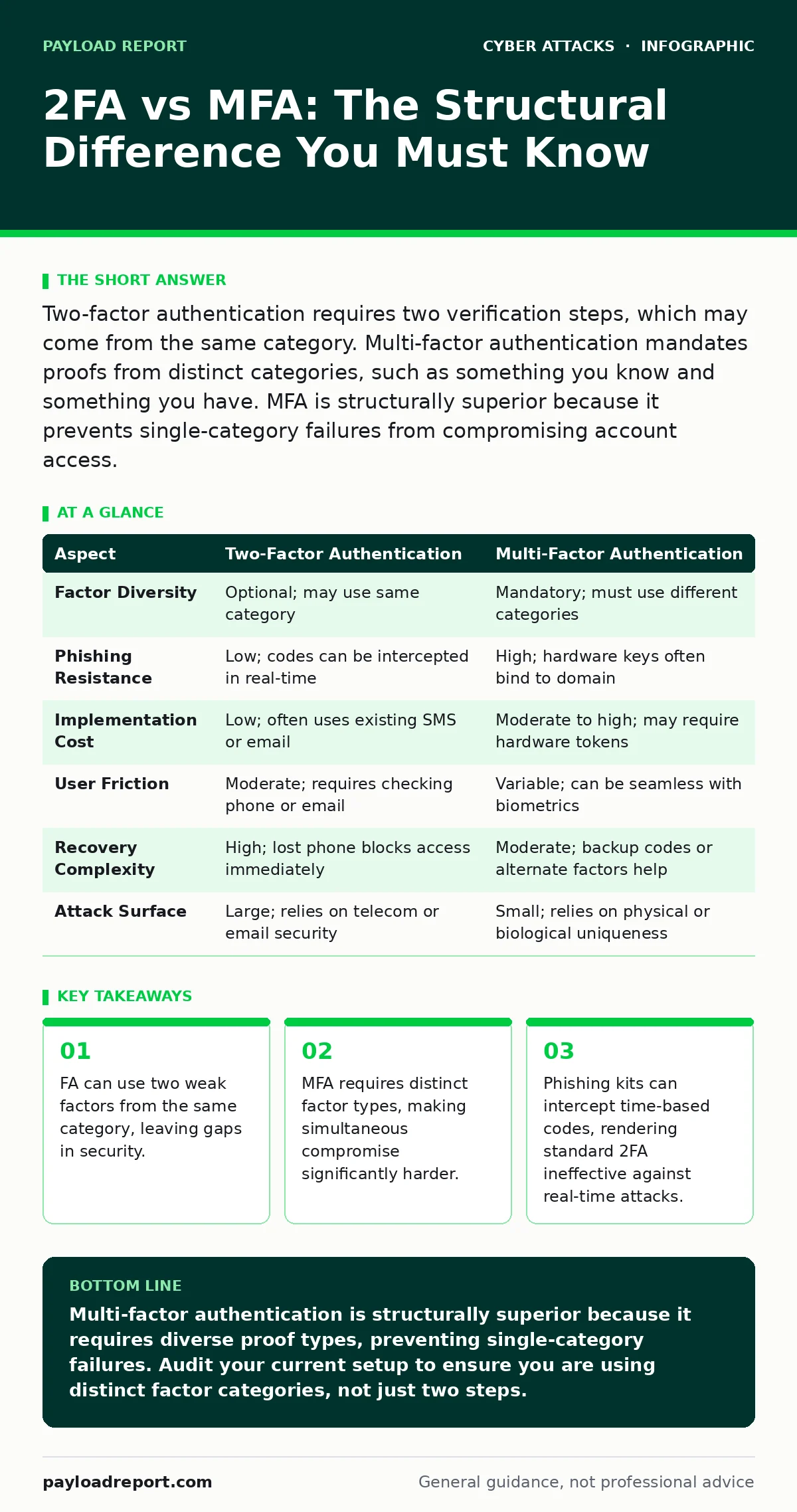
Two-factor authentication requires two verification steps, which may come from the same category. Multi-factor authentication mandates proofs from distinct categories, such as something you know and something you have. MFA is structurally superior because it prevents single-category failures from compromising account access.
The Structural Distinction Between Factors
The difference between two-factor authentication and multi-factor authentication lies in the diversity of the evidence you provide. Two-factor authentication simply demands two steps. These steps might both rely on what you know, such as a primary password and a secondary PIN. Multi-factor authentication requires proof from separate categories. You must combine something you know with something you have or something you are. This structural requirement prevents an attacker who has stolen one type of credential from gaining full access.
Defining Two-Factor Authentication
Two-factor authentication adds a second layer of defence to your login process. It does not specify the quality or type of that second layer. Many systems implement this by asking for a password and then a numeric code sent to your phone. Both the password and the code are things you know or can read. If an attacker intercepts the code via a man-in-the-middle attack, they possess both factors. The system grants access because it received two valid inputs, regardless of their similarity. This approach is better than single-factor authentication but remains vulnerable to advanced phishing.
Defining Multi-Factor Authentication
Multi-factor authentication enforces diversity in your verification methods. It requires at least two factors from different categories: knowledge, possession, or inherence. You might use a password (knowledge) combined with a hardware security key (possession). Or you might use a fingerprint (inherence) alongside a smart card. An attacker cannot bypass this by stealing only your password. They would also need to physically steal your device or replicate your biometric data. This separation of concerns creates a much higher barrier for unauthorised access.
Comparing Security Postures
The following table highlights the structural differences between these two approaches.
| Aspect | Two-Factor Authentication | Multi-Factor Authentication |
|---|---|---|
| Factor Diversity | Optional; may use same category | Mandatory; must use different categories |
| Phishing Resistance | Low; codes can be intercepted in real-time | High; hardware keys often bind to domain |
| Implementation Cost | Low; often uses existing SMS or email | Moderate to high; may require hardware tokens |
| User Friction | Moderate; requires checking phone or email | Variable; can be seamless with biometrics |
| Recovery Complexity | High; lost phone blocks access immediately | Moderate; backup codes or alternate factors help |
| Attack Surface | Large; relies on telecom or email security | Small; relies on physical or biological uniqueness |
Where the Overlap Occurs
Many organisations use the terms interchangeably, which causes confusion. When an organisation implements SMS codes alongside passwords, they often call it MFA. Technically, this is 2FA because both factors are things you know or receive. True MFA requires that second factor to be distinct in nature. The overlap exists in marketing materials and basic configuration wizards. You must look at the underlying mechanism, not the label, to understand your actual protection level. Relying on the label alone leaves you exposed to sophisticated credential theft.
See also: DNS Filtering: What It Blocks and What It Misses
Choosing the Right Approach
Selecting the correct authentication method depends on your risk tolerance and infrastructure.
Choose two-factor authentication when:
- You need a quick, low-cost improvement over single-password systems.
- Your users lack access to hardware tokens or biometric devices.
- The data being protected has a low impact if compromised.
Choose multi-factor authentication when:
- You handle sensitive data or financial transactions.
- You need protection against real-time phishing attacks.
- You can enforce hardware security keys or biometric verification.
Real-World Attack Scenarios
Imagine an attacker uses a phishing kit to mimic your login page. They capture your password and the time-based code you enter. With two-factor authentication, they have both required inputs and gain access immediately. The system sees two valid factors and logs them in. With multi-factor authentication using a FIDO2 security key, the attacker fails. The key checks the domain of the website. It refuses to sign the request for the fake site. This binding prevents the code from being useful elsewhere.
Suppose an attacker gains access to your email account. They reset your password for a banking site. If that site uses email-based 2FA, the attacker receives the reset code and logs in. If the site uses MFA with a hardware token, the attacker cannot proceed. They lack the physical device. This scenario highlights why factor diversity matters. It breaks the chain of compromise at the second step.
Enhancing Your Defences
Authentication is only one layer of your security stack. You should combine strong MFA with other controls. DNS filtering can block connections to known malicious domains before you even attempt a login. This stops the phishing attempt at the network level. Additionally, monitoring for vendor email compromise can reveal if an attacker is trying to impersonate your suppliers. If you see unusual activity, login alerts can warn you of suspicious access attempts. These layers work together to protect your identity.
Key takeaways
- FA can use two weak factors from the same category, leaving gaps in security.
- MFA requires distinct factor types, making simultaneous compromise significantly harder.
- Phishing kits can intercept time-based codes, rendering standard 2FA ineffective against real-time attacks.
Multi-factor authentication is structurally superior because it requires diverse proof types, preventing single-category failures. Audit your current setup to ensure you are using distinct factor categories, not just two steps.
Frequently asked questions
Is SMS two-factor authentication secure?
It is better than nothing, but it is vulnerable to SIM swapping and interception. It does not meet the strict definition of multi-factor authentication because both factors are knowledge-based.
Can I use my phone for multi-factor authentication?
Yes, if you use a biometric scan or a dedicated authenticator app that generates codes offline. These are distinct from the password, satisfying the diversity requirement.
What happens if I lose my hardware key?
You should always have a backup method, such as a secondary key or recovery codes. Without these, you may be locked out permanently.
Does multi-factor authentication stop all hacks?
No, it stops unauthorised access via stolen credentials. It does not protect against malware on your device or social engineering that tricks you into granting access.
How this guide was produced: written by the Payload Report editorial team with AI assistance, checked against the public references listed below, and reviewed when the facts change. See our editorial policy or report an error.