
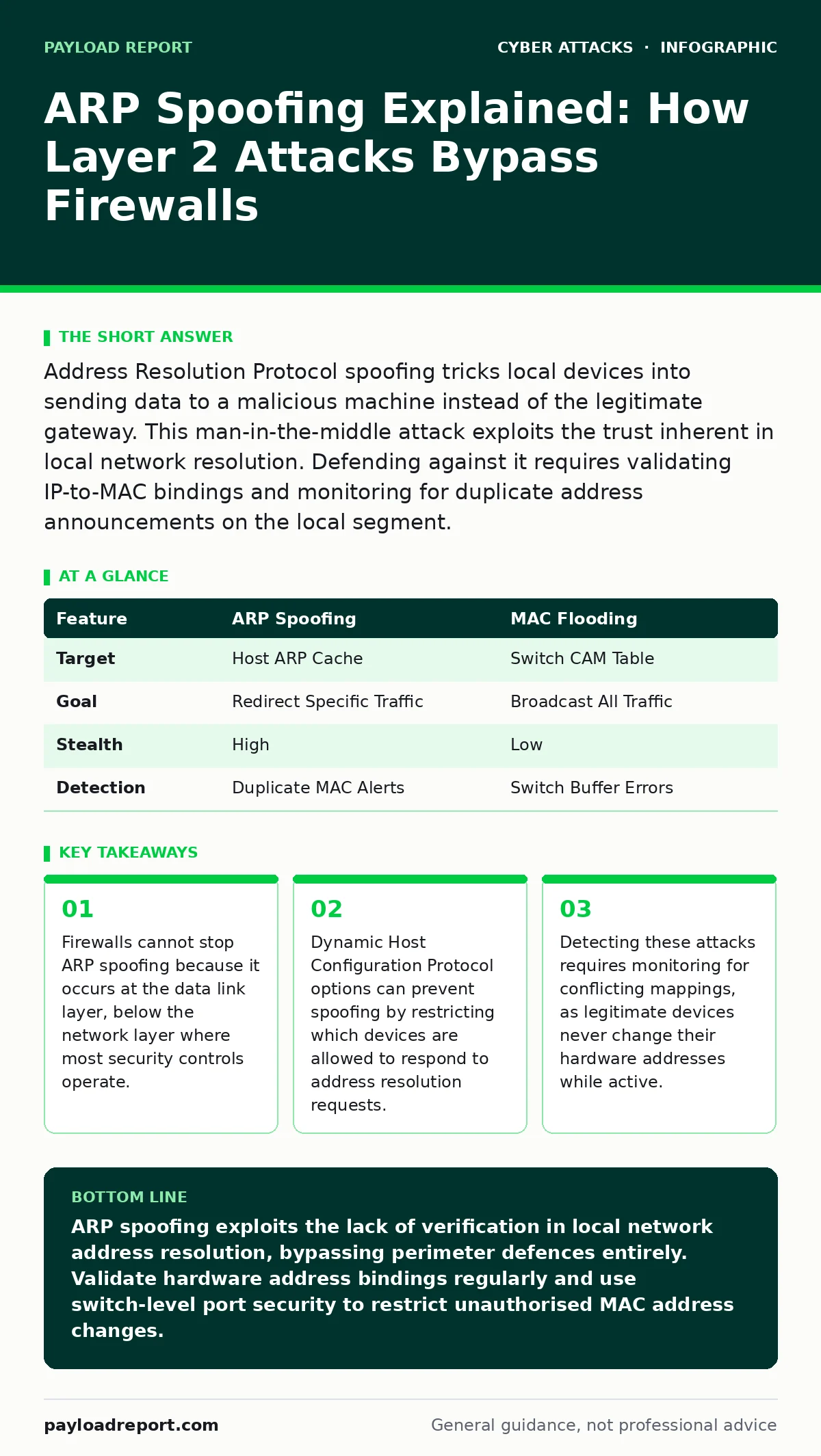
Address Resolution Protocol spoofing tricks local devices into sending data to a malicious machine instead of the legitimate gateway. This man-in-the-middle attack exploits the trust inherent in local network resolution. Defending against it requires validating IP-to-MAC bindings and monitoring for duplicate address announcements on the local segment.
How does ARP spoofing work on a local network?
ARP spoofing works by broadcasting false messages that associate the attacker’s hardware address with a victim’s IP address. The Address Resolution Protocol is designed to be stateless and trusting. It assumes that any response to a request is valid. When a device receives this false binding, it updates its local cache. Subsequent traffic destined for the spoofed IP is sent to the attacker’s machine. The attacker can then forward this traffic to the real destination to remain hidden, effectively creating a man-in-the-middle position.
Why can’t firewalls stop this type of attack?
Firewalls operate at the network layer and above, filtering packets based on IP addresses, ports, and protocols. ARP spoofing occurs at the data link layer, which handles physical addressing within a local broadcast domain. Most perimeter firewalls do not inspect or filter Address Resolution Protocol traffic because it is rarely routed across wide area networks. The attack happens before the packet is encapsulated with an IP header. Consequently, standard firewall rules are blind to the manipulation of hardware address mappings. This is a structural limitation of layered security architectures.
What are the signs of an active ARP spoofing attack?
The most reliable sign is a sudden increase in latency or packet loss for specific hosts. Legitimate devices never change their hardware addresses while the network interface is active. If a monitoring tool detects that an IP address is suddenly associated with a different MAC address, an attack is likely occurring. Another indicator is duplicate IP address warnings on the local network. Attackers often announce multiple IP-to-MAC pairs rapidly. Network management systems that track historical bindings can flag these deviations immediately. Static ARP entries do not change, making any deviation obvious.
Can encryption prevent data theft during these attacks?
Transport Layer Security encrypts the payload of network traffic, but it does not protect the routing of that traffic. An attacker using ARP spoofing can still see the destination IP and port, even if the content is unreadable. This allows them to perform denial-of-service attacks by dropping packets or injecting reset signals to terminate connections. While encryption prevents the reading of sensitive data like passwords, it does not stop the disruption of service. The attacker sits between the client and the server, controlling the flow. This is why confidentiality and availability must be defended separately.
How does Dynamic Host Configuration Protocol help mitigate this risk?
Dynamic Host Configuration Protocol servers can be configured to provide restricted options for address resolution. Some implementations allow the server to specify a trusted gateway address. Clients using this feature will only accept ARP responses from that specific hardware address. This reduces the attack surface significantly. However, this protection only works if all clients on the segment are configured to respect these DHCP options. Legacy devices often ignore these hints and rely on standard broadcast responses. Mixing compliant and non-compliant devices leaves gaps in the defence.
See also: Web Filtering Proxy: How It Works, Limits and Setup · N-day Vulnerabilities: Why Patching Fails and How to Compensate
What is the difference between ARP spoofing and MAC flooding?
ARP spoofing targets the cache of a specific host to redirect traffic. MAC flooding targets the switch itself to overflow its content addressable memory table. When the table is full, the switch reverts to hub mode, broadcasting all traffic to every port. The attacker then uses a packet sniffer to capture this broadcast traffic. ARP spoofing is surgical and stealthy, aiming for specific interception. MAC flooding is noisy and disruptive, aiming for broad visibility. Both exploit the trust in layer 2 forwarding, but they use different mechanisms to achieve their goals.
| Feature | ARP Spoofing | MAC Flooding |
|---|---|---|
| Target | Host ARP Cache | Switch CAM Table |
| Goal | Redirect Specific Traffic | Broadcast All Traffic |
| Stealth | High | Low |
| Detection | Duplicate MAC Alerts | Switch Buffer Errors |
Why is static ARP mapping not a perfect solution?
Static ARP mapping requires administrators to manually configure the IP-to-MAC binding on every device. This creates a significant maintenance burden in dynamic environments. If a device is replaced or its network interface card is changed, the static entry becomes invalid. Traffic to that device will fail until the mapping is updated. This rigidity makes it unsuitable for large networks with frequent hardware changes. The administrative overhead often leads to incomplete implementations. Partial static mapping leaves some devices exposed while others are protected, creating an inconsistent security posture.
How do you detect these attacks without dedicated hardware?
You can detect ARP spoofing by logging periodic scans of the local ARP tables. Compare the current bindings against a known baseline. Any discrepancy indicates a potential attack. Simple scripts can run on critical servers to check their own ARP cache for known gateways and critical peers. If the MAC address for the default gateway changes, the script can alert the operations team. This method requires no additional hardware. It relies on the fact that legitimate infrastructure does not change its hardware identity. Regular verification turns the static nature of hardware addresses into a detection tool.
What happens if an attacker spoofs your own IP address?
If an attacker spoofs your IP address, they can intercept responses meant for you. This is known as a blind man-in-the-middle attack. The attacker sends a false ARP reply to the router, claiming your IP address belongs to their MAC address. The router then sends incoming traffic to the attacker. The attacker must also poison your cache to send your outgoing traffic to them. You may experience intermittent connectivity as packets are delayed or dropped. This technique is often used to bypass rate limiting or to inject malicious content into legitimate streams.
How does this relate to broader identity assurance?
Network layer attacks like ARP spoofing highlight the fragility of implicit trust. This mirrors the risks in application layer authentication. Just as ARP assumes local responses are valid, many systems assume login attempts are legitimate. This is why security awareness training must cover the physical and network layers, not just phishing emails. Understanding that trust must be verified at every stage helps teams appreciate the need for MFA fatigue attacks resistance. If an attacker can manipulate the network path, they can also manipulate the authentication flow. Defending one layer without the other leaves the system exposed.
Key takeaways
- Firewalls cannot stop ARP spoofing because it occurs at the data link layer, below the network layer where most security controls operate.
- Dynamic Host Configuration Protocol options can prevent spoofing by restricting which devices are allowed to respond to address resolution requests.
- Detecting these attacks requires monitoring for conflicting mappings, as legitimate devices never change their hardware addresses while active.
ARP spoofing exploits the lack of verification in local network address resolution, bypassing perimeter defences entirely. Validate hardware address bindings regularly and use switch-level port security to restrict unauthorised MAC address changes.
Frequently asked questions
Can a home router protect me from ARP spoofing?
Most consumer routers do not inspect ARP traffic or validate MAC address bindings. They rely on the local network to be trusted, leaving connected devices vulnerable to attacks from other devices on the same Wi-Fi or Ethernet segment.
Is ARP spoofing the same as a DNS spoofing attack?
No. ARP spoofing manipulates the link between IP addresses and hardware addresses on the local network. DNS spoofing manipulates the translation between domain names and IP addresses at the application layer. They operate at different stages of the connection process.
How long does an ARP cache entry last?
Cache entries expire after a timeout period, which varies by operating system. Once expired, the device will request a new resolution. This window allows attackers to periodically resend false bindings to maintain the attack without being detected immediately.
Can I use a VPN to stop ARP spoofing?
A VPN encrypts traffic that leaves the local network, but it does not prevent the initial redirection of that traffic. The attacker can still intercept the packet before it is encapsulated in the VPN tunnel. Encryption protects the content, but not the delivery path within the local segment.
How this guide was produced: written by the Payload Report editorial team with AI assistance, checked against the public references listed below, and reviewed when the facts change. See our editorial policy or report an error.