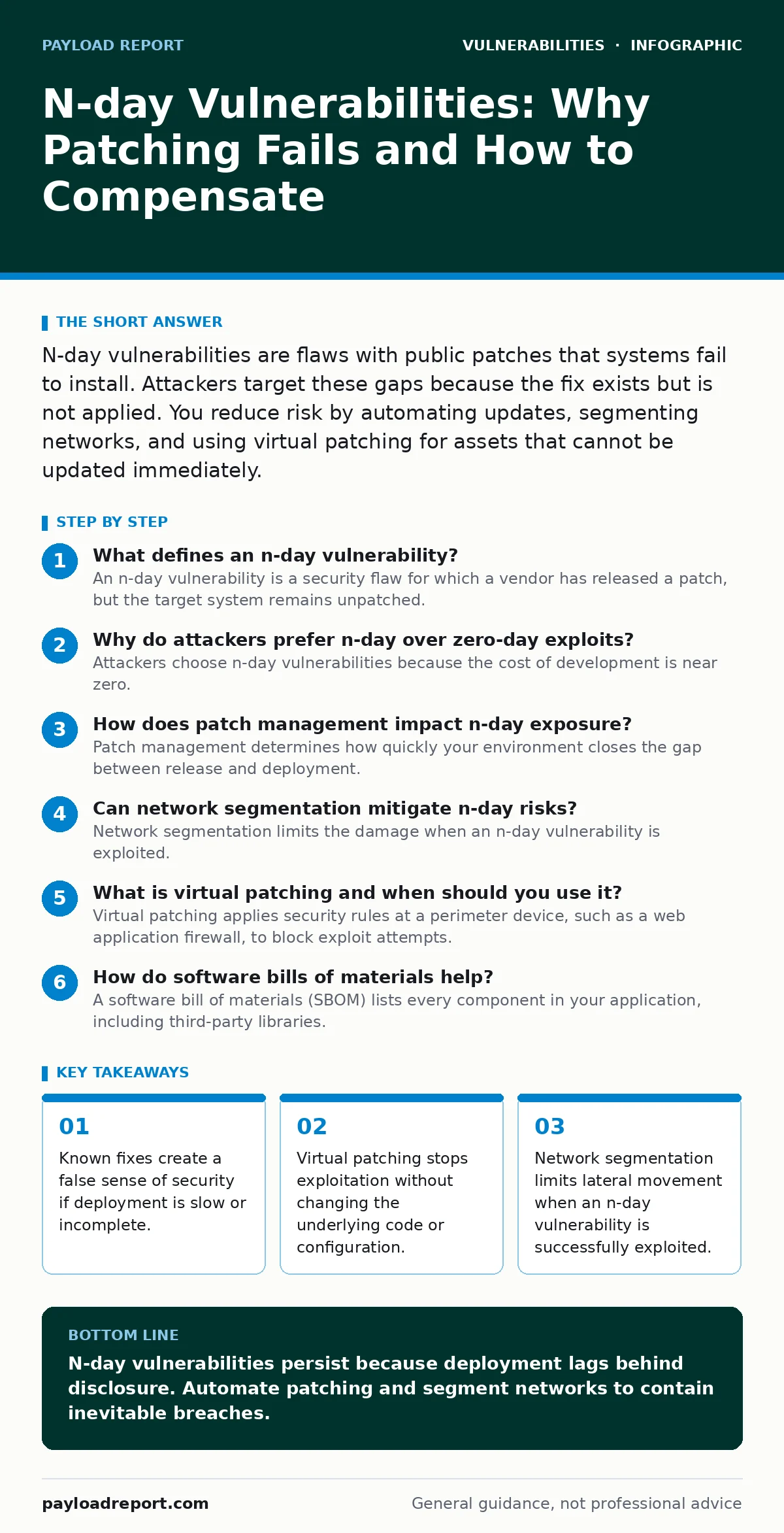
N-day vulnerabilities are flaws with public patches that systems fail to install. Attackers target these gaps because the fix exists but is not applied. You reduce risk by automating updates, segmenting networks, and using virtual patching for assets that cannot be updated immediately.
What defines an n-day vulnerability?
An n-day vulnerability is a security flaw for which a vendor has released a patch, but the target system remains unpatched. The "n" represents the number of days since the fix became available. Attackers prefer these targets because the exploit code is often already written and tested. The vulnerability is public, the fix is public, and the window of opportunity is purely administrative.
Why do attackers prefer n-day over zero-day exploits?
Attackers choose n-day vulnerabilities because the cost of development is near zero. Zero-day exploits require significant research and reverse engineering to discover a new flaw. N-day exploits reuse existing code against systems that failed to update. This approach scales easily across large numbers of victims. The attacker does not need to innovate; they only need to identify which systems lag behind on updates.
How does patch management impact n-day exposure?
Patch management determines how quickly your environment closes the gap between release and deployment. Manual processes introduce human delay and error, extending the window of exposure. Automated patching reduces this window to hours or minutes. However, automation requires rigorous testing to avoid breaking applications. A broken system is often more costly than a delayed patch, creating a tension between speed and stability.
| Vulnerability Type | Patch Available | Exploit Public | Primary Risk Factor |
|---|---|---|---|
| Zero-day | No | No | Discovery and development cost |
| N-day | Yes | Yes | Deployment delay and scope |
| Legacy | No | Yes | Lack of vendor support |
Can network segmentation mitigate n-day risks?
Network segmentation limits the damage when an n-day vulnerability is exploited. If an attacker compromises one server, segmentation prevents them from moving laterally to critical databases or internal tools. You treat each segment as a separate trust boundary. This strategy accepts that some systems will eventually be breached. It focuses on containment rather than prevention alone.
What is virtual patching and when should you use it?
Virtual patching applies security rules at a perimeter device, such as a web application firewall, to block exploit attempts. The underlying software remains unchanged. You use this when you cannot reboot a server or when a patch causes compatibility issues. It buys time for a proper fix. It does not remove the vulnerability from the system. An attacker who bypasses the perimeter control can still exploit the flaw.
See also: How Penetration Testing Works: The Mechanics Behind the Breach · Bug Bounty Best Practices: Build a Program That Catches Real Threats
How do software bills of materials help?
A software bill of materials (SBOM) lists every component in your application, including third-party libraries. When a vulnerability is disclosed, you can instantly check your SBOM to see if you are affected. This speeds up the decision process. You avoid scanning every server manually. The SBOM provides visibility into the supply chain. It turns a search operation into a lookup operation.
Why do legacy systems pose unique n-day challenges?
Legacy systems often run software that no longer receives updates. When a vulnerability is found in these components, there is no official patch. You face a permanent n-day scenario. You must compensate with isolation, strict access controls, and monitoring. Treating legacy systems as standard assets invites failure. They require a different risk model that accepts higher inherent risk in exchange for business continuity.
How does penetration testing validate n-day defences?
Penetration testing simulates real attacks to verify your controls. Testers attempt to exploit known n-day vulnerabilities in your environment. This reveals gaps in your patching process or firewall rules. It proves whether your virtual patches hold under pressure. Regular testing ensures your defences evolve. It moves security from theoretical compliance to proven resilience.
What is the hidden cost of ignoring n-days?
The hidden cost is the erosion of trust and the accumulation of technical debt. Each unpatched system is a liability. Over time, the volume of unpatched systems becomes unmanageable. Incident response becomes slower and more expensive. You spend more time containing breaches than preventing them. The business loses agility because security becomes a bottleneck.
How do you prioritise which n-days to fix first?
Prioritisation depends on exposure and impact. A vulnerability on a public-facing web server requires faster action than one on an isolated internal printer. You assess the severity of the flaw, the value of the asset, and the likelihood of exploitation. This risk-based approach ensures you address the most dangerous gaps first. It prevents resource exhaustion by chasing low-value targets.
Key takeaways
- Known fixes create a false sense of security if deployment is slow or incomplete.
- Virtual patching stops exploitation without changing the underlying code or configuration.
- Network segmentation limits lateral movement when an n-day vulnerability is successfully exploited.
N-day vulnerabilities persist because deployment lags behind disclosure. Automate patching and segment networks to contain inevitable breaches.
Frequently asked questions
Is an n-day vulnerability the same as a zero-day?
No. A zero-day has no patch, while an n-day has a patch that has not been applied to the target system.
Can antivirus software stop n-day exploits?
Antivirus may detect known malicious payloads, but it cannot fix the underlying vulnerability or block all exploitation techniques.
Do bug bounty programs cover n-day vulnerabilities?
Most programs exclude n-days because the fix is public. They focus on finding new, undiscovered flaws.
How long should a system remain unpatched?
Ideally zero days. Critical patches should be applied within hours or days, depending on the risk assessment.
How this guide was produced: written by the Payload Report editorial team with AI assistance, checked against the public references listed below, and reviewed when the facts change. See our editorial policy or report an error.