
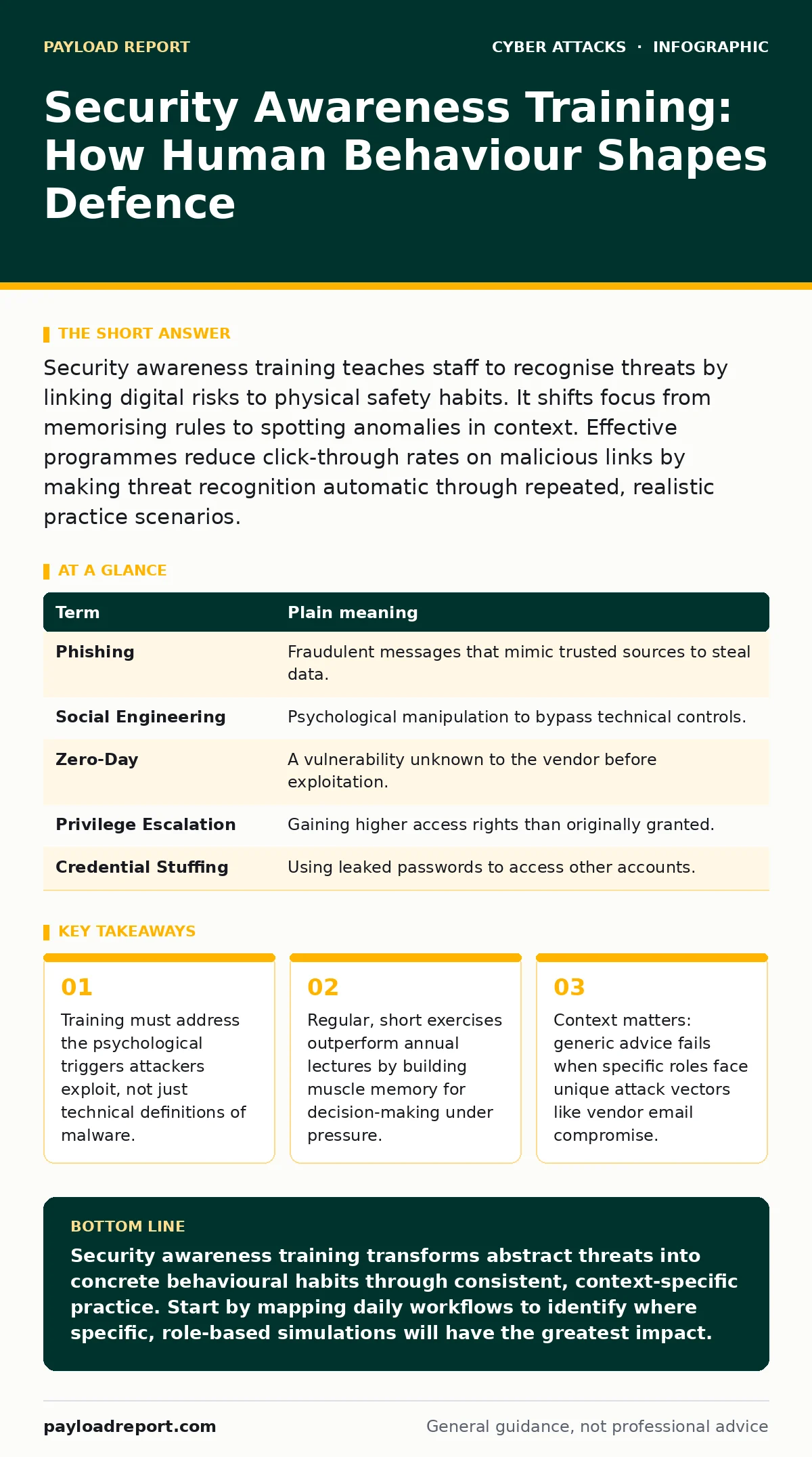
Security awareness training teaches staff to recognise threats by linking digital risks to physical safety habits. It shifts focus from memorising rules to spotting anomalies in context. Effective programmes reduce click-through rates on malicious links by making threat recognition automatic through repeated, realistic practice scenarios.
The Airport Security Metaphor
Imagine walking through an airport security checkpoint. You do not need to understand the physics of magnetometers to behave correctly. You simply know that laptops come out of bags and liquids stay in small containers. This routine becomes automatic. You follow the process because the consequences of failure are clear and immediate. Security awareness training works the same way. It aims to turn complex digital threats into simple, repeatable behavioural checks that become second nature.
Why Analogies Matter in Defence
Digital threats are abstract. A phishing email looks like a normal message until it is too late. By mapping these threats to physical world scenarios, you reduce the mental effort required to spot danger. When you treat a suspicious email like a stranger asking for directions in a restricted zone, the response becomes instinctive. This approach bridges the gap between technical policy and daily human behaviour. It transforms vague warnings into concrete actions.
Key Terms Defined
Understanding the vocabulary helps you discuss risks precisely. These terms appear frequently in incident reports and policy documents.
| Term | Plain meaning |
|---|---|
| Phishing | Fraudulent messages that mimic trusted sources to steal data. |
| Social Engineering | Psychological manipulation to bypass technical controls. |
| Zero-Day | A vulnerability unknown to the vendor before exploitation. |
| Privilege Escalation | Gaining higher access rights than originally granted. |
| Credential Stuffing | Using leaked passwords to access other accounts. |
The Hidden Cost of Compliance-Only Training
Many organisations treat training as a box-ticking exercise. Staff watch videos to satisfy auditors. This approach creates a false sense of security. It teaches people to click "Next" rather than to think critically. When an attack arrives, the trained reflex is irrelevant. Real security requires active engagement. You must test whether staff can apply knowledge in real time, not just recall definitions during a quiz.
Context-Specific Threat Vectors
Generic advice often fails for specialised roles. Finance teams face different risks than software developers. A developer might encounter watering hole attacks where trusted sites are compromised. Finance staff might face vendor email compromise requests for urgent payment changes. Tailoring training to these specific contexts increases relevance. It ensures that the examples resonate with the daily workflow of the recipient.
See also: MFA Fatigue Attack Mistakes: 7 Errors That Leave You Open · DDoS protection for ISP: scrubbing, routing and resilience
Practical Steps to Improve Defence
You can start improving your organisation's resilience immediately. These steps focus on behavioural change rather than technical complexity.
- Map the daily digital workflows of different teams. Identify where they interact with external parties or handle sensitive data.
- Create short, scenario-based simulations that mimic these specific workflows. Focus on the decision point, not the technical details of the malware.
- Provide immediate, constructive feedback after each simulation. Explain why the action was risky and what the correct behaviour would have been.
This approach builds a culture of shared responsibility. It moves the focus from blaming individuals to improving processes.
Integrating Technical and Human Controls
Training alone cannot stop every attack. Technical controls provide the safety net. DNS filtering blocks connections to known malicious domains before they reach the user. MFA fatigue attacks exploit users who are tired of approving requests, so training must teach them to pause and verify. Combining human vigilance with automated protection creates a layered defence. Neither approach is sufficient on its own.
Recognising Social Engineering Tactics
Attackers exploit trust and urgency. Smishing uses SMS to create a sense of immediate danger, such as a fake delivery alert. Dumpster diving involves searching physical trash for discarded passwords or documents. Understanding these tactics helps you spot the pattern. The goal is always to bypass security controls by manipulating the person who holds the keys.
Building Long-Term Resilience
Security awareness is not a one-time event. It requires continuous reinforcement. Regular, low-stakes exercises keep threat recognition sharp. When staff encounter a real attack, they should feel familiar with the signs. This familiarity reduces panic and improves response times. The goal is to make secure behaviour the path of least resistance.
Dealing with Human Error
Mistakes will happen. The goal is not perfection but rapid detection and recovery. When a user clicks a malicious link, the system should contain the damage. Training should emphasise reporting errors without fear of punishment. This transparency allows security teams to respond quickly. It turns human error into a data point for improving controls.
The Role of Clear Communication
Technical jargon alienates non-technical staff. Use plain language in all communications. Explain the "why" behind security rules. When people understand the impact of their actions, they are more likely to comply. Clear communication reduces confusion and minimises the likelihood of bypassing controls for convenience.
Key takeaways
- Training must address the psychological triggers attackers exploit, not just technical definitions of malware.
- Regular, short exercises outperform annual lectures by building muscle memory for decision-making under pressure.
- Context matters: generic advice fails when specific roles face unique attack vectors like vendor email compromise.
Security awareness training transforms abstract threats into concrete behavioural habits through consistent, context-specific practice. Start by mapping daily workflows to identify where specific, role-based simulations will have the greatest impact.
Frequently asked questions
How often should security awareness training occur?
Regular, short sessions are more effective than annual events. Monthly micro-training keeps threat recognition sharp and prevents habituation to static content.
Does training stop all phishing attacks?
No. Training reduces the likelihood of success but cannot guarantee prevention. It must be combined with technical controls like email filtering and multi-factor authentication.
How do you measure the effectiveness of training?
Track metrics like click-through rates on simulated phishing emails and the speed of reporting suspicious activity. These indicators reflect behavioural change better than quiz scores.
Should technical staff receive different training?
Yes. Technical staff face different risks, such as code injection or configuration errors. Their training should focus on secure coding practices and system hardening rather than basic email safety.
How this guide was produced: written by the Payload Report editorial team with AI assistance, checked against the public references listed below, and reviewed when the facts change. See our editorial policy or report an error.