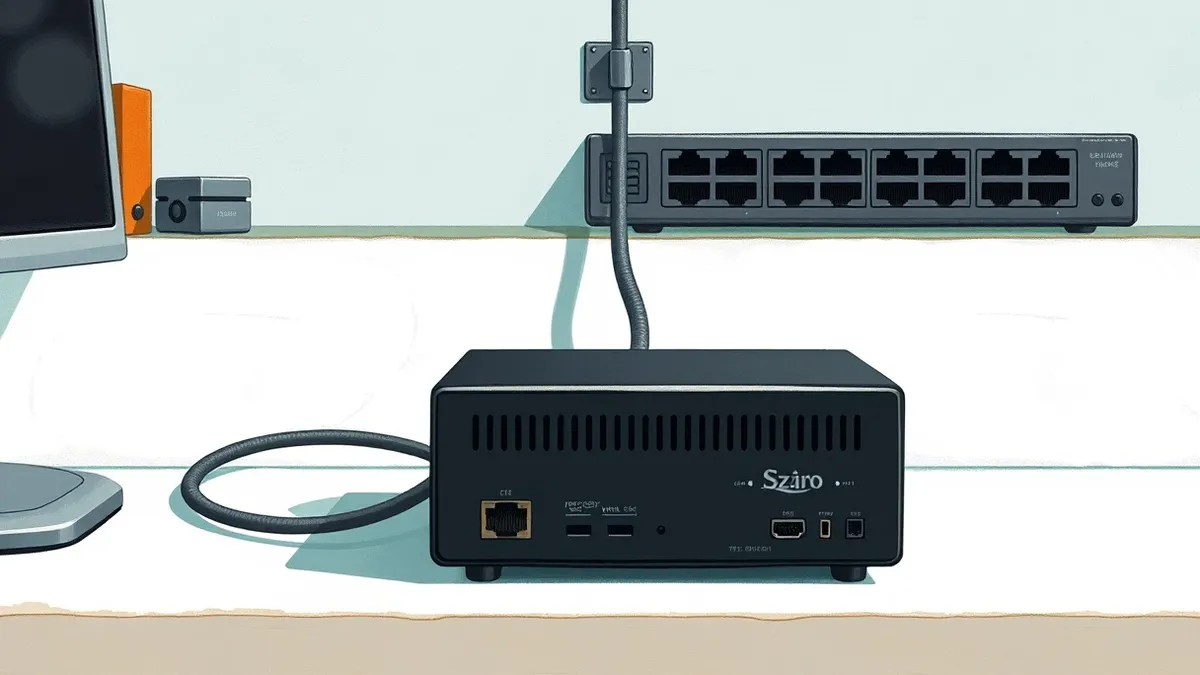
Vulnerabilities in VPN appliances are flaws in the software or configuration of devices that create encrypted tunnels for remote access. These weaknesses allow attackers to bypass firewalls, decrypt traffic, or execute commands on the gateway itself. They arise from outdated code, weak authentication settings, and exposed management interfaces that lack proper access controls.
Understanding the Core Risk
Imagine a heavily fortified castle where the only open gate is manned by a single guard who uses a diary to check names. If an attacker steals that diary or convinces the guard to ignore the book, the walls become irrelevant. VPN appliances function as that gate for modern networks. They create encrypted tunnels that allow authorised users to connect to internal resources from outside the corporate perimeter.
A vulnerability in a VPN appliance is a defect in the device’s software, firmware, or configuration that an attacker can exploit to gain unauthorised access, intercept data, or disrupt services. Because these devices sit at the edge of your network, they are high-value targets. Breaching a VPN appliance often grants an attacker a foothold inside the internal network, bypassing external firewalls and intrusion detection systems that monitor only perimeter traffic.
The risk extends beyond simple credential theft. Attackers may exploit flaws in how the appliance handles encrypted packets, manages user sessions, or communicates with directory services. When these mechanisms fail, the confidentiality, integrity, or availability of the entire remote access infrastructure is compromised.
At a Glance
| Aspect | Detail |
|---|---|
| Primary Target | Network perimeter devices handling encrypted remote access tunnels |
| Common Cause | Unpatched firmware, weak default configurations, exposed management ports |
| Attack Vector | Exploiting software bugs, brute-forcing admin panels, or hijacking sessions |
| Impact | Full network access, data interception, lateral movement to internal servers |
| Mitigation | Regular patching, disabling unused features, enforcing multi-factor authentication |
How Exploitation Occurs
Attackers rarely guess their way into a well-configured VPN. They look for known weaknesses in the appliance’s software stack. Many VPN appliances run on standard operating systems that include web servers, database engines, and cryptographic libraries. Each of these components introduces potential failure points.
A common scenario involves a buffer overflow in the packet processing engine. When the appliance receives a malformed encrypted packet, the underlying code may fail to handle the data correctly, allowing an attacker to execute arbitrary code on the device itself. This is not theoretical; such flaws appear regularly in patch management cycles for network hardware.
Another frequent vector is the management interface. If the admin panel is exposed to the public internet without strong authentication, attackers can brute-force login attempts or exploit session fixation bugs. Once inside the management console, an attacker can modify routing rules, install backdoors, or extract sensitive configuration files including private keys.
Common Forms of Weakness
Not all vulnerabilities are created equal. Some stem from coding errors, while others result from poor operational practices. Understanding the specific form of the weakness helps in identifying and remediating it quickly.
Software Bugs: These are errors in the code that handles encryption, authentication, or packet routing. A flaw in the implementation of a cryptographic protocol might allow an attacker to decrypt traffic without the key. This is similar to server-side template injection, where user input is processed incorrectly by the server, leading to code execution.
Configuration Errors: These occur when administrators leave default settings active or misconfigure security policies. Leaving Telnet or SSH open on the management interface, or failing to enforce certificate validation, are classic examples. These errors are often easier to exploit than software bugs because they do not require a zero-day vulnerability.
Supply Chain Issues: VPN appliances rely on third-party libraries and components. If a vendor includes a vulnerable library in their firmware, every appliance running that firmware is at risk. This is why maintaining an accurate software bill of materials (SBOM) is critical for tracking dependencies and responding to upstream vulnerabilities.
Who Is Most Affected
Organisations that rely heavily on remote work are particularly exposed. The more users connecting through the VPN, the larger the attack surface. Small to medium-sized businesses often lack dedicated security teams to monitor and patch these devices regularly, making them prime targets.
Healthcare and financial institutions face higher stakes because they handle sensitive personal data. A compromise of their VPN appliances can lead to significant regulatory penalties and reputational damage. Even large enterprises are not immune; complex networks with multiple legacy VPN devices often have inconsistent security postures, creating weak links that attackers can exploit.
Remote workers themselves are affected by the loss of trust in their connection. If a VPN appliance is compromised, their credentials, session tokens, and even local network activity may be exposed. This undermines the entire purpose of using a secure tunnel for remote access.
What People Usually Get Wrong
Many organisations assume that encrypting traffic is enough to secure their VPN. Encryption protects data in transit, but it does not protect the endpoints that terminate the tunnel. If the VPN appliance itself is compromised, the encryption provides no benefit. Attackers can sit at the end of the tunnel and capture data before it is encrypted or after it is decrypted.
Another common misconception is that multi-factor authentication (MFA) solves all access problems. MFA helps prevent unauthorised logins, but it does not protect against software vulnerabilities or configuration errors. An attacker who exploits a buffer overflow in the VPN software does not need a valid password. They bypass the authentication mechanism entirely.
Reducing the Risk Effectively
Securing a VPN appliance requires a layered approach. Start by ensuring that the device is running the latest firmware. Vendors regularly release updates to fix security flaws, and delaying these updates leaves your network exposed. Integrate appliance patching into your broader patch management strategy to ensure consistency.
Disable any features or services that are not strictly necessary. This includes unused management protocols, diagnostic tools, and guest access portals. Each enabled service increases the attack surface. Restrict access to the management interface to specific IP addresses or internal networks only. Never expose the admin panel directly to the public internet.
Enforce strict access controls. Use role-based access to limit what administrators can do. Require MFA for all administrative logins. Monitor logs for unusual activity, such as multiple failed login attempts or changes to routing rules. Regularly review and test your VPN configuration against industry benchmarks to ensure it remains secure.
The Hidden Cost of Complexity
Complexity is the enemy of security. Many organisations deploy multiple VPN appliances from different vendors to handle different user groups or geographic regions. This diversity creates a management nightmare. Each device type requires different patching schedules, configuration standards, and monitoring tools.
This fragmentation often leads to inconsistent security postures. One appliance may be fully patched and hardened, while another remains on an outdated version with known vulnerabilities. Attackers will target the weakest link. Simplifying your VPN architecture, where possible, reduces the number of devices to manage and decreases the likelihood of configuration drift.
Regularly audit your VPN setup. Check for default credentials, unused accounts, and excessive privileges. Review the security advisory reading process to ensure that your team is aware of new threats and knows how to respond. A proactive approach to vulnerability management is far more effective than reacting to a breach after it occurs.
Beyond the VPN Gateway
While VPN appliances are critical, they are part of a larger ecosystem. The security of your remote access infrastructure depends on the strength of your internal networks, identity management systems, and endpoint security. A compromised VPN can be used as a stepping stone to attack other systems.
Consider how your VPN integrates with other services. Does it rely on a directory service for authentication? Is that service properly secured? Are the certificates used for encryption managed and rotated regularly? Addressing these dependencies is essential for a holistic security strategy.
Refer to guides on vulnerabilities in VPN gateways and application delivery controllers for a broader perspective on perimeter security. Also, consider hardening a WordPress site if your VPN management interface includes web-based components, as these often share similar web application vulnerabilities.
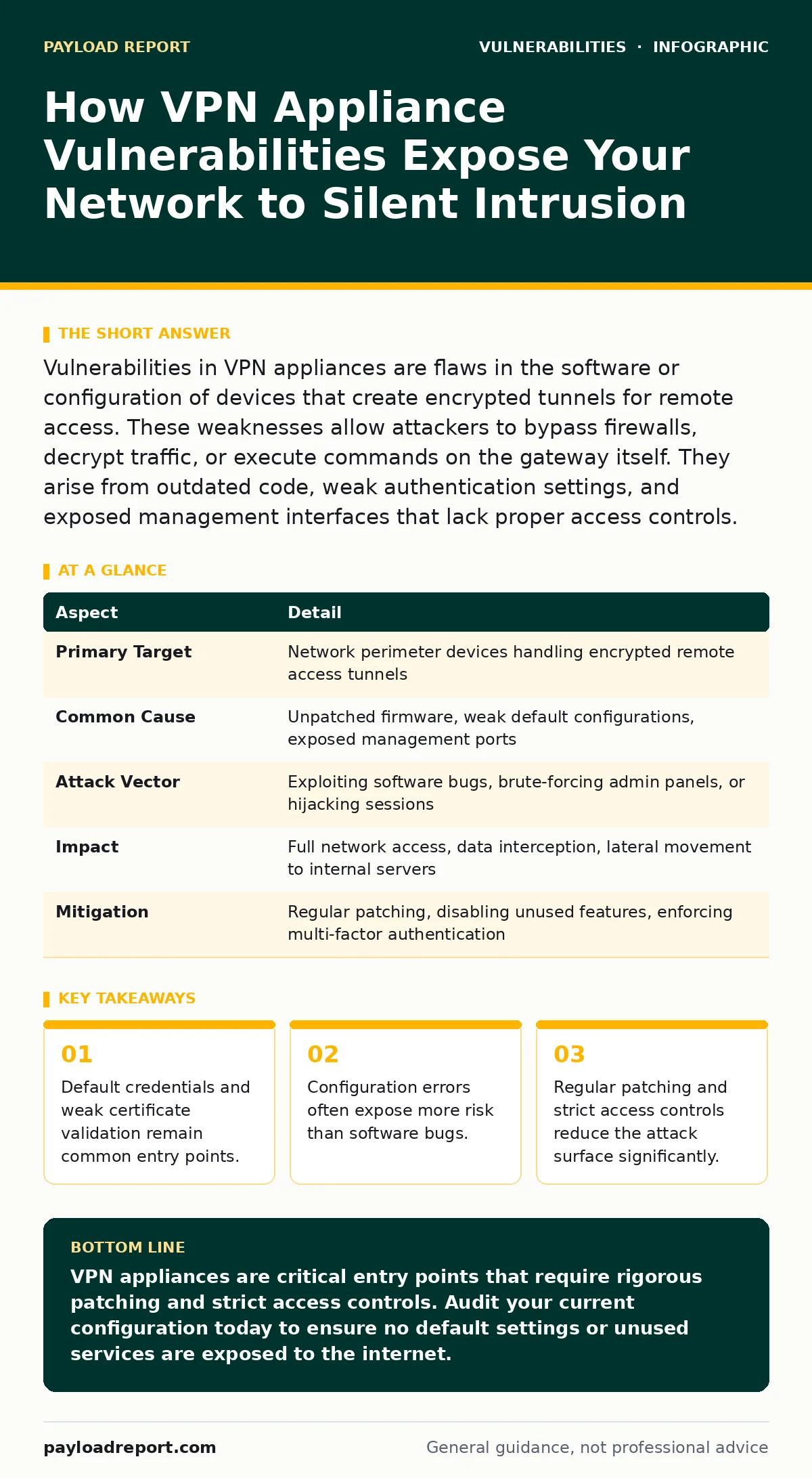
Key takeaways
- Default credentials and weak certificate validation remain common entry points.
- Configuration errors often expose more risk than software bugs.
- Regular patching and strict access controls reduce the attack surface significantly.
VPN appliances are critical entry points that require rigorous patching and strict access controls. Audit your current configuration today to ensure no default settings or unused services are exposed to the internet.
Frequently asked questions
Can a VPN appliance vulnerability be exploited remotely?
Yes, many vulnerabilities allow remote exploitation without prior access, especially if the management interface is exposed or the packet processing engine has flaws.
How often should VPN appliances be patched?
They should be patched as soon as vendors release security updates, ideally within a defined service level agreement to minimise exposure windows.
Is multi-factor authentication enough to secure a VPN?
No, MFA protects against credential theft but does not mitigate risks from software bugs, configuration errors, or supply chain compromises.
What is split-tunneling and why is it a risk?
Split-tunneling allows some traffic to bypass the VPN. This can expose internal resources to less secure networks if the user’s device is compromised.
How this guide was produced: written by the Payload Report editorial team with AI assistance, checked against the public references listed below, and reviewed when the facts change. See our editorial policy or report an error.