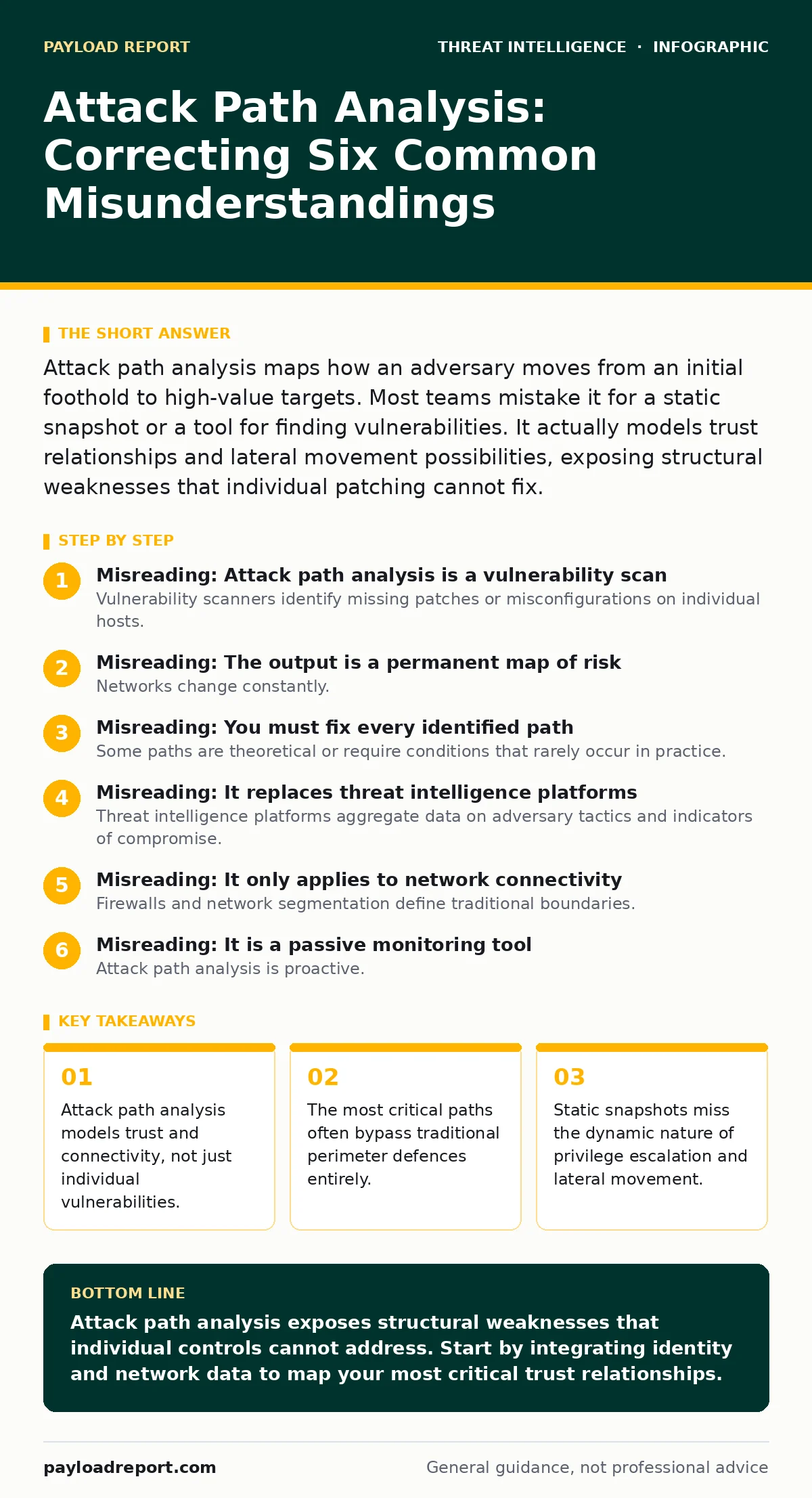
Attack path analysis maps how an adversary moves from an initial foothold to high-value targets. Most teams mistake it for a static snapshot or a tool for finding vulnerabilities. It actually models trust relationships and lateral movement possibilities, exposing structural weaknesses that individual patching cannot fix.
Misreading: Attack path analysis is a vulnerability scan
Vulnerability scanners identify missing patches or misconfigurations on individual hosts. Attack path analysis connects these dots to show how an adversary chains exploits to reach critical assets. A single unpatched server is a risk. A path connecting that server to the domain controller is a crisis. You must distinguish between finding holes and finding the route through them.
Correct reading: Treat vulnerability data as input for path modelling. The value lies in the connections between assets, not the count of flaws on any single machine. A system with many low-severity flaws may be less dangerous than a single system with one flaw that grants administrative access to a trusted zone.
Misreading: The output is a permanent map of risk
Networks change constantly. New users join, permissions shift, and applications update. A path that exists today may vanish tomorrow, or a new, more efficient route may open. Relying on a static report creates a false sense of security. The analysis is a snapshot of a moving target. You must refresh the data frequently to maintain accuracy.
Correct reading: View the analysis as a living model of your environment. Integrate it with identity management and configuration databases. When permissions change, the attack paths change. Regular re-calculation ensures you are defending against current realities, not historical artefacts. This dynamic approach reveals emerging risks before they become breaches.
Misreading: You must fix every identified path
Some paths are theoretical or require conditions that rarely occur in practice. Attempting to close every possible route leads to operational paralysis. Security controls must balance risk reduction with business functionality. Closing a path that is critical for a legitimate administrative task breaks the system. Prioritisation is necessary. You cannot eliminate all risk.
Correct reading: Focus on paths that are both exploitable and valuable to an attacker. Assess the likelihood of exploitation and the impact of compromise. Some paths may be acceptable risks given the cost of mitigation. Use the analysis to inform compensating controls, such as enhanced monitoring, rather than attempting impossible total closure. This pragmatic approach preserves functionality while reducing critical exposure.
Misreading: It replaces threat intelligence platforms
Threat intelligence platforms aggregate data on adversary tactics and indicators of compromise. Attack path analysis maps your internal topology and trust relationships. One tells you what the enemy wants; the other shows how they can get it. Combining both views provides a complete picture. Using one without the other leaves blind spots in your defence strategy.
Correct reading: Use threat intelligence to identify likely entry points and objectives. Use attack path analysis to determine if those objectives are reachable. For instance, if intelligence suggests adversaries target specific cloud services, your path analysis should verify if those services are connected to on-premise core systems. This integration closes the gap between external threat data and internal structural reality.
Misreading: It only applies to network connectivity
Firewalls and network segmentation define traditional boundaries. Attack path analysis must also model identity and application-layer trust. An adversary may not need to traverse the network if they possess valid credentials. Privilege escalation and lateral movement often occur through identity management flaws, not network holes. Ignoring identity paths misses the majority of modern lateral movement techniques.
Correct reading: Include identity and access management data in your models. Map group memberships, role assignments, and service account permissions. A user with excessive privileges can move laterally without exploiting network vulnerabilities. Understanding these identity-based paths is critical for defending against credential dumping and other defence evasion techniques that rely on stolen access rights.
See also: Log Tampering: How Attackers Erase Their Footprints · Threat Intelligence Platforms: 8 FAQs Answered for Operational Use
Misreading: It is a passive monitoring tool
Attack path analysis is proactive. It models potential futures, not just past events. Passive monitoring waits for an alert. Path analysis predicts where an alert is likely to originate and where it will lead. It allows you to test hypotheses about your security posture. Suppose you add a new vendor portal. Path analysis shows how that addition changes your risk profile before the first connection is made.
Correct reading: Use the model to simulate changes. Test the impact of new applications, third-party access, or architectural changes. This predictive capability supports purple teaming by providing realistic scenarios for testing. It shifts security from reactive containment to proactive design. You shape the environment to be inherently less navigable for adversaries.
Key takeaways
- Attack path analysis models trust and connectivity, not just individual vulnerabilities.
- The most critical paths often bypass traditional perimeter defences entirely.
- Static snapshots miss the dynamic nature of privilege escalation and lateral movement.
Attack path analysis exposes structural weaknesses that individual controls cannot address. Start by integrating identity and network data to map your most critical trust relationships.
Frequently asked questions
How often should I run attack path analysis?
Run it whenever significant changes occur to your infrastructure or identity permissions. For high-risk environments, weekly or daily updates are advisable to capture dynamic changes in trust relationships.
Does attack path analysis detect active breaches?
No. It models potential routes, not active traffic. Use it alongside intrusion detection and monitoring tools. The analysis tells you where to look during an incident, but it does not alert you to real-time activity.
Can I use attack path analysis for cloud environments?
Yes. Cloud environments rely heavily on identity and API-based trust. Path analysis is particularly valuable here, as traditional network boundaries are less relevant. Focus on role-based access controls and service-to-service permissions.
How does this relate to domain generation algorithms?
It does not directly. Domain generation algorithms are evasion techniques used by malware. Attack path analysis focuses on infrastructure and identity trust. However, understanding how malware communicates helps you model the entry points that path analysis then traces through your internal systems.
How this guide was produced: written by the Payload Report editorial team with AI assistance, checked against the public references listed below, and reviewed when the facts change. See our editorial policy or report an error.