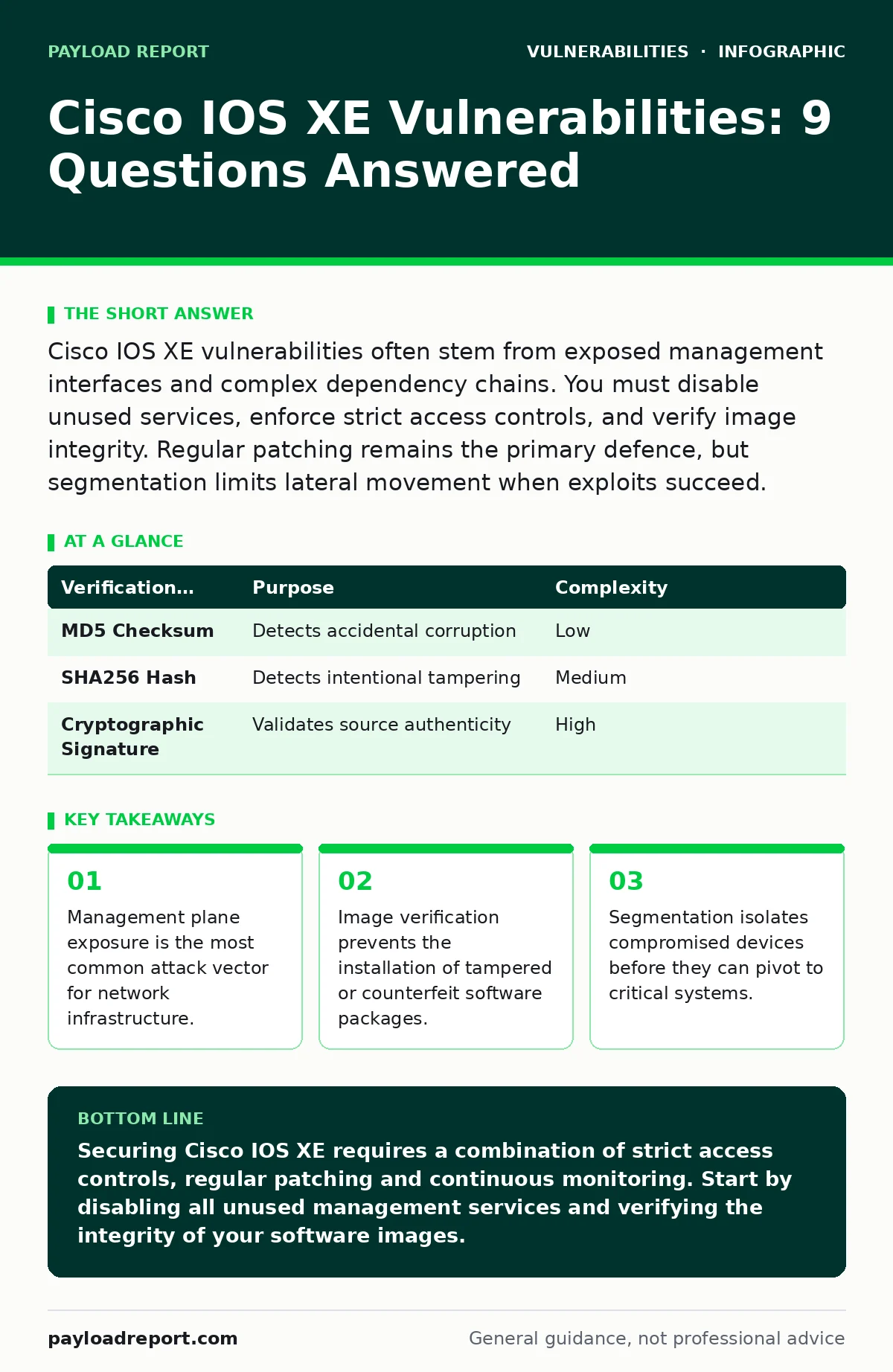
Cisco IOS XE vulnerabilities often stem from exposed management interfaces and complex dependency chains. You must disable unused services, enforce strict access controls, and verify image integrity. Regular patching remains the primary defence, but segmentation limits lateral movement when exploits succeed.
What is Cisco IOS XE and why is it targeted?
Cisco IOS XE is a network operating system that combines the reliability of traditional IOS with a modular Linux-based architecture. Attackers target it because it controls the traffic flow for enterprise networks. Compromising a router or switch running this software allows an adversary to intercept, modify, or block data across the entire organisation. The modular nature increases the attack surface compared to monolithic systems.
How do default configurations create security risks?
Default configurations often enable management services that are unnecessary for production environments. Telnet and HTTP are frequently left active by default, providing unencrypted access to the device. These services transmit credentials in plain text, allowing anyone on the network to capture them. Disabling unused services reduces the number of entry points available to an attacker.
Why is the management plane the primary concern?
The management plane handles configuration, monitoring and control traffic separate from user data. It is often accessible from wider network segments than the data plane. If an attacker gains access to this plane, they can change routing tables or disable security features. Isolating the management plane restricts who can interact with the device.
How do attackers exploit known vulnerabilities?
Attackers scan for devices running outdated versions of IOS XE that contain known flaws. They use automated tools to identify specific version numbers and match them against public vulnerability databases. Once a match is found, they send crafted packets that trigger the vulnerability. This often results in remote code execution or a denial of service condition.
What role does image integrity verification play?
IOS XE images are large software packages that can be tampered with during download or storage. Without verification, you might install a compromised image that contains backdoors. Cisco provides cryptographic signatures for all official images. Verifying these signatures ensures the software has not been altered since it was released. This step is critical when updating devices in isolated environments.
| Verification Method | Purpose | Complexity |
|---|---|---|
| MD5 Checksum | Detects accidental corruption | Low |
| SHA256 Hash | Detects intentional tampering | Medium |
| Cryptographic Signature | Validates source authenticity | High |
See also: DDoS protection for ISP: scrubbing, routing and resilience · Web Filtering Proxy: How It Works, Limits and Setup
How does segmentation limit the impact of a breach?
Network segmentation divides the infrastructure into smaller, isolated zones. If one device is compromised, the attacker cannot easily move to other segments. This containment strategy buys time for detection and response. It also prevents a single vulnerability from affecting the entire network. Proper VLAN configuration and access control lists enforce these boundaries.
Why is patching difficult in network environments?
Network devices often require reboots to apply security patches, causing service disruption. Production networks demand high availability, making scheduled downtime difficult to arrange. This tension leads to delayed patching, leaving devices exposed for longer periods. You must balance security requirements with operational continuity.
What are the risks of third-party dependencies?
IOS XE relies on various third-party libraries and components for functionality. Vulnerabilities in these underlying components can affect the entire system. This is similar to how server-side template injection affects web applications. You cannot control the security of these dependencies directly. You must rely on the vendor to patch them promptly.
How do you detect a compromised device?
Detection relies on monitoring for unusual behaviour rather than just known signatures. Look for unexpected configuration changes, new user accounts or outbound connections to unknown hosts. Anomalies in traffic patterns can also indicate command and control communication. Continuous monitoring is necessary because traditional antivirus tools are ineffective on network operating systems.
What is the role of zero-day vulnerabilities?
Zero-day vulnerabilities are unknown flaws that have no available patch. Attackers exploit them before the vendor is aware of the issue. Mitigation focuses on reducing the attack surface and limiting exposure. Segmentation and strict access controls remain your best defence against these threats. You cannot patch what you do not know exists.
How do you verify the authenticity of updates?
Always download updates from official vendor sources. Verify the cryptographic signature before installing the image. This process ensures that the software has not been intercepted or modified. Automated update systems can streamline this process, but manual verification provides an additional layer of assurance. Never trust an update source without validation.
Why is configuration backup critical for recovery?
Regular backups of device configurations allow for rapid recovery after a compromise. If an attacker modifies the configuration, you can restore the previous state. This minimises downtime and reduces the effort required for remediation. Store backups securely, preferably offline, to prevent them from being compromised as well. This practice is fundamental to incident response.
How does this relate to other infrastructure risks?
Understanding these principles helps you address broader infrastructure security. For instance, the concept of verifying inputs applies to server-side template injection vulnerabilities. Similarly, managing access controls is relevant when addressing weak password policies. The underlying security hygiene remains consistent across different technologies. You should also consider how insecure file permissions can expose sensitive configuration data.
Key takeaways
- Management plane exposure is the most common attack vector for network infrastructure.
- Image verification prevents the installation of tampered or counterfeit software packages.
- Segmentation isolates compromised devices before they can pivot to critical systems.
Securing Cisco IOS XE requires a combination of strict access controls, regular patching and continuous monitoring. Start by disabling all unused management services and verifying the integrity of your software images.
Frequently asked questions
Can I use Cisco IOS XE on a home network?
While technically possible, it is overkill for most home networks and introduces unnecessary complexity. Consumer-grade routers are designed for ease of use and sufficient security for typical home environments.
How often should I check for IOS XE updates?
You should check for updates regularly, ideally monthly, to stay informed about new security advisories. However, only apply patches after thorough testing in a non-production environment.
Is SSL necessary for device management?
Yes, SSL encrypts the communication between your management station and the device. This prevents eavesdropping and man-in-the-middle attacks. Always prefer HTTPS over HTTP for administrative access.
What is the difference between IOS and IOS XE?
IOS XE is a newer architecture that runs on a Linux kernel, offering more modularity and automation capabilities. Traditional IOS is a monolithic system with a different underlying structure.
How this guide was produced: written by the Payload Report editorial team with AI assistance, checked against the public references listed below, and reviewed when the facts change. See our editorial policy or report an error.