
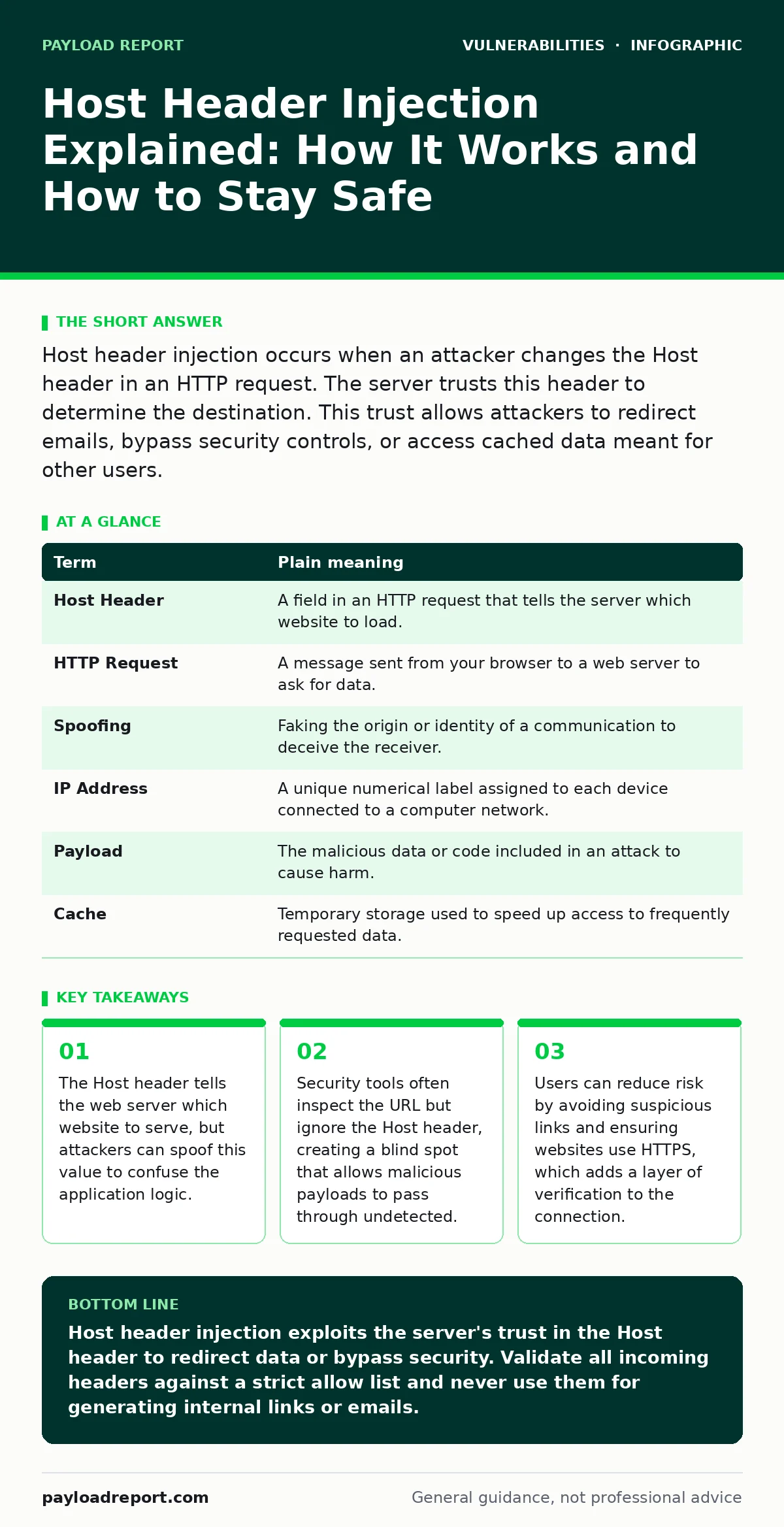
Host header injection occurs when an attacker changes the Host header in an HTTP request. The server trusts this header to determine the destination. This trust allows attackers to redirect emails, bypass security controls, or access cached data meant for other users.
The Mailroom Mistake Analogy
Imagine a large office building with a single main entrance. The receptionist does not know where every package should go. Instead, the sender writes the destination department on the outside of the envelope. The receptionist looks at that label and hands the package to the correct desk. If a malicious actor writes "Executive Suite" on a package meant for the recycling bin, the receptionist follows the label. The package reaches the wrong place because the system trusts the external label. Web servers work in much the same way. They rely on the Host header to decide which website to present to you.
What Is Host Header Injection?
Host header injection is a technique where an attacker modifies the Host header of an HTTP request. The Host header is a part of the HTTP protocol that specifies the domain name of the server you are trying to reach. When multiple websites share the same IP address, the server uses this header to distinguish between them. An attacker sends a request with a fake Host header. The server processes the request as if it came from the specified domain. This confusion can lead to data leakage or bypassing of security measures.
| Term | Plain meaning |
|---|---|
| Host Header | A field in an HTTP request that tells the server which website to load. |
| HTTP Request | A message sent from your browser to a web server to ask for data. |
| Spoofing | Faking the origin or identity of a communication to deceive the receiver. |
| IP Address | A unique numerical label assigned to each device connected to a computer network. |
| Payload | The malicious data or code included in an attack to cause harm. |
| Cache | Temporary storage used to speed up access to frequently requested data. |
Why Servers Trust the Header
Web servers are designed to handle many websites on a single machine. This setup saves resources and simplifies management. The server cannot determine the intended website from the IP address alone. It must look at the Host header. This design creates a fundamental trust issue. The server assumes the header is correct. It does not verify if the requester actually owns that domain. This assumption allows attackers to inject false headers. The server then performs actions based on the fake identity. This behaviour is similar to how vulnerabilities in VPN appliances can be exploited if the device trusts external configuration data without proper validation.
The Hidden Costs of Trust
The most common consequence is email redirection. If a web application sends password reset emails, it may use the Host header to build the reset link. An attacker sets the Host header to their own domain. The server generates a reset link pointing to the attacker's site. The user clicks the link and enters their password. The attacker captures the credentials.
This happens because the application trusts the header for constructing URLs. Another risk is cache poisoning. The server saves the response for the fake host. Other users requesting that host receive the malicious cached content. This mirrors issues seen in server-side template injection (SSTI) where trusted data is processed in an unsafe context.
What This Means for You
As an ordinary user, you cannot fix the server code. However, you can spot the signs. If you receive a password reset email that looks slightly off, check the domain carefully. Legitimate services use their official domain. If the link points to a different address, do not click it. Phishing attacks often use similar techniques. Host header injection makes these attacks more convincing because the email comes from the real server. It just contains a fake link. This is why weak password policies exacerbate the damage; if your password is simple, an attacker gains full access immediately after capturing the reset token.
See also: Formjacking Explained: How Stealing Payment Data Works
Simple Safety Habits
You can protect yourself by adopting a few simple habits. These steps reduce the chance of falling for injection-based attacks. They do not stop the attack at the server level, but they stop the final step where you hand over your data.
- Verify the domain in the browser address bar before entering any credentials.
- Enable multi-factor authentication on all accounts to limit the value of stolen passwords.
- Report suspicious emails to the organisation's security team so they can investigate the server configuration.
Checking Your Own Systems
If you manage web applications, you must validate the Host header. Compare the received header against a list of allowed domains. Reject requests that do not match. This prevents the server from processing requests for unknown hosts. You should also ensure that email functions do not use the Host header for generating links. Hardcode the domain or use a configuration variable instead. This approach removes the user-controlled variable from the equation. It is a simple change that closes a significant gap. Similar care is needed when handling unsafe YAML deserialization where untrusted data can alter application behaviour.
The Bigger Picture
Host header injection highlights a broader issue in web security. Systems often trust external inputs too easily. This trust extends to other areas like IoT device vulnerabilities where devices accept commands from unverified sources. It also relates to vulnerabilities in industrial control systems where network segmentation fails to stop malicious traffic. Understanding this attack helps you see how small design choices create large risks. The solution is always the same: validate input, verify identity, and assume nothing is safe.
Key takeaways
- The Host header tells the web server which website to serve, but attackers can spoof this value to confuse the application logic.
- Security tools often inspect the URL but ignore the Host header, creating a blind spot that allows malicious payloads to pass through undetected.
- Users can reduce risk by avoiding suspicious links and ensuring websites use HTTPS, which adds a layer of verification to the connection.
Host header injection exploits the server's trust in the Host header to redirect data or bypass security. Validate all incoming headers against a strict allow list and never use them for generating internal links or emails.
Frequently asked questions
Can a firewall stop host header injection?
Standard firewalls often inspect the URL but ignore the Host header. You need a web application firewall configured to validate headers specifically.
How do I know if my site is vulnerable?
You can test by sending a request with a modified Host header. If the server responds with content for the fake host, it is likely vulnerable.
How this guide was produced: written by the Payload Report editorial team with AI assistance, checked against the public references listed below, and reviewed when the facts change. See our editorial policy or report an error.